Part 2: The File With Her Father’s Signature
The room did not explode right away.
That was the worst part.
After the words landed, everyone seemed to breathe at the same time, but nobody moved. The principal stood with one hand still resting on the folder, his thumb pressed against the corner of the first document as if holding it down could stop the truth from spreading.
Olivia Preston’s face changed so fast I almost missed it. The polished smile, the offended stare, the rich-girl boredom she wore like expensive perfume—gone.
For one second, she looked exactly like what she was.
A girl who had just realized the lie had her father’s name on it.
“Who said that?” she snapped.
Her voice cracked on the last word.
At the back of the guidance office, a quiet woman in a navy coat stepped forward. I had seen her before, but only from a distance, near the accessibility desk and the equipment-aid cabinet. She was Ms. Elise Laurent, the district liaison sent from the European education foundation that helped fund exchange and support programs at our school.
She did not raise her voice.
She did not need to.
“I did,” she said. “Because I signed the original grant approval in Lyon before the program was transferred here.”
Olivia’s eyes flicked to the door again, then to the window, then to the principal.
“Then you’re confused,” she said quickly. “My dad donates equipment. He doesn’t—”
“He signed a recommendation to suspend the aid station’s expansion,” Ms. Laurent interrupted. “Two weeks after usage labels were removed. Three days after visitor logs were altered. One day before your club submitted a proposal asking for that funding.”
The silence turned hard.
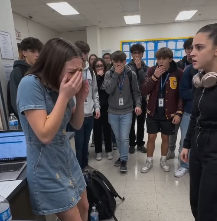
I felt sauce drying on my cheek from the food Olivia had thrown at me. My dress felt sticky near the collar. Someone offered me a napkin, but I could not lift my hand. I was too busy staring at the folder.
Because until that moment, I had thought I was protecting a program.
I had not understood I had walked into something much bigger.
The principal opened the second page. His jaw tightened.
“Olivia,” he said slowly, “did you know about this recommendation?”
She laughed once, sharp and fake.
“Are you seriously asking me that after she”—Olivia pointed at me so fast her bracelet flashed—“made this whole thing about herself?”
I swallowed.
“I didn’t make you throw food at me.”
A few students murmured.
Olivia turned on them. “Oh, please. She was waiting for a moment.”
“No,” I said, my voice shaking, but louder than before. “I was waiting for someone to check the camera.”
The principal looked at me.
That was when I pulled the second envelope from my bag.
The one I had almost left at home.
Olivia saw it and stepped toward me.
Ms. Laurent moved first.
“Do not touch her,” she said.
It was not loud. It was worse than loud.
Olivia froze.
I handed the envelope to the principal. Inside were printed stills from the hallway camera: a figure in a black jumpsuit, expensive headphones around her neck, taking down signs from the support-material shelf after school hours. Another image showed her carrying a plastic bin toward the media club room.
The last picture showed her father’s company van outside the delivery entrance.
The principal’s face went pale.
Olivia whispered, “That’s not what it looks like.”
Ms. Laurent leaned over the image.
“It looks like theft of grant-funded materials.”
Olivia’s mouth opened, but no sound came out.
Then the office door opened.
A tall man in a charcoal coat stepped in, his hair silver at the temples, his expression irritated before he even understood the room.
“Olivia,” he said. “What happened now?”
Her father.
Mr. Preston looked from the principal to Ms. Laurent to me.
Then he saw the folder.
His irritation vanished.
And for the first time that day, Olivia looked relieved.
“Dad,” she said, breathless. “Tell them.”
He did not look at her.
He looked at the signature.
Then he said the five words that turned the room colder.
“Where did you get this?”
Part 3: The Donor Who Forgot The Cameras
Mr. Preston did not ask whether the document was real.
That told everyone enough.
The principal straightened slowly, like his spine had suddenly remembered his job. “Mr. Preston, this is an internal school matter involving student conduct and possible misuse of program funds.”
“My daughter has been publicly accused,” Mr. Preston said. “So no, it is no longer internal.”
His voice had the smooth authority of a man used to entering rooms after damage had already been cleaned for him.
Olivia stood beside him, still breathing too fast.
He put one hand on her shoulder, but not gently. More like he was holding her in place.
“Grace,” the principal said, “please sit down.”
I sat because my knees were beginning to tremble.
The chair squeaked under me. The sound made Olivia flinch, which almost made me laugh, except my throat hurt too much.
Ms. Laurent took the folder from the principal and placed another document beside it.
“This is the inventory record from the original aid station,” she said. “Headsets, translated instructions, large-print guides, sign-in sheets, repair cards, hearing-support equipment, and directional labels. All grant property.”
Mr. Preston smiled without warmth.
“Outdated materials,” he said. “My company offered newer options.”
“No,” I said before I could stop myself.
Every adult turned to me.
My fingers dug into the edge of the chair.
“The newer options were locked behind club access,” I said. “Students had to ask Olivia’s media team. Some stopped coming because they thought the aid station was closed.”
Olivia scoffed. “Because they didn’t need it.”
A boy near the wall looked up.
His name was Emil Hartmann, an exchange student from Vienna who used the captioning equipment during assemblies. He had barely spoken all year.
Now his face was red.
“I needed it,” he said.
Olivia stared at him like he had betrayed her personally.
Another student, Clara Voss, lifted her hand a little. “Me too. I thought the school removed it.”
Then a junior by the door said, “The Spanish guide disappeared.”
Another said, “The large-print instructions were gone before review day.”
The room began filling with small voices, each one a match.
Mr. Preston’s face tightened.
“Children misunderstand systems,” he said.
Ms. Laurent looked at him. “Then perhaps the cameras misunderstood too.”
She placed a tablet on the desk.
The principal pressed play.
The footage was silent, which somehow made it worse.
Olivia appeared in the hallway after dismissal, moving fast, checking over her shoulder. She removed labels from the support shelf. She opened the cabinet with a keycard. She carried items out in two trips.
Then the footage changed.
Mr. Preston’s van pulled up near the service entrance at 6:18 p.m.
A driver got out.
Then Mr. Preston himself appeared.
He did not carry anything, but he opened the side door of the van.
Olivia handed him a box.
The principal paused the video.
No one breathed.
Olivia whispered, “Dad.”
Mr. Preston’s face hardened.
“That footage is being misread.”
Ms. Laurent folded her arms. “You removed foundation property from school premises.”
“I recovered items my company provided.”
“No,” I said, reaching into my bag one last time.
My hand found the small repair tag I had saved from the bottom of the bin.
The paper was wrinkled from being folded too many times.
I placed it on the desk.
“Those headsets were not from your company,” I said. “They were donated by the foundation. Your company only serviced them.”
Ms. Laurent picked up the tag.
A tiny smile crossed her face, but it was not happy.
It was the expression of someone finally seeing the missing piece.
“This repair number,” she said, “belongs to a device reported missing last term.”
Mr. Preston stepped forward.
The principal moved between us.
Olivia’s eyes filled with tears, but they were angry tears.
“You don’t understand,” she snapped at me. “That program was embarrassing. Nobody wanted the school looking like it needed charity equipment.”
Emil stood up.
His chair scraped against the floor.
“I wanted it,” he said.
Olivia turned away from him.
Then Ms. Laurent checked the back of the repair tag.
Her face changed.
She looked at Mr. Preston.
“Why,” she asked quietly, “is there a private invoice number written on foundation equipment?”
Mr. Preston’s hand dropped from Olivia’s shoulder.
And Olivia, finally realizing her father was not there to save her, whispered, “You said it was already approved.”
Part 4: The Club Room Behind The Locked Door
That sentence ruined him more than any document could have.
Mr. Preston turned to his daughter with a look so sharp she stepped back.
“Olivia,” he said. “Stop talking.”
But everyone had heard.
The principal closed the office door.
Outside, students had gathered in the hallway. Shadows moved behind the frosted glass. Phones were probably out again. Whispers slipped through the cracks like cold air.
Ms. Laurent took a notebook from her coat pocket.
“You told your daughter the removal was approved?” she asked.
Mr. Preston ignored her.
“Principal Duarte,” he said, “I suggest you call the district superintendent before this becomes defamatory.”
The principal’s name being spoken like a threat seemed to wake something in him.
“I already did,” he said.
Mr. Preston blinked.
The principal looked toward his assistant. “Please bring the media club inventory key.”
Olivia’s face drained.
“No,” she said.
It came out too fast.
The principal looked at her. “Why not?”
Her lips trembled.
“Because everyone’s making this dramatic.”
Ms. Laurent stepped toward the door. “Then opening the room should calm things down.”
Nobody spoke as we crossed the hallway.
Students parted on both sides. I hated how they looked at my stained face, but I hated more that some of them looked guilty. Not because they had hurt me. Because they had watched and waited to see who would win.
The media club room sat at the end of the corridor behind a glass panel covered in posters. Olivia’s name appeared on almost all of them: fundraiser chair, audio lead, event host, senior showcase coordinator.
The principal unlocked the door.
The smell hit first.
Dust. Plastic. Warm cables. Old paper.
Inside, the room was too neat in the way hidden things are neat. Bins stacked by color. Equipment bags labeled in perfect handwriting. A cabinet with a shiny new lock sat against the far wall.
Olivia whispered, “That cabinet is private.”
The principal opened it.
At first, nobody moved.
Then Ms. Laurent reached in and pulled out a roll of blue accessibility signs.
Behind it were laminated support guides, translated labels, missing sign-in sheets, large-print instruction cards, and three foundation headsets wrapped in black cloth.
Clara covered her mouth.
Emil stared like someone had handed him proof that his loneliness had not been his fault.
The principal lifted one of the sign-in sheets.
Names had been crossed out in black marker.
Mine was not on it.
But Emil’s was.
Clara’s was.
A dozen others were.
Ms. Laurent’s voice went very soft. “Why were these students removed from the usage report?”
Olivia backed into a table.
Her headphones slipped from her neck and hit the floor.
She did not pick them up.
“My club needed the room,” she said. “And the numbers looked bad.”
“What numbers?” the principal asked.
Olivia pressed her lips together.
Mr. Preston answered for her.
“The program was inefficient.”
“No,” I said, my heart banging against my ribs. “The program looked inefficient because the students who used it were deleted.”
The principal checked the sheet again.
Then he saw something else.
A sticky note attached to the bottom.
He peeled it off.
His expression changed from anger to disbelief.
He read it aloud.
“‘Lower traffic makes transfer easier. Submit after review.’”
The handwriting was Olivia’s.
No one had to say it.
The room already knew.
Ms. Laurent took a photo of the note.
Mr. Preston reached for it. “That is a student’s private planning note.”
The principal blocked him. “It is evidence.”
Olivia suddenly turned on me.
“You think you’re better than me because you help people carry forms?” she said, voice shaking. “You don’t even belong in this program. You’re not special. You just wanted everyone to clap for poor little Grace.”
My face burned.
I wanted to answer. I wanted to tell her I had never wanted applause. I wanted to tell her being visible had never felt like power to me.
But before I could speak, Emil stepped beside me.
Then Clara.
Then two more students.
Not in front of me.
Beside me.
And that somehow felt bigger.
Ms. Laurent opened a lower drawer in the cabinet.
Inside was a sealed envelope with the Preston Audio logo.
She opened it.
A contract slid out.
Her eyes moved down the page.
Then she looked at the principal.
“This is not a club transfer request,” she said.
Her voice turned icy.
“This is a resale agreement.”
Part 5: The Agreement That Bought Silence
The word resale seemed too small for the damage it caused.
It floated in the club room, plain and ugly, while Olivia stared at the contract like she had never expected paper to betray her.
The principal took it from Ms. Laurent.
His eyes moved line by line.
“What exactly was being sold?” he asked.
Ms. Laurent did not answer right away. She turned the contract toward him and tapped the item list.
Three refurbished captioning headsets.
Two portable translation screens.
Four audio-support receivers.
One accessibility storage cabinet.
All marked as surplus.
All marked as cleared by school review.
All marked with a projected resale value.
My stomach turned.
“That cabinet was still being used,” Clara said.
Her voice was small, but the room listened now.
Mr. Preston exhaled slowly. “This is being taken out of context.”
“Then put it in context,” Ms. Laurent said.
His eyes narrowed. “My company stores, repairs, and replaces outdated equipment. Some items are sold after decommissioning. That is standard.”
“Not when the equipment was made to look unused by removing the users,” I said.
He looked at me then.
Really looked.
Not like I was a student. Not like I was a person.
Like I was a problem he had underestimated.
“Grace,” he said, almost kindly, “you are young. You do not understand how institutions work.”
I stood still.
The old Grace Miller—the one who tried to stay invisible, who apologized when people bumped into her—would have lowered her eyes.
But my cheek was sticky. My dress was stained. My hands were shaking.
And I was tired.
“No,” I said. “I understand exactly how this one worked.”
Olivia laughed bitterly. “You think one folder makes you brave?”
“No,” I said. “It made me late to lunch. You made me brave when you threw food in my face.”
Someone in the hallway gasped.
The principal looked down, hiding something that almost looked like pride.
Then the superintendent arrived.
Dr. Helena Weiss was smaller than I expected, with silver glasses and a calm face that made everyone else look messy. She entered the club room, listened for less than five minutes, and then asked one question.
“Who had access to the altered logs?”
The principal said, “My office, guidance staff, student program assistants, and the media club audio lead for event coordination.”
Everyone looked at Olivia.
Olivia whispered, “I didn’t alter them.”
Ms. Laurent lifted the sign-in sheets. “Then who did?”
Olivia looked at her father.
Mr. Preston said nothing.
That silence did something to her.
Her face changed again, but this time not into fear.
Into fury.
“You told me to make it clean,” she said.
Mr. Preston snapped, “Enough.”
“No,” Olivia said, louder now. “You told me if the program looked active, the foundation would renew it directly and your company would lose the replacement bid.”
The superintendent’s pen stopped moving.
My heart slammed once, hard.
Ms. Laurent’s eyes sharpened.
Olivia pointed at the contract. “You said all I had to do was make the station look messy and unused. You said nobody would care because the students who needed it wouldn’t complain.”
Emil’s face crumpled.
I felt something inside me break for him.
Mr. Preston’s voice dropped. “You are confused.”
Olivia laughed, but tears had spilled down her face now.
“No. You’re just angry I said it in front of them.”
The hallway outside erupted.
The principal closed the door fully, but it was too late.
Everyone had heard enough.
Dr. Weiss looked at Mr. Preston.
“This matter is now suspended from school handling,” she said. “We will notify the board, the foundation, and legal counsel.”
Mr. Preston’s face darkened.
“You will regret treating a donor this way.”
Dr. Weiss did not blink.
“I regret taking so long.”
For a second, I thought that was the end of it.
Then Ms. Laurent checked the last page of the agreement.
Her face went completely still.
“There is another signature,” she said.
The superintendent leaned in.
The principal leaned in.
Olivia leaned in too.
Ms. Laurent looked directly at me.
“Grace,” she said gently, “do you know someone named Marta Bellamy?”
The room tilted.
Because Marta Bellamy was my mother.
Part 6: The Name I Never Expected To See
I heard the room after that, but only in pieces.
A chair leg scraping.
Olivia whispering, “What?”
The principal saying my name.
My own breath, too loud in my ears.
Marta Bellamy was the name my mother used before she married my stepfather. She worked nights filing invoices for a contractor office in Hackney when we lived in London for six months after Ohio. She never talked much about that time, only that it had been hard, and that some people paid late when they knew you were too tired to fight.
I stared at the paper.
There it was.
Marta Bellamy.
Not as a buyer.
Not as a seller.
As a witness.
“That’s impossible,” I said.
Ms. Laurent softened. “Is she your mother?”
I nodded once.
Mr. Preston suddenly looked interested.
Too interested.
“Well,” he said quietly, “perhaps Grace’s family connection explains why she had access to private material.”
My fear turned hot.
“No.”
But Dr. Weiss was already looking at the signature.
“This date is eight years old.”
Ms. Laurent nodded. “Before the equipment was transferred to this school. Before Olivia was a student here.”
Olivia wiped her face with the back of her hand. “What does that mean?”
Nobody answered.
Ms. Laurent removed one more page from the envelope, older than the rest, folded twice. She opened it carefully.
I saw my mother’s handwriting before I understood the words.
Neat. Slanted. A little rushed.
Ms. Laurent read silently first.
Then she looked at me like she was about to hand me something heavy.
“This is a warning letter,” she said. “Your mother reported that Preston Audio was relabeling donated accessibility equipment as surplus stock in London.”
Mr. Preston went white.
Not pale.
White.
The kind of white that made every line in his face appear at once.
“My mother reported you?” I whispered.
He pointed at Ms. Laurent. “That document is stolen.”
“No,” Ms. Laurent said. “It was archived with the original foundation case file.”
The principal looked at me. “Grace, did your mother know you were investigating this?”
“I wasn’t investigating,” I said. “I just restored the labels.”
But even as I said it, I remembered things.
My mother telling me never to throw away delivery slips.
My mother teaching me to photograph forms before handing them in.
My mother looking too long at the Preston Audio banner during orientation night.
My mother asking, “Are students still using that support station?”
I had thought she was being careful because life had made her that way.
Maybe she had been afraid.
Dr. Weiss asked, “Where is your mother now?”
“At work,” I said. “She cleans offices near King’s Cross in the evenings.”
Mr. Preston laughed under his breath.
It was a terrible mistake.
Everyone heard the contempt in it.
Olivia heard it too.
For the first time, she looked at me without hatred.
Almost with recognition.
Ms. Laurent held up the warning letter.
“According to this, Marta Bellamy testified against a false surplus scheme. The case collapsed when the witness employer claimed she had stolen documents.”
“My mother would never steal,” I said.
My voice broke.
Mr. Preston smiled faintly.
“There were official findings.”
“No,” Ms. Laurent said. “There were missing files.”
She turned the paper over.
On the back was a copied inventory stamp.
And beneath it, in my mother’s handwriting, one sentence.
“If this disappears, check the schools.”
I pressed my hand to my mouth.
Olivia sank into a chair.
The principal whispered, “This has been going on for years.”
Then my phone buzzed.
Once.
Twice.
A message from my mother.
Grace, where are you?
Before I could answer, another message arrived.
Do not go near Preston today.
My fingers went cold.
Then the office phone rang from down the hall, shrill and endless.
The principal answered it on speaker.
A woman’s voice came through, breathless and terrified.
It was my mother.
“Is Grace with you?” she asked. “Because Mr. Preston’s solicitor just called my workplace.”
She inhaled sharply.
Then she said, “They told me to make my daughter stop.”
Part 7: The Mother Who Had Kept The First Proof
My mother arrived thirty-two minutes later in her cleaning uniform, her hair pulled back too tightly and her coat buttoned wrong.
She looked smaller than I remembered.
Not weak.
Just worn down by years of carrying things nobody else could see.
When she saw my stained dress and the dried sauce near my cheek, her face changed.
She crossed the room and touched my chin with shaking fingers.
“Who did that?”
I did not answer.
Olivia looked at the floor.
My mother turned toward her.
For a second, I thought she might shout.
Instead, she looked past Olivia to Mr. Preston.
“You,” she said.
One word.
Eight years inside it.
Mr. Preston adjusted his coat. “Marta.”
My mother flinched at the way he said her name.
“You don’t get to say it like we’re old friends,” she said.
Ms. Laurent placed the archived warning letter on the table. “Mrs. Miller, did you write this?”
My mother stared at it.
Her lips parted.
I watched the past return to her face.
“Yes,” she whispered.
“Why didn’t you tell me?” I asked.
She looked at me, and the answer was already in her eyes.
Because she had tried once.
Because nobody believed her.
Because mothers sometimes hide the fire and let their children think the room is only warm.
Mr. Preston spoke first. “Mrs. Miller was dismissed from a contractor position after mishandling confidential paperwork.”
My mother’s hand tightened around mine.
“I was dismissed,” she said, “because I found equipment donated for disabled students being sold through private invoices.”
Dr. Weiss leaned forward. “Do you have proof?”
Mr. Preston almost smiled again.
Almost.
My mother looked at me.
Then she reached into her coat and pulled out a small red notebook with a cracked spine.
“I kept numbers,” she said.
Mr. Preston’s smile died.
She placed the notebook beside the contract.
Inside were invoice codes, dates, school initials, delivery references, names of storage units, and notes written in her careful hand. Some pages were stained. Some were taped back in.
Ms. Laurent turned the pages slowly.
“This matches the repair tag Grace found,” she said.
My mother looked at me then, really looked, and something like grief passed between us.
“You found a tag?”
I nodded.
She closed her eyes.
“I hoped I was wrong.”
Olivia suddenly stood.
“I didn’t know about London,” she said.
Nobody answered her.
She looked at me. “I didn’t.”
I believed her.
I hated that I believed her.
Because believing her meant the cruelty had been hers, but the machine behind it had been older, colder, and built by adults.
Dr. Weiss asked my mother, “Would you be willing to make a formal statement?”
My mother looked at Mr. Preston.
He stared back with the expression of a man measuring how much fear he still owned.
Then she looked at me.
At my stained dress.
At the students outside the glass.
At Emil, still holding one of the recovered headsets like it might vanish again.
My mother straightened.
“Yes,” she said.
Mr. Preston stepped forward. “Think carefully.”
My mother did not move.
“I did,” she said. “For eight years.”
Then Olivia whispered something I almost did not hear.
“He has a storage unit.”
Everyone turned.
Her father looked at her as if she had slapped him.
Olivia’s voice shook. “In Croydon. He keeps older equipment there before auctions. He told me not to mention it because competitors steal inventory.”
Ms. Laurent asked, “Do you know the address?”
Olivia looked at me.
Her face was wet, ruined, young.
Then she nodded.
“Yes.”
Mr. Preston’s voice was low and dangerous. “Olivia.”
She stepped away from him.
For the first time all day, she stood without his hand on her shoulder.
And then she said the sentence that finished him.
“I’ll give them everything.”
Part 8: The Storage Unit With Our Names Inside
The storage unit in Croydon opened two days later under gray morning rain.
I was not supposed to be there.
Dr. Weiss said students should be protected from legal matters. Ms. Laurent said the foundation could handle it. My mother said I had already been through enough.
But when investigators asked who could identify the school equipment from the aid station, everyone looked at me.
So I stood beside my mother under a borrowed umbrella while the metal door rolled up with a sound like thunder.
Inside were shelves.
Rows and rows of them.
Headsets. Translation screens. large-print kits. Braille-labeled cases. Old school cabinets. Boxes marked with names of cities across Europe: London, Dublin, Lyon, Madrid, Brussels, Glasgow.
Each label felt like a student who had been told to manage without help.
Ms. Laurent covered her mouth.
My mother did not cry.
She walked to the nearest shelf and touched a dusty blue case.
“I packed this,” she said. “I remember the scratch on the handle.”
An investigator opened the case.
Inside was a stack of documents wrapped in plastic.
Not invoices.
Student letters.
Thank-you notes.
Usage reports.
Complaints that had never been filed.
And then, beneath them, a folder with my mother’s old name on it.
MARTA BELLAMY — LIABILITY RECORD.
She opened it with shaking hands.
Inside was the accusation that had ruined her job eight years earlier.
But clipped behind it was a draft memo Preston had never meant anyone to see.
Ms. Laurent read it aloud.
“‘Witness credibility can be undermined through alleged document mishandling. Contractor status makes removal simple.’”
My mother sat down on an overturned crate.
I knelt beside her.
For years, I had thought poverty had made her quiet.
Now I understood.
They had punished her for telling the truth, and she had survived anyway.
Olivia arrived later with Dr. Weiss, her black jumpsuit replaced by a plain coat, her expensive headphones gone.
She did not come near me at first.
Then she crossed the concrete floor and stopped in front of my mother.
“I’m sorry,” she said.
My mother looked at her for a long time.
“Sorry is not repair,” she said.
Olivia nodded, tears gathering again. “Then tell me what repair is.”
That was the part no one expected.
Because Olivia did not get expelled immediately.
She did not vanish into some clean punishment that made everyone feel finished.
Instead, Dr. Weiss suspended her from all leadership roles, placed her under formal review, and required testimony before the board. Her father’s company lost every school contract within a month. The foundation opened a restitution fund. The missing equipment was returned, replaced, or paid for.
And Olivia, by her own statement, gave investigators the auction contacts, private invoice lists, and storage records.
The public scandal reached newspapers from London to Lyon.
But the most shocking thing happened quietly.
Three weeks later, the guidance office reopened the support station.
Not in a corner.
Not behind the club room.
In the main hall, with glass doors, student volunteers, translated signs, captioning tools, quiet seating, and a wall where students could write what access meant to them.
They asked my mother to cut the ribbon.
She refused.
Then she handed the scissors to Emil, Clara, and me.
My hands shook when the ribbon fell.
People clapped, but I barely heard them.
I was looking at my mother.
She was looking at the wall.
Someone had pinned her old warning sentence there, printed in blue beneath the foundation seal.
If this disappears, check the schools.
Olivia stood at the back.
She did not clap loudly. She did not try to be seen.
But when Emil’s headset failed during the opening speech, she stepped forward with a replacement battery before anyone asked.
He looked at her for a long moment.
Then he took it.
Not forgiveness.
Not yet.
But repair had to begin somewhere.
That evening, my mother and I walked home through wet London streets, sharing chips from a paper bag because neither of us wanted to cook.
She bumped my shoulder gently.
“You were brave,” she said.
I shook my head. “I was scared the whole time.”
She smiled, tired and real.
“Good,” she said. “Bravery without fear is just performance.”
At the corner, my phone buzzed.
A message from Ms. Laurent.
The foundation board voted today. The restored program will be renamed.
I opened the attachment.
At the top of the new sign, in clean blue letters, were two names.
BELLAMY-MILLER ACCESS PROJECT.
My mother read it once.
Then again.
Then she covered her face and cried in the middle of the pavement while buses hissed past and strangers stepped around us.
I held her like she had held every hidden truth for me.
And for the first time in my life, being visible did not feel like danger.
It felt like proof.
