Part 2: The File Isabelle Never Expected To Surface
The second file made a sound when it hit the table.
Not loud.
Just paper against wood.
But every person in the academic club room turned toward it like it had cracked the floor open.
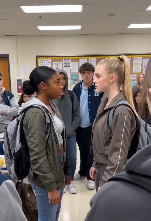
Isabelle Monroe’s face changed before she could control it.
She had been standing there with her chin lifted, one hand still half-raised from shoving me, her polished smile ready to return as soon as an adult told everyone to put their phones away. She looked certain the room would arrange itself around her again.
Then Clara Whitmore stepped forward.
Clara was Isabelle’s closest friend, at least that was what everyone thought. She was the quiet one beside Isabelle in every club photo, the girl who carried extra folders, fixed the projector, and laughed half a second late at jokes that were not funny.
Now she stood beside the staff table with a folder pressed against her chest.
Her hands were shaking.
Isabelle whispered, “Clara, don’t.”
That was the first time her voice sounded small.
Mr. Ellery, the academic club adviser, looked from Isabelle to Clara. His face had gone completely still after seeing the timestamped proof on my phone.
The proof showed the family tree file had been edited at 7:18 a.m.
Before I even arrived.
Before I touched the club computer.
Before Isabelle told everyone I had deleted her work out of jealousy.
“Clara,” Mr. Ellery said carefully, “what is in your folder?”
Clara’s eyes flicked toward me.
I was still standing near the bookshelf, shoulder aching from where I had hit the edge of a chair after Isabelle shoved me. My palms were cold. My throat felt tight. I hated that sauce from someone’s snack table had smeared on my sleeve when I caught myself.
I hated more that people were filming but nobody had helped.
Clara swallowed.
“It’s the original printout,” she said.
Isabelle’s mouth tightened. “You don’t know what you’re doing.”
Clara flinched, but she did not step back.
“Yes,” she said. “I finally do.”
The room went so quiet I could hear the projector fan humming.
Mr. Ellery took the folder from Clara and opened it.
Inside was the family tree research project Isabelle had claimed I ruined. The project that connected local historical families to public records, census documents, adoption archives, and immigration files. The project that mattered because the winner would present at the regional history symposium.
Isabelle’s family had sponsored the symposium for years.
She had already acted like the trophy belonged to her.
Mr. Ellery turned the pages slowly.
Then he stopped.
His eyes moved across the printed page once.
Then again.
He looked at Isabelle.
“Why is Emil Bauer’s name missing from this version?”
The question did not mean anything to most people in the room.
But Isabelle reacted as if he had shouted.
Her cheeks went white.
Clara looked down.
I took one careful step closer.
Emil Bauer was the name I had found in the archived source. A teenage factory worker from Bremen whose signature appeared in the immigration registry connected to Isabelle’s great-grandmother’s line. When I cross-checked it, his record changed everything about the story Isabelle had been telling.
Her family’s “pure founding lineage” presentation was not just incomplete.
It had been deliberately cleaned.
Isabelle laughed, but the sound broke in the middle. “That’s irrelevant.”
Mr. Ellery lifted the timestamped sheet. “Then why was it removed after the file was marked final?”
Isabelle looked at Clara again.
This time, there was no friendship in her stare.
Only warning.
Clara’s voice trembled. “Because her mother said the symposium board would never feature a Monroe project with that name in it.”
A ripple moved through the students.
Isabelle snapped, “Shut up.”
Mr. Ellery straightened.
“Isabelle.”
But Clara was already crying.
Not loudly. Just tears slipping down her face while she kept her voice painfully steady.
“She told me to help edit it,” Clara said. “She said it was just formatting. Then she said if anyone noticed, we would say Lena had touched the file.”
There it was.
My name.
Lena Fischer.
The problem girl. The scholarship student. The one Isabelle had decided would be easy to blame because my family tree was full of gaps, accents, old records, and names people mispronounced.
The room tilted around me.
Isabelle looked at me and smiled with pure anger.
“You really think this makes you special?” she said.
“No,” I answered, my voice rough. “I think it makes you caught.”
Part 3: Clara Confessed What She Helped Hide
Isabelle moved toward the folder.
Mr. Ellery picked it up before she reached it.
The simple motion embarrassed her more than a reprimand could have. Her hand froze in the air. Students saw it. Phones caught it. Her control slipped one inch further.
“You can’t just take my project,” Isabelle said.
Mr. Ellery’s voice stayed level. “This project is under review.”
“My family paid for half the equipment in this room.”
“And every student in this room is still expected to tell the truth.”
That sentence landed hard.
Someone near the back whispered, “Finally.”
Isabelle heard it. Her head turned sharply, but she could not find who said it.
Clara wiped her face with her sleeve. “There’s more.”
Isabelle’s eyes widened. “No.”
Clara opened her backpack and pulled out a flash drive with a chipped blue cap.
“I copied the version history last night,” she said. “I was scared she would delete it.”
Mr. Ellery looked pained. “Why didn’t you bring this to me earlier?”
Clara’s mouth trembled. “Because I was scared of her.”
Isabelle scoffed, but nobody believed the sound.
Clara turned toward the room. Her voice shook harder now, but she kept going.
“She doesn’t yell where adults can hear. She just tells you what will happen if you stop being useful.”
The students stared.
Clara looked at me. “She said Lena was perfect for blame because people already thought she was intense about records.”
My face burned.
I had heard those words before. Intense. Difficult. Too serious. Weird about details.
People say those things when they want truth to sound like a personality flaw.
Clara pushed the flash drive toward Mr. Ellery.
“The timestamped proof Lena found is real,” she said. “But it’s not the first file Isabelle changed.”
Mr. Ellery plugged the drive into the club laptop.
The projector screen flickered.
A folder appeared.
Not one project.
Twelve.
Names filled the screen: scholarship essays, debate rosters, research abstracts, volunteer hour logs, club nominations.
The room changed.
This was no longer about my project.
This was about everyone.
A boy from debate stepped forward. “Why is my essay folder there?”
A girl from the community history team covered her mouth. “That’s my interview transcript.”
Mr. Ellery opened one file.
It showed a nomination list for the regional academic delegation. My name had been moved from alternate to removed. Another student’s name had been added.
Isabelle’s.
The timestamp showed the edit happened from a sponsor-access account.
A murmur rose.
Isabelle’s smile was gone now.
“You’re all acting insane,” she said. “Anyone could have used that account.”
Clara shook her head. “Your mother gave you the password.”
Isabelle spun toward her. “You promised.”
Clara flinched, then whispered, “I promised before you shoved Lena.”
That sentence hung in the air.
Not because the shove was the worst thing Isabelle had done.
Because it was the moment Clara stopped pretending the rest was harmless.
Mr. Ellery clicked another file.
A volunteer hour log.
A student named Tomas Novak had lost twelve hours. Isabelle had gained twelve.
Tomas stood slowly from the back row. His face was pale.
“My university recommendation mentioned missing hours,” he said.
Nobody answered him.
Mr. Ellery opened another file.
A research award rubric.
Scores had been adjusted. Comments had been rewritten. A judge’s note praising another student’s archive work had been deleted.
The more the screen revealed, the less Isabelle looked like a girl defending herself.
She looked like someone watching a locked drawer open in public.
Then the door of the club room swung open.
A woman stepped inside in a cream coat, pearl earrings, and the same sharp eyes as Isabelle.
Mrs. Monroe.
She did not look at the screen first.
She looked at her daughter.
Then at me.
Her expression turned cold.
“What did you do?” she asked.
Before I could speak, Mr. Ellery stepped between us.
“Mrs. Monroe,” he said, “we need to discuss your sponsor-access account.”
Her eyes flicked to the projector.
For one second, fear crossed her face.
Then she smiled.
“Turn that off,” she said. “Before this school makes a mistake it cannot afford.”
Part 4: Mrs Monroe Threatened The Wrong Teacher
Nobody turned off the projector.
That was the first miracle.
Mr. Ellery stood beside the laptop, one hand still near the keyboard, but he did not move. Ms. Harper, the assistant head, stepped into the room behind Mrs. Monroe with a folder of her own, looking like she had run across campus.
“Leave the screen on,” Ms. Harper said.
Mrs. Monroe’s smile thinned. “This is a private student matter.”
“It became a school matter when official records were altered.”
Isabelle looked between the two adults, suddenly less certain her mother could swallow the room whole.
Mrs. Monroe placed her handbag on the staff table with careful precision.
“My daughter has been harassed all morning by a student who clearly does not understand boundaries.”
I felt the old trap closing.
Make me the problem.
Make my proof sound like obsession.
Make my voice sound unstable.
Ms. Harper looked at me. “Lena, did you access Isabelle’s project after it was submitted?”
“No,” I said.
My voice came out steadier than I felt.
Mrs. Monroe gave a soft laugh. “Of course she says that.”
Clara stepped forward. “Because it’s true.”
Mrs. Monroe turned toward her so slowly that Clara’s shoulders rose around her neck.
“Clara,” she said, “your parents would be very disappointed to see you involved in this.”
Clara went pale.
Mr. Ellery’s voice sharpened. “Do not threaten students in my room.”
Mrs. Monroe looked amused. “I’m reminding her to think.”
“No,” he said. “You are reminding us why she was afraid.”
A few students inhaled at once.
Mrs. Monroe’s eyes hardened.
Ms. Harper opened her folder. “We checked the access account after Mr. Ellery called me. The sponsor login was used at 7:18 this morning to edit Isabelle’s file.”
Mrs. Monroe lifted her chin. “Shared accounts are messy.”
“It was used from a tablet registered to your household.”
Isabelle stared at her mother.
“What?” she whispered.
Mrs. Monroe did not look at her.
Ms. Harper continued. “And at 7:31, the same device accessed the academic delegation list.”
The room rippled again.
Mrs. Monroe’s hand closed around the strap of her handbag.
“Administrative access was granted to support the club,” she said. “Not to let children invent conspiracies.”
I stepped forward before I could talk myself out of it.
“Then why was Emil Bauer removed?”
Mrs. Monroe finally looked at me directly.
The cold in her eyes made me want to step back.
I did not.
She said, “Because some names distract from the educational purpose.”
My stomach tightened.
That was not a denial.
It was a confession dressed as superiority.
Mr. Ellery asked, “Who was Emil Bauer?”
Mrs. Monroe’s jaw flexed.
I answered.
“He was an undocumented labor organizer who testified against factory abuse after arriving from Bremen. Isabelle’s great-grandmother signed a statement supporting him. Their families were connected.”
The room was silent.
I swallowed.
“Isabelle’s presentation erased him because it made the Monroe family history less clean and more complicated.”
Mrs. Monroe’s eyes flashed. “You have no right to interpret my family.”
“No,” I said. “But you had no right to rewrite everyone else’s records to protect yours.”
Isabelle stared at me.
For a second, I saw something almost human in her expression.
Not regret.
Recognition.
She had known the lie was ugly. She just had not expected anyone outside her circle to name it.
Mrs. Monroe turned to Ms. Harper.
“You will delete those files,” she said quietly. “You will discipline this girl for harassment. And you will remember who funds your symposium.”
Ms. Harper did not blink.
“The board has already been notified.”
Mrs. Monroe went still.
Then Mr. Ellery clicked one more folder on Clara’s drive.
The file name appeared on the projector:
MONROE_SPONSOR_CONDITION_LETTER_FINAL.PDF
Isabelle made a small sound.
Mrs. Monroe reached for the laptop.
But this time, half the room moved.
Tomas blocked the table. Clara grabbed the flash drive. Ms. Harper stepped in front of the screen.
And I finally understood.
Isabelle had spent all morning trying to make me look unstable because the truth was not just in the family tree.
It was in the money.
Part 5: The Donation Letter Changed Everything
The PDF opened slowly.
For three seconds, the room watched a loading circle spin while Mrs. Monroe stood frozen in the middle of the academic club room, her perfect cream coat bright under the ceiling lights.
Then the letter appeared.
Monroe Heritage Foundation.
Academic Excellence Partnership.
Confidential sponsorship conditions.
Ms. Harper read it silently first.
Her face changed.
Mr. Ellery leaned closer.
Mrs. Monroe said, “That document is privileged.”
Ms. Harper looked up. “It is a sponsorship agreement involving student selection criteria.”
“That is not your concern.”
“It became our concern,” Ms. Harper said, “when students’ records were changed to match it.”
A student whispered, “What does it say?”
Ms. Harper hesitated.
Then she read aloud.
The foundation would continue funding the regional history symposium if the school prioritized “legacy-aligned leadership candidates,” maintained “reputational standards,” and avoided elevating projects that created “unproductive narratives around donor families.”
Every word sounded clean.
Every word was rotten.
Tomas muttered, “So if our projects made sponsors look bad, we disappeared?”
Nobody corrected him.
Mrs. Monroe’s voice turned smooth again. “This is standard donor language.”
“No,” Mr. Ellery said. “This is pressure.”
Isabelle had gone very quiet.
She was staring at the letter as if seeing it for the first time.
Maybe she had known pieces.
Maybe she had heard her mother say the school owed them.
Maybe she had believed that was just how important families spoke.
But seeing it written down was different.
Clara’s flash drive trembled in her hand.
“Isabelle told me the symposium list was already decided,” she said. “She said the rest of us were just there to make it look competitive.”
A bitter sound moved through the room.
I looked at the students around me, and for the first time that day, I saw the same expression on faces that had laughed at me earlier.
Humiliation.
Not mine.
Theirs.
They were realizing they had been audience members in a show built to make them feel lucky for being allowed near the stage.
Mrs. Monroe looked toward the door, probably calculating how many people had filmed, how fast the story would spread, how much control she still had.
Then Isabelle spoke.
“Mom,” she said, voice low, “did you change the delegation list?”
Mrs. Monroe did not answer.
Isabelle’s lips parted. “Did you?”
Her mother turned on her with a look so sharp the entire room felt it.
“Do not perform guilt for people who would trade places with you in a second.”
Isabelle recoiled.
It was small.
But I saw it.
So did Clara.
Mrs. Monroe continued, “Everything I did was to protect your future.”
Isabelle’s laugh came out broken. “My future?”
“You think these people will protect you when you lose?”
For the first time, Isabelle did not look like the villain of the room.
She looked like a girl who had been trained to believe love was something earned by winning.
Still, the sauce on my sleeve was real.
The ache in my shoulder was real.
The records she helped change were real.
Pity did not erase harm.
Ms. Harper closed the PDF. “Mrs. Monroe, you need to leave campus while the board reviews this.”
Mrs. Monroe smiled. “The board president plays tennis with my husband.”
Ms. Harper’s face tightened.
That was when the last person entered.
An older man in a dark suit stood in the doorway, holding a thin black binder.
Everyone recognized him from the school website.
Board President Alaric Voss.
Mrs. Monroe’s smile returned in full.
“Alaric,” she said. “Thank God. Put an end to this.”
He did not smile back.
He looked at the projector.
Then at Mrs. Monroe.
Then at me.
“I intend to,” he said.
He opened the binder.
Inside was a printed complaint.
Signed six months earlier.
By Isabelle Monroe.
Part 6: Isabelle’s Own Complaint Came Back
Isabelle looked as if the floor had vanished beneath her.
“No,” she whispered.
Mrs. Monroe turned slowly toward Mr. Voss. “That is confidential.”
Mr. Voss’s voice was quiet. “It was confidential because the student requested protection.”
Isabelle’s face burned red.
Students stared at her now with a different kind of shock.
Not because she had been caught lying.
Because she had once tried to tell the truth.
Mr. Voss placed the complaint on the table.
“I received this last semester,” he said. “Isabelle reported that sponsor access was being misused to influence club outcomes.”
Clara stared at Isabelle. “You reported it?”
Isabelle did not answer.
Mrs. Monroe’s voice was deadly calm. “My daughter was under stress. She misunderstood ordinary administrative support.”
Mr. Voss looked at her. “The complaint included screenshots.”
Isabelle closed her eyes.
I felt something twist in my chest.
This did not make her innocent.
It made the story worse.
Because somewhere inside Isabelle Monroe, before the shove, before the pizza-stained rumors, before she turned the room against me, there had been a girl who knew the system was wrong.
And someone had crushed that girl back into obedience.
Mr. Voss turned to Isabelle.
“Do you want me to continue?”
Mrs. Monroe snapped, “She is a minor. You will stop.”
Isabelle opened her eyes.
Her hands were shaking.
For one long second, she looked at her mother like she was standing at the edge of a bridge only she could see.
Then she said, “Continue.”
Mrs. Monroe’s face went pale with fury.
Mr. Voss read from the complaint.
Isabelle had written that her mother used donations to “guide” student recognition. She had written that teachers were pressured to select sponsor-approved projects. She had written that she was expected to win publicly so the foundation looked generous, historic, and powerful.
Then came the sentence that made Clara start crying again.
“I do not know how to stop benefiting from something I hate.”
No one spoke.
Isabelle wiped her face quickly, furious at the tears.
“I tried,” she said. “I sent it. Nothing happened.”
Mr. Voss lowered his eyes. “I failed to act quickly enough.”
Mrs. Monroe laughed. “How noble.”
He looked at her. “No. Not noble. Late.”
That honesty made the room feel different.
Ms. Harper asked, “Why was the complaint buried?”
Mr. Voss opened another page. “Because the foundation’s legal office challenged the claims and requested internal mediation.”
Mrs. Monroe’s smile sharpened.
Then Mr. Voss added, “But today’s timestamped records, Clara’s files, and the access logs confirm the pattern. The board will suspend the Monroe sponsorship immediately.”
The words landed like a door slamming.
Mrs. Monroe’s composure cracked.
“You cannot run that symposium without us.”
Mr. Ellery said, “Then we will build something smaller and honest.”
A few students nodded.
Then more.
The room shifted again, not into chaos this time, but into a kind of courage.
Isabelle looked at me.
Her lips trembled.
“I shouldn’t have blamed you,” she said.
“No,” I answered. “You shouldn’t have shoved me.”
She flinched.
Good.
Some truths should sting.
She swallowed. “I know.”
Mrs. Monroe grabbed Isabelle’s arm.
“We are leaving.”
Isabelle looked down at her mother’s hand.
Then she pulled free.
It was not dramatic.
No speech.
No music.
Just a girl removing someone’s fingers from her sleeve.
But the room understood.
Mrs. Monroe understood too.
Her voice dropped. “Do not make me choose what happens next.”
Isabelle’s face went still.
Then she reached into her bag and pulled out her own phone.
“I recorded you this morning,” she said.
Her mother froze.
Isabelle looked at Mr. Voss, then at Ms. Harper, then finally at me.
“And this time, I’m not deleting it.”
Part 7: The Recording Made Her Mother Silent
The recording began with the rustle of a car door closing.
At first, there was only Mrs. Monroe’s voice, crisp and impatient.
“Stop crying before you walk in. Winners do not look guilty.”
Then Isabelle’s voice, smaller than I had ever heard it.
“Lena found the timestamp.”
Mrs. Monroe exhaled sharply. “Then make her emotional. Make her loud. Make everyone tired of her before any adult checks the file.”
My stomach went cold.
Even though I already knew.
Even though I had lived the result.
Hearing the plan spoken plainly felt like being shoved all over again.
The recording continued.
Isabelle whispered, “What if Clara says something?”
Mrs. Monroe answered, “Clara’s parents need my recommendation contact. She will remember that.”
Clara covered her mouth with both hands.
The audio crackled.
Then Mrs. Monroe said the line that finally killed every excuse in the room.
“If Lena insists on the truth, turn the truth into a scene.”
The recording ended.
Nobody moved.
Mrs. Monroe stared at her daughter with a kind of disbelief that looked almost like hatred.
“You recorded your own mother?”
Isabelle’s face crumpled.
“No,” she said. “I recorded the person who taught me to be cruel.”
The room held its breath.
Mrs. Monroe raised her hand slightly, not to hit, but to point, to command, to regain the invisible leash.
Ms. Harper stepped in front of Isabelle.
Mr. Voss stood beside her.
Mr. Ellery moved too.
Adults had failed before.
This time, they did not.
Mrs. Monroe lowered her hand.
“You will regret this,” she whispered.
Isabelle nodded, tears falling freely now. “Probably.”
Then she looked at me.
“I’m sorry,” she said.
I did not answer right away.
Everyone expected something. Forgiveness, maybe. Or a dramatic refusal.
But real hurt is not neat enough for either.
“You made them laugh at my family tree,” I said.
Isabelle’s face tightened.
“You made them think I changed your file because I was jealous. You shoved me because you thought the room would enjoy watching me fall.”
Her tears kept falling.
“I know.”
“No,” I said. “You don’t. Not yet.”
That was the truth.
She could be trapped and still guilty.
She could be scared and still responsible.
She could expose her mother and still owe people repair.
Mr. Voss closed the binder. “The symposium will be postponed. Every affected record will be reviewed by an independent committee. Students will have the chance to resubmit work without donor interference.”
Tomas let out a shaky breath.
Clara sat down like her legs had finally given up.
Elena Martín from the debate team started crying quietly near the shelves.
The whole room looked exhausted.
Then Mr. Ellery turned to me.
“Lena, your timestamped proof started this review. Would you be willing to submit your source file to the committee?”
I nodded.
My hands were still shaking.
But this time, nobody laughed.
Mrs. Monroe was escorted out by campus security, her heels striking the hallway floor with sharp, furious clicks. Isabelle watched her go, face pale and wet, and did not follow.
For a moment, she looked completely alone.
Then Clara stepped beside her.
Not close enough to comfort.
Close enough to show she had not disappeared.
That was more honest than a hug.
I picked up my phone and opened the original family tree file again.
Emil Bauer’s name sat there in the archive record, quiet and stubborn.
A person erased because he made a powerful family’s story inconvenient.
I understood him better now.
And I knew exactly what my symposium project had to become.
Not a defense.
Not revenge.
A record no one could clean.
Part 8: The Family Tree They Could Not Rewrite
The rescheduled symposium took place three weeks later in the old city library instead of the private auditorium the Monroe Foundation usually rented.
The room was smaller.
The chairs did not match.
The projector had a faint yellow mark in one corner.
No donor banners hung behind the stage.
Somehow, it felt more important than any polished event the school had ever held.
Every student project had been reviewed again. Tomas got his volunteer hours restored. Elena Martín returned to the debate roster. Clara submitted a project on silent witnesses in historical archives, and she stood at the podium with her hands shaking but her voice clear.
Isabelle came too.
People stared when she entered.
She wore a simple navy sweater instead of her usual perfect blazer. No pearl clips. No polished performance. She sat in the second row, not with her mother, not with a crowd, but beside Mr. Ellery.
She had received consequences: suspension from club leadership, formal restitution, written apologies to every student affected, and mandatory testimony in the board review. Her name was removed from the award shortlist.
Nobody pretended that fixed everything.
But she showed up.
When my turn came, I carried my folder to the podium and looked at the audience.
My parents sat near the back. My father held his hands folded in his lap, trying to look calm. My mother smiled at me with her eyes already wet.
On the screen behind me was the title of my project:
THE NAMES LEFT OUT: HOW FAMILY HISTORIES CHANGE WHEN POWER HOLDS THE PEN
I spoke about family trees.
Not the pretty kind people frame on walls.
The real kind.
The kind with broken branches, missing documents, changed spellings, hidden adoptions, inconvenient witnesses, and people who signed records even when no one planned to honor them later.
Then I told Emil Bauer’s story.
A boy from Bremen who worked dangerous hours, learned English from street signs and factory notices, and testified when powerful men expected him to stay grateful and silent.
I showed the source record.
The timestamp.
The deleted version.
The restored file.
The room did not gasp.
It listened.
That was better.
Near the end, I looked at Isabelle.
Her face was pale, but she did not look away.
“Some people think a family tree is meant to prove purity,” I said. “But a tree that has been cut and cleaned until only flattering branches remain is not history. It is decoration.”
The next slide appeared.
It showed a restored tree with every erased name added back.
Emil Bauer.
The factory witnesses.
The women who signed statements.
The families who changed names to survive.
The students whose records had been edited.
And at the bottom, one line in bold:
A RECORD IS NOT TRUTH UNTIL THE POWERLESS CAN CHALLENGE IT.
When I finished, the room stayed quiet for one heartbeat.
Then my mother stood.
Then my father.
Then Tomas.
Then Clara.
Then, slowly, Isabelle.
The applause rose around me, not wild, not empty, but steady enough to make my chest hurt.
Afterward, Isabelle found me near the archive display.
“I added Emil Bauer to my project,” she said.
I looked at her.
She swallowed. “And I removed myself from the presenter list.”
I nodded. “That was right.”
“I know.”
She held out a small envelope. “These are copies of every file I still had. I don’t want to decide what matters anymore.”
I took it.
No hug.
No instant forgiveness.
Just the transfer of proof from someone who had hidden it to someone who would not.
Across the room, Clara was laughing with her parents through tears. Tomas was showing his restored records to a university adviser. Mr. Voss was speaking to families about a new rule: no sponsor account would ever touch student files again.
The shocking part came at the end of the night.
Mrs. Monroe’s foundation withdrew permanently.
Everyone expected panic.
Instead, the families voted to rename the symposium.
Not after a donor.
Not after a board member.
After the restored archive project.
The Bauer Record Symposium.
A name Isabelle’s mother had tried to erase became the name printed on every future invitation.
I walked outside into the cool evening air with my folder under my arm. The city lights blurred softly beyond the library steps. My shoulder no longer hurt, but I still remembered the shove. I still remembered the laughter.
I also remembered the silence after the timestamp opened.
That silence had not been empty.
It had been the sound of a room finally making space for the truth.
My father touched the folder gently.
“You protected the record,” he said.
I looked back through the library windows, where students were still gathered around the restored family tree.
“No,” I said. “The record protected all of us once someone finally refused to close it.”
