Part 2: The Clipboard No One Wanted Opened
The cafeteria smelled like marinara sauce, floor cleaner, and panic.
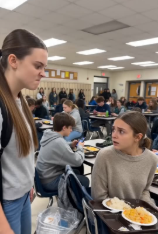
For three seconds after Marina Sterling threw the food at me, nobody moved. A red-orange streak slid down the front of my sweater, warm at first, then cold as it soaked through the fabric. My skirt was spotted. My shoes were splashed. Somewhere to my left, a phone camera clicked again and again, hungry for the worst angle.
Marina stood in front of me with her chest rising fast.
“See?” she shouted, turning to the crowd. “This is what she does. She causes drama, then acts innocent.”
I wiped sauce from my wrist with a napkin someone shoved into my hand.
My fingers shook, but I kept them visible.
That mattered.
I had learned that when people already wanted to doubt you, even the way you moved could become part of their lie.
“I didn’t cause this,” I said.
Marina laughed. “You accused my parents’ fundraiser committee of stealing.”
“No,” I said, looking past her toward the office door. “I said the form didn’t match the deposits.”
That sentence made her face tighten.
Not much.
Just enough.
The phones kept recording. Students whispered my name. Alina Petrova. Ukrainian girl. Quiet girl. Scholarship girl. The one who always checked the details too many times.
Assistant Principal Grant pushed through the crowd with two teachers behind him.
“What happened?”
Marina pointed at me before he finished speaking.
“She tried to sabotage the senior fundraiser.”
I swallowed.
“No, I corrected a reimbursement form before the wrong number got submitted.”
Mr. Grant looked at my ruined sweater, then at the tray on the floor, then at Marina’s clean hands.
“Who threw the food?”
The crowd went quiet in the guilty way crowds do when they all know the answer but want someone else to say it.
A freshman near the vending machines lifted his phone.
“I got it,” he said softly.
Marina spun toward him. “Delete that.”
The freshman stepped back.
Mr. Grant’s expression changed.
“Marina,” he said, “come with me.”
Her smile returned, but thinner now. “Gladly. My parents are already at the fundraiser table. They can explain.”
That was the mistake.
She thought her parents being there made her safe.
I knew the form made them exposed.
I picked up the clipboard from the edge of the lunch table. Marina reached for it, fast.
I pulled it back.
Her fingers missed by an inch.
Mr. Grant noticed.
“Alina,” he said, “bring the clipboard.”
Marina’s eyes locked on mine.
For the first time since the sauce hit my sweater, she looked scared.
Part 3: Her Parents Smiled Until The Total Changed
The front office was too bright.
Fluorescent lights buzzed overhead while I stood beside the counter, sticky sauce drying against my sweater. Marina sat in one chair with perfect posture, legs crossed, chin high, like she was waiting for everyone else to realize they had embarrassed themselves.
Her parents were already there.
Whitney and Calvin Sterling sat at the conference table with matching fundraiser badges pinned to their shirts. Whitney wore a pearl necklace and kept one hand on a leather folder. Calvin had the relaxed smile of a man used to being thanked before anyone checked his math.
The senior class fundraiser display stood behind them: glossy posters, prize baskets, donation jars, and a sign that read:
COMMUNITY DINNER FUND — SUPPORT STUDENT ACTIVITIES
Mr. Grant placed the clipboard on the table.
Marina’s mother smiled at me.
Not kindly.
“Oh, Alina,” she said. “I’m sorry this has become so emotional for you.”
My cheeks burned worse than my stained sweater.
“It isn’t emotional,” I said. “It’s arithmetic.”
Calvin Sterling chuckled. “Teenagers see one confusing receipt and imagine corruption.”
I opened the clipboard.
My hand trembled once, so I pressed my palm flat against the paper.
“This is the fundraiser order form submitted to the student office,” I said. “It lists 420 dinner tickets sold at twenty dollars each.”
Mr. Grant leaned over.
“That should be $8,400.”
I nodded. “But the deposit envelope says $5,880.”
Whitney waved a hand. “Processing fees. Vendor fees. Supplies.”
I turned the form around.
“Then why does this section say supplies were donated?”
The room went still.
On the form, under vendor contribution, three boxes were checked.
Pasta donated.
Sauce donated.
Bread donated.
Mr. Grant’s eyes narrowed.
Calvin’s smile dimmed.
Marina spoke quickly. “She doesn’t understand how fundraisers work.”
I looked at her.
“Maybe not. But I understand that if food was donated and volunteers served it, nearly three thousand dollars should not disappear.”
Whitney’s pearl necklace shifted against her throat as she swallowed.
Then the office secretary, Mrs. Bell, stepped in holding a sealed envelope.
“I found the original copy,” she said. “The one turned in last Friday.”
Marina’s chair scraped.
“Why were you looking for that?”
Mrs. Bell looked at her over her glasses.
“Because Alina kept saying, ‘Check it.’ So I checked it.”
Mr. Grant opened the envelope.
Inside was another form.
Same fundraiser.
Same date.
Different total.
520 tickets sold.
$10,400 expected.
The missing amount was no longer three thousand dollars.
It was $4,520.
And Marina’s mother stopped smiling.
Part 4: The Signature That Should Not Exist
No one spoke for a long moment.
Even the office printer seemed too loud, coughing out papers behind the secretary’s desk while Marina stared at the original form like it had betrayed her.
Mr. Grant placed both forms side by side.
“Why are there two versions?”
Calvin Sterling leaned forward. “Administrative mistake.”
Mrs. Bell shook her head. “No. The original was scanned before filing. The copy on the clipboard was turned in today.”
Whitney’s voice sharpened. “Are you accusing us of something?”
“I’m asking,” Mr. Grant said, “who changed the ticket count.”
Marina looked at me with hatred so open it almost felt like heat.
“This is what she wanted,” she said. “She wanted to humiliate my family because she’s jealous.”
I laughed once.
I did not mean to.
It came out small and bitter.
“Jealous of what? Sauce on my clothes?”
Her face flushed.
Mr. Grant held up a hand. “Enough.”
Then he pointed to the bottom of the altered form.
“Alina, what did you notice first?”
I hesitated.
This was the part I had been afraid to say out loud.
“The approval signature.”
Whitney’s eyes flicked down.
Mr. Grant followed my finger.
Approved by: Ms. Nora Whitcomb, Student Activities Coordinator.
But Ms. Whitcomb had been out sick for two days.
“I emailed her this morning,” I said. “She told me she hadn’t approved the revised form.”
Mrs. Bell went pale.
Mr. Grant picked up his phone.
Marina whispered, “Don’t.”
It was so quiet I almost missed it.
But her father heard.
He looked at her.
“What did you do?”
Marina’s face twisted. “I was fixing it.”
Whitney snapped, “Marina.”
The word was not comfort.
It was warning.
Mr. Grant called Ms. Whitcomb on speaker.
Her voice came through thin and tired.
“I did not sign any revised fundraiser form. I did not approve any cash adjustment. And I definitely did not authorize changing the ticket count.”
The office air went heavy.
Mr. Grant said, “Thank you.”
Before he could hang up, Ms. Whitcomb added, “Also, I sent Alina to check the numbers because she was the only student volunteer who noticed the deposits were short.”
Marina stared at me.
Everyone did.
That was the second the story flipped.
I had not been snooping.
I had been asked to help.
Mr. Grant ended the call slowly.
Then Mrs. Bell pointed at the signature line.
“There’s pressure variation.”
Calvin frowned. “What?”
She lifted the paper closer.
“I used to process enrollment forms. This signature was traced. You can see where the pen stopped and restarted.”
Marina’s breathing turned uneven.
Mr. Grant looked at her.
“Marina, did you forge Ms. Whitcomb’s signature?”
Marina’s eyes filled, but she did not answer.
Then her mother reached across the table and covered her hand.
For one second, I thought she was comforting her.
But Whitney squeezed too hard.
Marina flinched.
And I understood that Marina was scared of more than being caught.
Part 5: The Video Showed Who Taught Her
The office door opened again, and Principal Dawson walked in carrying a laptop.
He was usually calm in that distant principal way, but now his face looked carved from stone.
“I’ve reviewed the cafeteria video,” he said.
Marina dropped her eyes.
Whitney released her hand.
Principal Dawson set the laptop on the table and turned it toward us.
The video showed the cafeteria from above: students moving in lines, fundraiser posters along the wall, me standing near the clipboard table, Marina approaching fast.
No audio.
Just movement.
My hands were visible at my sides.
Marina pointed at me.
I pointed toward the office.
Then she grabbed the tray and threw the food.
I watched it happen from outside my own body.
The crowd recoiled. Phones rose. Marina turned, performing outrage before the sauce had even finished sliding down my sweater.
Principal Dawson paused the video.
“Marina,” he said, “you attacked a student.”
Her voice cracked. “I didn’t mean to.”
“You meant to make her look unstable,” he said.
She started crying.
Not loudly. Not dramatically. Just tears slipping down her face while she stared at the frozen image of herself with the tray in her hand.
Calvin Sterling rubbed his forehead. “This has gone far enough.”
“No,” Principal Dawson said. “It has not.”
He clicked to another file.
“This is security footage from last night outside the activities office.”
Whitney’s face changed first.
The footage showed the hallway dark except for one strip of light under the office door.
At 7:18 p.m., Marina entered with a keycard.
At 7:20 p.m., Whitney Sterling followed her.
The room went silent.
On screen, mother and daughter disappeared inside.
At 7:36 p.m., they came out.
Whitney carried the leather folder now sitting beside her elbow.
Marina looked sick.
Principal Dawson paused it.
“Mrs. Sterling, why were you in the activities office after hours?”
Whitney straightened. “We were organizing materials.”
Mrs. Bell spoke quietly.
“That office was locked.”
Principal Dawson looked at Marina.
“Your student media pass was used to enter.”
Marina wiped her face. “Mom said we had permission.”
Whitney turned sharply. “Marina.”
But Marina kept crying.
“She said the form had to be corrected because the school would misunderstand the numbers.”
Calvin looked at his wife.
“Whitney?”
For the first time, his voice had doubt in it.
Whitney’s face hardened.
“Do not look at me like I did something wrong. I have carried this fundraiser for years while this school takes credit.”
Principal Dawson leaned forward.
“Where is the missing money?”
Whitney did not answer.
Then Mrs. Bell opened the leather folder.
Inside were printed invoices.
But they were not from food vendors.
They were from Sterling Event Consulting.
Whitney’s private company.
Part 6: Marina Finally Broke The Family Story
Marina stared at the invoices like she had never seen them before.
Maybe she had not.
That was the worst part.
Her name was on the mess. Her hands had thrown the food. Her pass had opened the office. Her panic had made the cafeteria explode.
But the company name belonged to her mother.
Sterling Event Consulting.
Consultation fee.
Promotion fee.
Fundraiser management fee.
Student engagement strategy fee.
Each line looked harmless alone.
Together, they swallowed thousands of dollars.
Mr. Grant read one under his breath.
“Student engagement strategy, $1,200?”
Calvin’s face had gone gray.
“Whitney, what is this?”
Whitney snatched the folder closed.
“It is work. Work I did. Work nobody appreciates because schools expect mothers to volunteer endlessly.”
Principal Dawson said, “You billed a student fundraiser through a private company without authorization.”
Whitney’s mouth tightened. “I recovered costs.”
“From students,” I said.
She looked at me with such sharp disgust that I stepped back before I meant to.
Marina saw it.
Something changed in her expression.
She had hated me five minutes earlier.
Now she looked at me like I was standing where she had been standing for years.
Under Whitney Sterling’s eyes.
Marina whispered, “You said the invoices were just for accounting.”
Whitney turned on her. “They were.”
“You said if anyone checked, I should say Alina changed the clipboard.”
The room stopped.
My heartbeat thudded once, hard.
Whitney’s face went white.
Marina pressed both hands against her stomach like she might be sick.
“She told me Alina was already suspicious because Ms. Whitcomb trusted her with the deposits. She said if Alina got blamed first, everyone would stop looking at the forms.”
“Marina,” Whitney said slowly, “think very carefully.”
Marina lifted her head.
Her eyes were red.
“I am thinking.”
She looked at me.
“I threw the food because I wanted everyone filming you, not the clipboard.”
The words hurt, even though I already knew them.
She swallowed.
“I’m sorry.”
I did not answer.
Not yet.
Forgiveness was not a bandage someone else got to slap over the wound they made.
Principal Dawson asked, “Did you forge Ms. Whitcomb’s signature?”
Marina nodded.
“My mom traced it first on another paper. I copied it onto the form.”
Whitney stood. “This conversation is over.”
Principal Dawson did not move.
“No. It is being documented.”
Calvin sat back slowly, staring at his wife like she had become a stranger at their own table.
Then Mrs. Bell’s phone buzzed.
She read the message, frowned, and looked up.
“The bank confirmed the fundraiser deposit slip,” she said. “There were two deposits.”
Mr. Grant asked, “Two?”
She nodded.
“One to the school account.”
Then she looked at Whitney.
“And one to Sterling Event Consulting.”
Part 7: The Cafeteria Saw The Truth Return
By the end of the day, the clip of Marina throwing food at me had already spread through school.
But this time, it did not travel alone.
Someone posted the full hallway statement from Principal Dawson: the fundraiser was under review, the altered forms were invalid, and any student sharing edited clips to harass another student would face discipline.
The words did not erase the humiliation.
I still had to walk through the hallway in a borrowed hoodie from the lost-and-found. I still heard whispers. I still saw people glance at me and then away, ashamed too late.
But the story had changed shape.
By morning, the cafeteria was packed for an emergency senior fundraiser meeting.
Principal Dawson stood beside Ms. Whitcomb, who had come in pale but furious, wrapped in a gray scarf and holding the original scanned records like they were armor.
Marina sat in the front row.
Her parents sat behind her, separated by one empty chair.
Whitney Sterling looked polished again, but there was a stiffness around her mouth that no lipstick could hide.
Principal Dawson explained the numbers.
Not dramatically.
That made it worse.
520 tickets sold.
$10,400 expected.
$5,880 deposited to school.
$4,520 diverted through unauthorized invoices.
A murmur rolled through the cafeteria.
Students who had paid for tickets looked at Whitney. Parents looked at Calvin. Teachers looked at the fundraiser posters like they had been personally lied to by the glossy paper.
Then Ms. Whitcomb stepped forward.
“The corrected funds are being recovered,” she said. “The senior event will continue, but no parent committee will handle cash again without staff oversight.”
Applause started in the back.
Then stopped when Marina stood.
Her hands were shaking.
She turned to face the cafeteria.
“I lied about Alina.”
The room quieted so fast it almost hurt.
“I forged a signature. I changed a form. I threw food at her because I wanted everyone to think she was the problem.”
Her mother whispered, “Sit down.”
Marina did not.
“My mom told me to protect the fundraiser reputation. I chose to protect myself instead of telling the truth.”
Her voice cracked.
“That was cowardly.”
She turned toward me.
“I’m sorry, Alina. In front of everyone. Not in private where it helps me more than you.”
Every phone was up again.
But this time, they were recording the correction.
I stood slowly.
My legs felt weak.
“I don’t accept being blamed anymore,” I said.
My voice shook at first, then steadied.
“I checked the form because Ms. Whitcomb asked me to. I kept saying check it because the proof was there. And I want everyone who filmed me covered in food to film this too.”
The phones stayed raised.
So I said it clearly.
“The truth should travel at least as far as the lie.”
Part 8: The Form Became Something Bigger
Two weeks later, the fundraiser table looked completely different.
No glossy Sterling banner.
No private company folders.
No cash box watched by parents who smiled too easily.
Instead, there was a clear lockbox, two staff signatures, a digital receipt screen, and a laminated sign that said:
EVERY DEPOSIT IS VERIFIED DAILY.
It should have felt like a small change.
It did not.
It felt like the school had finally admitted that trust was not a decoration. It was a system.
The missing money was returned after Calvin Sterling agreed to cooperate with the review. Whitney Sterling was removed from all school committees, and her company’s invoices were sent to the district’s legal office. No one announced every detail to students, but enough became public for the whispers to stop blaming me.
Marina was suspended from fundraiser leadership and assigned restitution service.
Not glamorous service.
Real service.
She spent lunch periods helping Ms. Whitcomb scan old forms, label receipts, and build the new verification binder. At first, she moved like every paper burned her fingers. Then, little by little, she stopped acting above the work.
One Thursday afternoon, I found her alone in the activities office.
She was staring at a blank apology form.
“I don’t know how to write it without sounding like I want sympathy,” she said.
I stayed by the door.
“Then don’t ask for any.”
She nodded.
For a while, only the scanner moved.
Then she said, “My mom always said people respect confidence.”
“They respect honesty more,” I said. “Just not as loudly at first.”
Marina looked at me.
“I hated that you noticed things.”
I almost smiled, but not kindly.
“I noticed.”
She looked down.
“I thought if you were quiet, it meant you were weak.”
“No,” I said. “It meant I was watching.”
That was the last private conversation we had for a long time.
The senior fundraiser dinner happened on a rainy Friday night. Students served food. Teachers counted tickets. Parents stayed where parents belonged: helping, not controlling.
Near the entrance, Ms. Whitcomb displayed the new verification binder.
On the first page was a copy of the corrected form.
Not the forged one.
Not the altered one.
The real one.
At the bottom, under student volunteer notes, she had written:
Discrepancy identified by Alina Petrova before final submission.
I stared at that sentence for a long time.
It was not a trophy.
It was not revenge.
It was something better.
A record.
Later, Marina walked past me carrying a tray of bread.
She stopped.
“I’m not asking you to forgive me,” she said.
“Good,” I answered.
She nodded, accepting that.
Then she added, “But I am going to tell the truth when people bring it up.”
I looked across the cafeteria at the phones, the laughter, the families eating dinner under paper decorations that students had made themselves.
“Start there,” I said.
By the end of the night, the fundraiser had earned enough to replace what was nearly lost and still cover the senior trip.
Everyone called it a success.
But I knew the real victory had happened earlier, in the office, when someone finally opened the form.
Because a lie can own a crowd for ten seconds.
A video can make humiliation look like guilt.
But a record, kept clean and checked in time, can walk into a room after everyone has already judged you and quietly make them all look again.
