The slap came before the truth did, but the truth was already sitting in the cafeteria computer, waiting for someone brave enough to open the right file.
For three seconds after Brielle Whitmore’s palm hit my face, the public-school cafeteria at Eastview High in Denver, Colorado, forgot how to breathe.
Forks stopped scraping trays. Milk cartons froze halfway to mouths. Somewhere near the vending machines, a basketball rolled loose from somebody’s backpack and bumped softly against a chair leg, again and again, like a tiny clock counting down the moment before everything exploded.
I stood there with my cheek burning, my black hoodie sleeve still pushed up because I had been pointing at the serving line, and every pair of eyes in the room fixed on me as if the slap itself were the whole story.
It was not.
My name is Maya Johnson. I was seventeen years old, Ethiopian American, and I had spent most of senior year learning that some people did not need facts if they had confidence, money, and the right last name.
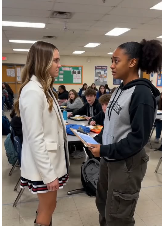
That day, I looked exactly like the kind of girl Brielle Whitmore loved to underestimate: gray shirt, black hoodie, cargo pants, scuffed black Converse sneakers, hair pulled back in a plain braid, no jewelry except the thin silver bracelet my grandmother gave me before she moved back to Addis Ababa.
Brielle, on the other hand, looked like she had been styled for a magazine spread called Future Leaders of America. She wore a white blazer over a fitted top, a tennis skirt even though it was forty degrees outside, and glossy boots that clicked against the cafeteria floor like punctuation marks. Her blond hair fell in perfect waves around her shoulders. Her lip gloss shined under the fluorescent lights.
She was eighteen, English American, daughter of the PTA president, and the kind of student adults described as “promising” before she even did anything.
I was described as “quiet.”
Sometimes “hardworking.”
Sometimes, when adults thought I could not hear them, “sensitive.”
And that day, sensitive apparently meant I was supposed to keep quiet while an altered allergy menu risked sending another student to the nurse’s office, or worse.
I had not yelled. I had not accused anyone. I had not made a scene.
All I had done was step up to the cafeteria counter and say, “Can someone please cross-check the allergy medical list before serving lunch?”
That was apparently enough to make Brielle Whitmore snap.
The cafeteria had been chaotic before then, the normal lunchtime storm of trays, voices, backpacks, laughter, and chairs dragged too hard across tile. The smell of pizza, reheated pasta, sanitizer, and fries hung in the air. Students crowded toward the hot lunch station, where the menu board announced:
CHICKEN CURRY BOWLS
VEGETABLE RICE
SUNFLOWER CRUNCH SALAD
GLUTEN-FREE OPTION AVAILABLE
I had noticed the problem because of Jonah Kim.
Jonah was a sophomore who sat two tables behind me in AP Environmental Science. He was funny in a quiet way, the kind of kid who wrote tiny sarcastic comments in the margins of worksheets and then pretended not to smile when people noticed. He also had a severe sesame allergy.
Everyone in the school food office knew it. His medical form was on file. His parents had submitted updated documents at the start of the year. He wore a medical bracelet. The cafeteria staff had always been careful.
But that morning, I had volunteered in the office during first period because the counseling department needed help sorting service-credit forms for the winter fundraiser. I was not supposed to see the lunch allergy menu.
I saw it because Ms. Patel, the cafeteria manager, rushed in looking for printer paper and left a folder open beside the copier.
Inside was the official allergy substitution sheet.
Jonah Kim — sesame allergy — no tahini, sesame oil, sesame seed garnish, cross-contact restriction.
I noticed it because the lunch menu had chicken curry bowls that day, and the sauce supplier had changed last week. I remembered because Jonah had joked in class that he trusted the cafeteria more than he trusted restaurants.
Then, at 11:42 a.m., when I walked into the cafeteria and saw the digital menu board, Jonah’s name was not on the allergy restriction note anymore.
The line for lunch was already moving.
Jonah was four students away from the counter.
And Brielle Whitmore was standing beside the serving station with a clipboard, smiling like she owned the room.
She did not work in the cafeteria. She was there because the PTA had launched a “Healthy Lunch Leadership Initiative,” which mostly meant Brielle got to wear a blazer, hold a clipboard, and tell everyone her mother had made school meals more inclusive.
Her mother, Victoria Whitmore, was the PTA president.
She loved speeches.
She loved photographs.
She loved saying the school was “a family.”
And Brielle loved being seen as the daughter who carried that family legacy.
I walked faster.
“Ms. Patel,” I said, trying to keep my voice calm.
Ms. Patel looked up from the serving station. “Maya? Everything okay?”
“Can you check the allergy medical list before you serve the curry bowls?”
The lunch aide beside her paused with a ladle in midair.
Brielle turned toward me slowly.
Her smile stayed in place for half a second too long.
“Why?” Ms. Patel asked.
“I think the menu note is missing something.”
Brielle laughed lightly. “Maya, the menu was approved this morning.”
“I know,” I said. “That’s why I’m asking to check the medical list.”
Brielle’s eyes sharpened. “You know?”
“I saw the printed allergy substitution sheet in the office earlier.”
Her clipboard lowered an inch.
It was a small movement, but I saw it.
So did Jonah.
He stopped in line, tray in hand, watching us.
Ms. Patel frowned. “What did you see?”
“Jonah’s sesame restriction was on the official sheet,” I said. “But the digital menu board doesn’t list it. I just think somebody should cross-check before serving.”
The cafeteria noise dipped, not fully silent yet, but quieter around us.
Brielle stepped closer. “You shouldn’t be looking through private medical documents.”
“I wasn’t looking through them,” I said. “The folder was open by the copier. And I’m not saying his details out loud to embarrass him. I’m asking staff to check before lunch moves forward.”
But it was too late.
Jonah’s face had already gone red.
A group of juniors near the condiment station turned to stare at him.
Brielle noticed and seized the moment.
“You just announced his medical information in front of half the cafeteria,” she said, loud enough for people to hear.
My stomach dropped.
That was not what I had done.
But the way she said it made it sound possible.
“I didn’t announce anything,” I said. “I said there was an allergy issue.”
“You said his name.”
“Because he was about to be served.”
“Because you wanted attention.”
The words landed with the exact practiced force of someone who had been waiting for a reason to say them.
Ms. Patel held up a hand. “Brielle, stop. Maya, come here. Show me what you mean.”
I moved toward the counter, but Brielle stepped into my path.
“Do not make this a scene,” she said under her breath.
“I’m not.”
“You always do this.”
I stared at her. “Always do what?”
“Act like you’re morally better than everyone else.”
That was when I knew this was not about lunch.
It was about the service-credit list.
Three days earlier, I had noticed another record problem. Students who volunteered at the PTA food drive were supposed to receive community service credits. The official list had included me, Jonah, and five other students who had unloaded boxes in the snow behind the gym.
But the public thank-you post on the school website credited only Brielle and her leadership committee.
When I asked the counseling office about it, the secretary told me the list had been “updated by PTA request.”
I had not accused Brielle then.
I had only asked for the original sign-in sheet to be checked.
Just like now.
One adult. One record. One verification.
And just like now, Brielle had looked at me as if I had committed a crime by noticing.
“Please move,” I said.
Her smile disappeared.
“Don’t tell me what to do.”
“Then don’t block me.”
The first phone came up near the soda machine.
Then another.
Then another.
Brielle saw them and changed instantly, rearranging her face into wounded dignity.
“I’m trying to protect student privacy,” she said loudly. “Maya is spreading medical information and causing panic.”
“No,” Jonah said suddenly.
His voice cracked, but he spoke.
“She’s trying to protect me.”
Brielle turned toward him. “Jonah, you don’t understand what’s going on.”
He swallowed. “I understand I have an allergy.”
A few students murmured.
Ms. Patel stepped out from behind the counter. “Everyone back up. I’m pausing service until I check the medical list.”
That should have ended it.
It should have been simple.
But Brielle’s face changed.
For one brief second, I saw fear behind her anger. Real fear. Not embarrassment. Not annoyance. Fear of what would happen if Ms. Patel opened the right file.
Then Brielle moved.
Her palm cracked against my cheek so hard my head turned.
The cafeteria died.
My trayless hands hung at my sides. I tasted metal, though my lip was not bleeding. Heat spread from my cheek to my ear, then down my neck.
Brielle breathed hard, eyes wide, as if she had surprised herself.
Then she pointed at me.
“She was threatening me.”
I almost laughed.
Not because anything was funny.
Because I had seen this before.
Someone powerful hits you, then describes your body as the danger.
I touched my cheek.
“You slapped me,” I said.
“You got in my face.”
“I asked for the medical list to be checked.”
“You were trying to humiliate my family.”
There it was.
Not privacy.
Not lunch safety.
Family image.
Before anyone could respond, Principal Lawson entered from the cafeteria side door with Assistant Principal Greene behind him. Someone must have texted the office. Principal Lawson was tall, tired-looking, and permanently dressed like he was late to a district meeting. Mr. Greene was shorter, sharper, and harder to read.
“What happened?” Principal Lawson demanded.
Brielle immediately stepped toward him. “Maya caused a public medical privacy incident and then came at me.”
Jonah said, “That’s not true.”
Brielle’s eyes flashed. “Jonah, stop.”
The way she said it made my skin crawl.
Like she had a right to stop him.
Mr. Greene looked at me. “Maya?”
“My cheek hurts,” I said, my voice shaking now. “Because Brielle slapped me. I asked Ms. Patel to check the allergy medical list before serving lunch. That’s all.”
Principal Lawson looked toward Ms. Patel.
She nodded. “Maya asked me to check the list. Calmly. I had already paused service when Brielle struck her.”
Brielle’s face tightened. “Ms. Patel, with respect, you didn’t hear what she said before that.”
“I heard enough,” Ms. Patel replied.
Something in Brielle’s expression shifted again.
Calculation.
She turned to Principal Lawson, lowering her voice just enough to sound mature. “My mom has been working for months to fix cafeteria transparency. If students start accusing PTA volunteers of altering menus without proof, the whole program becomes impossible.”
Principal Lawson flinched at the word PTA.
It was tiny, but I saw it.
So did Brielle.
Her mother’s influence entered the room without her body.
Victoria Whitmore had raised money for new cafeteria equipment, organized staff appreciation lunches, gotten local news coverage for the school garden, and once publicly corrected a district official during a board meeting. Teachers smiled around her carefully. Administrators answered her emails quickly.
Brielle knew that.
She had been raised knowing that.
Mr. Greene turned toward the serving line. “Ms. Patel, can you pull up the official medical restriction list?”
“Yes,” Ms. Patel said.
Principal Lawson hesitated. “Maybe we should move this to the office.”
My heart sank.
No.
That was how truth disappeared.
Behind closed doors, everything became “confidential.” Everything became “complicated.” Everything became “we looked into it” without anyone knowing what “it” was.
Jonah spoke before I could.
“I want it checked here.”
Everyone turned.
His face was pale, but he held his tray with both hands like a shield.
“It’s about my food,” he said. “I want to know if I was about to be served something unsafe.”
The cafeteria stayed silent.
Mr. Greene nodded once. “That is reasonable.”
Principal Lawson looked uncomfortable, but he did not argue.
Ms. Patel went to the cafeteria computer near the register. The screen was connected to the menu display system, and because the lunch initiative had planned to show a “nutrition transparency demo” later that day, the cafeteria projector was already connected to the wall screen.
The irony was so perfect it felt unreal.
The same screen meant to celebrate Brielle’s family program was about to expose it.
Ms. Patel logged in.
Brielle’s boots clicked once as she shifted her weight.
I noticed her hands.
The right one, the one she had slapped me with, trembled slightly.
Ms. Patel opened the official medical restriction list.
She did not show the full private page to the cafeteria, only the lunch compliance summary, which listed student ID numbers rather than full medical details.
“Student K-204,” she said carefully. “Sesame restriction active. No sesame oil, tahini, seed garnish, or cross-contact.”
Jonah closed his eyes.
Mr. Greene asked, “Does today’s curry sauce contain sesame?”
Ms. Patel clicked the supplier note. Her mouth tightened.
“Yes. The new sauce uses sesame oil.”
A wave of noise moved through the cafeteria.
Someone whispered, “Oh my God.”
Another student said, “He was literally in line.”
Principal Lawson’s face drained of color. “Why wasn’t that on the menu board?”
Ms. Patel opened the digital menu edit history.
Brielle stepped back.
I saw it.
One step.
Then another.
Mr. Greene saw it too.
“Brielle,” he said. “Stay here.”
“I need to call my mother.”
“You can wait.”
“No, I really need to—”
“Stay here.”
Ms. Patel clicked the edit history tab.
The wall screen changed.
TODAY’S MENU ALLERGY NOTE
Original upload: 7:18 a.m. — Patel, N.
Edited: 10:06 a.m. — Whitmore PTA Access
Edited field: Removed sesame warning from curry bowl public display
Edited by: bwhitmore.student
The cafeteria erupted.
Brielle’s face changed before Ms. Patel even finished reading the line.
It was not just fear now.
It was collapse.
The perfect girl in white suddenly looked like a photograph dropped in water.
“That’s not—” she started. “That doesn’t mean I—”
Mr. Greene’s voice cut through the noise. “Quiet!”
The room obeyed.
Principal Lawson stared at the screen. “Brielle, why did your student account remove the sesame warning?”
“I didn’t remove anything. Someone must have used my login.”
Ms. Patel said, “Your account was issued temporary PTA display access for the lunch initiative.”
“I share committee devices,” Brielle said quickly. “Anyone could have—”
“Then why did you slap Maya when she asked us to check?” Jonah asked.
Brielle looked at him like she hated him for speaking.
“That is enough,” Principal Lawson said.
But it was not enough.
Not yet.
Because the menu edit proved danger, but it did not prove motive.
And Brielle knew that.
She straightened, still pale but recovering, like someone grabbing the edge of a table before falling.
“I made a mistake,” she said, voice shaking. “Maybe I clicked something by accident while updating the display. That does not mean Maya had the right to publicly accuse me or expose Jonah.”
“I didn’t accuse you,” I said. “I asked for a cross-check.”
Brielle turned to the cafeteria. Tears filled her eyes now, perfectly timed. “I have worked so hard for this school. My mother has worked so hard. One technical error and suddenly everyone acts like I tried to hurt someone?”
The room shifted.
Not fully.
But enough.
Some people wanted the story to stop there. Accident. Stress. Misunderstanding. Slap because emotions ran high. Apology later. Move on.
That would protect everyone important.
I felt the old familiar pressure to be reasonable.
To accept half-truth as better than no truth.
To be grateful they had checked at all.
Then Jonah said, “What about the service credits?”
My head turned.
Brielle went still.
So did Principal Lawson.
Mr. Greene looked at Jonah. “What service credits?”
Jonah’s voice was quiet but firm. “The food drive list. Maya asked about it. My hours disappeared too.”
Now students began speaking.
“Mine too.”
“I was there Saturday.”
“Brielle’s committee got all the credit.”
“I signed in behind Maya.”
Ms. Patel looked at Principal Lawson. “This is bigger than the menu.”
Brielle snapped, “No, it isn’t.”
Her voice cracked too sharply.
Everyone heard it.
Mr. Greene stepped toward the cafeteria computer. “Can we access the volunteer credit records?”
Principal Lawson said, “That’s a counseling office system.”
“But the lunch initiative uploaded the PTA verification forms, right?” Ms. Patel asked. “I received copies for food-service audit.”
Brielle’s eyes flicked toward the side door.
Again.
Escape.
Mr. Greene noticed.
“Do not move,” he said.
Ms. Patel opened a folder labeled PTA FOOD DRIVE DOCUMENTS.
I stared at the screen, heart pounding.
Inside were scanned forms.
Original sign-in sheet.
PTA summary.
Credit upload.
Email chain.
The cafeteria had gone so silent I could hear the hum of the projector.
Ms. Patel opened the original sign-in sheet first.
There was my name.
Maya Johnson — 5.5 hours.
Jonah Kim — 4 hours.
Aaliyah Brooks — 4.5 hours.
Diego Ramirez — 5 hours.
Samira Hassan — 3.5 hours.
Several others.
Then Ms. Patel opened the PTA summary.
My name was gone.
Jonah’s was gone.
Aaliyah’s was gone.
Diego’s was gone.
Samira’s was gone.
In their place:
Brielle Whitmore — 18 hours.
Whitmore Student Leadership Committee — 22 hours.
The room exploded again, angrier this time.
Because lunch safety was frightening.
But stolen credit was personal.
Aaliyah stood up from her table. “Are you kidding me?”
Diego shouted, “I unloaded boxes in the snow!”
Samira’s voice shook. “Those hours were for my scholarship application.”
Brielle looked cornered now. “My committee organized the event.”
“You didn’t even show up until the local reporter came,” Aaliyah snapped.
That landed.
Because everyone remembered the photo.
Brielle in her white coat, holding one can of soup for the camera, while the rest of us stood behind the gym with wet gloves and numb fingers.
Mr. Greene opened the email chain.
The first email was from Ms. Han in counseling:
Please verify attached student volunteer hours for service-credit upload.
The reply came from Victoria Whitmore.
Thank you. Please use the attached corrected version. Several student entries were duplicates or non-approved participants. Brielle’s committee should receive primary credit for event leadership.
Principal Lawson whispered, “Victoria…”
Then came another email.
From Brielle’s school account to Victoria Whitmore.
Mom, Maya asked counseling about the original sheet. She saw too much. If this gets out before the PTA lunch presentation, it makes us look fake.
Victoria’s reply:
Handle her carefully. Do not let her turn this into one of those equity complaints. The family story matters right now.
My throat tightened.
The family story.
There it was.
The real motive.
Not outrage.
Not privacy.
Image.
Brielle’s family had built a public version of themselves as generous, inclusive, protective, community-minded. The altered allergy menu was not random. The sesame warning had been removed because it contradicted the glossy “safe, transparent, student-centered lunch initiative” presentation scheduled for that afternoon.
If the menu showed a major allergy warning, the presentation looked less perfect.
If the service-credit list showed immigrant, Black, Muslim, Latino, and Asian students doing the real labor, Brielle’s leadership image looked less impressive.
So the records changed.
The menu changed.
The credit line changed.
And when I asked one adult to check, Brielle slapped me because she was not defending safety.
She was defending a lie.
Before anyone could speak, the cafeteria doors opened.
Victoria Whitmore walked in.
She was dressed in a cream coat, pearl earrings, and the controlled smile of a woman who expected rooms to rearrange themselves around her. Two other PTA members followed behind her, carrying gift bags for the lunch presentation.
Her eyes moved from the silent cafeteria to the projector screen.
Then to Brielle.
Then to me, with one red cheek.
Her smile vanished.
“What is going on?” she asked.
Principal Lawson swallowed. “Victoria, we are reviewing some serious concerns.”
Victoria looked at the screen again.
Her own email was displayed there.
For the first time, she had no prepared expression.
Brielle whispered, “Mom.”
Victoria did not answer her daughter.
She looked at Principal Lawson. “This should not be displayed publicly.”
Jonah stepped forward.
“It was my allergy.”
Victoria turned to him, blinking as if she had forgotten students were real people.
He lifted his wrist, showing his medical bracelet. “I was about to be served food with sesame oil because someone removed the warning.”
Victoria’s face tightened. “I’m sure that was an administrative mistake.”
“No,” I said.
My voice was not loud.
But it carried.
Victoria looked at me.
I felt everyone watching. My cheek still hurt. My hands were shaking inside my hoodie sleeves. But I thought of my grandmother’s bracelet on my wrist. I thought of my mother working double shifts at Denver Health. I thought of my father telling me, “A record is not just paper, Maya. For people like us, sometimes it is the only witness that does not get tired.”
So I spoke.
“You changed the service-credit list,” I said. “Brielle changed the allergy menu display. Then she slapped me when I asked for verification.”
Victoria inhaled sharply. “That is a very serious accusation.”
“The records are serious,” I said. “I’m just reading them.”
Something moved through the cafeteria then.
Not applause.
Not yet.
Recognition.
Students understood that sentence because they had lived it in different ways. We had all watched people with influence act like the accusation was worse than the action. We had all seen truth treated as rudeness when it came from the wrong mouth.
Victoria turned to Principal Lawson. “I want this projector turned off immediately.”
Mr. Greene said, “No.”
The word stunned everyone.
Even Principal Lawson.
Mr. Greene stepped forward, face calm but hard. “A student was assaulted after raising a safety concern. A medical accommodation appears to have been altered. Service-credit records appear to have been falsified. We are preserving the visible record until district compliance arrives.”
Victoria stared at him. “You cannot be serious.”
“I am.”
“You have no idea what this will do to the school.”
Mr. Greene looked at Jonah, then at me, then at the students whose service hours had vanished.
“Yes,” he said. “I think I do.”
Brielle began crying again, but this time nobody rushed to comfort her.
Victoria finally turned on her daughter.
“Brielle,” she said quietly, “what did you do?”
Brielle wiped her face with the back of her hand. “You told me to protect the presentation.”
The cafeteria went still.
Victoria’s face went white.
“I did not tell you to remove an allergy warning.”
“You said the menu looked scary with all the warnings,” Brielle said, voice breaking. “You said donors don’t like seeing liability language. You said it made our program look dangerous.”
“I meant ask Ms. Patel about formatting!”
“No, you didn’t!” Brielle shouted. “You said Maya was becoming a problem. You said she was one of those students who always finds a way to make good families look bad.”
The words hung in the air like smoke.
Victoria looked around and realized every student had heard.
Every phone had heard.
Every adult had heard.
And finally, the perfect Whitmore story cracked open.
District compliance arrived twenty minutes later.
Lunch was stopped. Safe meals were distributed after a full medical-list cross-check. Jonah’s parents were called, not because he had been harmed, but because he had almost been. Brielle was removed from campus pending disciplinary review. Victoria resigned from the PTA before the next board meeting, though everyone knew resignation was not the same as accountability.
But the twist none of us saw coming arrived the following week.
I was called into the auditorium with Jonah, Aaliyah, Diego, Samira, Ms. Patel, Mr. Greene, and Principal Lawson. I thought it was another interview. Another statement. Another adult asking me to repeat the worst part until it sounded less real.
Instead, district officials stood onstage beside a woman I did not recognize.
She was older, with silver hair, a navy suit, and kind eyes that missed nothing.
“My name is Dr. Helen Mercer,” she said. “I oversee student equity compliance for Denver Public Schools.”
My stomach tightened at the word compliance.
But then she looked at me and smiled.
“Maya Johnson, your request to verify the official record prevented a potentially life-threatening mistake.”
Jonah glanced at me and nodded.
Dr. Mercer continued. “It also uncovered a pattern of improper credit reassignment affecting scholarship-eligible students.”
Aaliyah whispered, “Pattern?”
Dr. Mercer clicked a remote.
The auditorium screen lit up with a chart.
Not just the food drive.
Three years of PTA-sponsored events.
Service hours had been shifted repeatedly from regular student volunteers to leadership committee members connected to PTA board families. Students who needed those hours for scholarships, honor societies, immigration-support programs, or graduation pathways had lost credit quietly.
My chest tightened.
It had never been just us.
It had never been just Brielle.
The record I asked them to check had opened a door into years of polished theft.
Then Dr. Mercer said the sentence that made the whole auditorium erupt.
“All affected students will receive restored service credits, formal letters of correction, and scholarship application support from the district.”
Samira burst into tears.
Diego covered his face.
Aaliyah whispered, “Finally.”
I sat frozen.
Happy endings do not always feel happy at first. Sometimes they feel like your body finally realizing how scared it has been.
Then Principal Lawson stepped up to the microphone.
He looked older than he had the week before.
“I owe several students an apology,” he said. “Especially Maya Johnson and Jonah Kim. Our school responded too slowly because we were too concerned with managing reputation. That was wrong.”
He turned toward me.
“Maya, you asked for one adult to check the record. We should have done that immediately.”
My eyes burned.
I nodded because I could not speak.
After the assembly, Jonah found me near the auditorium doors.
He held out a folded paper.
“What is this?” I asked.
“A copy of the corrected lunch safety procedure,” he said. “Ms. Patel asked me to give you one.”
I opened it.
At the bottom, under the new verification policy, there was a line:
Student safety concerns may be raised by any student and must be checked against the official record before service continues.
Below it were two student advisory names.
Jonah Kim.
Maya Johnson.
I laughed, but it came out broken.
“You okay?” Jonah asked.
“No,” I said honestly. “But I think I will be.”
He smiled. “That counts.”
A month later, my restored service hours helped complete my scholarship application.
Two months later, I received the letter.
Full tuition support for a summer public health program at the University of Colorado.
My mother cried in the kitchen. My father read the letter three times. My grandmother called from Addis Ababa and said, “You protected food. That is holy work.”
I did not know what to say to that.
So I touched the silver bracelet on my wrist and cried too.
As for Brielle Whitmore, she finished the year through remote instruction. People whispered that her family was humiliated, that Victoria had lost her board connections, that the Whitmore name no longer opened every door at Eastview High.
But I did not spend much time thinking about their fall.
I thought about Jonah eating lunch without fear.
I thought about Samira submitting her scholarship forms with the hours she had earned.
I thought about Aaliyah starting a student record-watch committee and making Principal Lawson attend the first meeting.
I thought about Ms. Patel taping a handwritten sign near the serving line that said:
WHEN IN DOUBT, CHECK THE LIST.
And I thought about the slap less and less.
Not because it did not matter.
It did.
For a while, my cheek seemed to remember it every time Brielle’s name came up. But memory changed shape. The humiliation became proof. The pain became a timestamp. The moment everyone stared at me became the moment everyone finally saw what had been happening in plain sight.
On the last day of school, I stood in the cafeteria before lunch started, watching sunlight fall through the high windows onto the empty tables.
Jonah walked in carrying two trays.
“Curry bowl?” he asked.
I raised an eyebrow.
“Sesame-free,” he said quickly. “Triple checked.”
I laughed.
We sat at the table near the window, the same place where students had stared at me after Brielle slapped me.
Only now, nobody was whispering.
Nobody was pointing.
Nobody was deciding whether I deserved to be believed.
The corrected menu glowed on the screen above the serving line, clear and careful and impossible to miss.
For the first time all year, the cafeteria looked like normal school chaos.
But underneath it, something had changed.
The records were harder to alter.
The adults were quicker to check.
And the students knew the truth could survive, even when someone powerful tried to slap it out of the room.
I used to think being quiet meant staying safe.
Now I know better.
Quiet is not the same as silent.
And the next time someone tells me I am making trouble by asking for proof, I will remember Brielle Whitmore’s face when the record opened in front of everyone.
I will remember Jonah’s voice saying, “I want it checked here.”
I will remember that one verified truth can pull a whole hidden system into the light.
And I will remember the lesson my father taught me that day when he hugged me in our kitchen and pressed my scholarship letter against his chest like it was something sacred.
“People can edit a file, Maya,” he said. “But they cannot erase everyone who remembers what was true.”
He was right.
The record remembered.
So did we.
And that was enough to change everything.
THE END
