Part 2: The Line Under Owen’s Signature
…it was routed through Bay 12 after Owen reported it missing.
I read the line twice.
Then a third time.
The warehouse lights buzzed above me. Diesel stood in front of my knees, broad and steady, while the shift boss stayed half-sprawled against the plastic pallets, one hand pressed to his ribs and all the cruelty drained from his face.
His name was Maren Holt, though everyone called him Holt because he liked a name that sounded like a warning.
The second document in my hand carried Owen’s signature.
Not a photocopy.
Not a careless scan.
His real signature, strong and slanted, the way he signed birthday cards, deployment forms, and the last note he had tucked into my hospital bag before leaving.
At the top was a logistics authorization I had never seen.
“Personal Effects Hold — Mitchell, Owen.”
Under that, Owen had written:
“If anyone attempts to separate Grace from my personal effects, my deployment coin, or the sealed family crate, ask why Bay 12 was accessed after I reported internal tampering.”
My throat closed.
Family crate.
I looked at the heavy sealed box Holt had ordered me to carry.
It was marked with a red label:
TEAM LIFT REQUIRED.
And below that, another label had been half-scraped away.
I bent closer.
Holt snapped, “Don’t touch that.”
Diesel turned his head just enough.
Holt stopped.
A woman behind me, the one who had pretended to scroll, stepped forward. Her name tag said NINA.
“I’ll read it,” she said.
Her voice shook, but she moved anyway.
She peeled the damaged corner of the label.
Under the warehouse barcode was Owen’s name.
Staff Sergeant Owen Mitchell.
My hand went to my belly.
“That crate is my husband’s?”
Nina looked at Holt.
Then at me.
“Yes.”
Holt pushed himself up.
“That is military-controlled property. She has no clearance.”
I lifted the forged light-duty form.
“Then why did you order me to carry it?”
No one answered.
Because the answer was suddenly obvious.
If I lifted it and got hurt, they could say I violated my restrictions.
If I refused, they could say I was insubordinate.
If the crate disappeared, they could say I had been the last one near it.
Holt had not slapped me because I was difficult.
He had slapped me because Diesel, my belly, Owen’s coin, and that missing form had all put me one step too close to the truth.
A forklift driver near the loading doors raised his hand.
“I saw Bay 12 opened last night.”
Holt turned on him.
“Don’t.”
The driver swallowed.
“By Holt. And Mr. Vance.”
A new name entered the air.
Edwin Vance, regional operations manager.
The man whose office looked down over the whole warehouse through glass walls.
I looked up.
Vance stood there now, behind the glass, holding his phone.
Watching.
When he realized I had seen him, he stepped back from the window.
Then the warehouse alarm chirped.
Not the fire alarm.
The inventory lockdown alarm.
Nina whispered, “Someone just sealed the exits.”
Part 3: The Bay They Opened After Midnight
For a moment, nobody moved.
The warehouse was too large for silence, yet silence found every aisle. Conveyor belts sat still. Pallet jacks froze where workers had abandoned them. Diesel stayed planted in front of me, body angled toward Holt, ears sharp.
Nina grabbed the radio clipped to her belt.
“Who triggered lockdown?”
Static.
Then a man’s voice answered.
“Inventory control. Nobody leaves until internal property is accounted for.”
Holt’s face changed.
Relief.
That scared me more than his anger.
Nina lowered the radio.
“That’s Vance.”
I looked toward the glass office again. The blinds were closing from the inside, slat by slat, like an eye shutting.
A man near the loading doors muttered, “He’s trying to trap the paperwork before police get here.”
The word police seemed to wake people.
Someone finally called.
Someone else filmed.
A younger employee pulled two chairs together and told me to sit. I did, because my legs had started trembling in a way pride could not fix. Diesel moved with me and sat so close his shoulder pressed against my knee.
Holt tried to stand straight.
“This is a workplace incident. Phones down. Everyone return to station.”
Nina held up the forged light-duty form.
“You forged her signature.”
“I processed a correction.”
“She’s eight months pregnant.”
“She refused direct instruction.”
I looked at him.
“You told me to lift my husband’s crate.”
Holt’s jaw clenched.
“You don’t know what’s in it.”
“No,” I said. “But Owen did.”
The forklift driver, whose name was Mateo, came closer with a tablet.
“I have the Bay 12 scan history.”
Holt snapped, “That is restricted.”
Mateo looked at Diesel, then at me, then at the red mark on my cheek.
“Not anymore.”
The scan log showed Owen’s crate had arrived three weeks earlier and was placed on family hold. Then, two nights ago, after midnight, Bay 12 was opened using Holt’s badge. Ten minutes later, Vance’s badge. Then the crate was moved from secure storage to active outbound freight.
Destination: disposal processing.
My stomach tightened.
“Disposal?”
Nina’s face went pale.
“That means destroyed, sold as damaged, or written off.”
The heavy box sat twenty feet away from me, silent, sealed, waiting to be erased.
My phone vibrated.
Unknown number.
I answered, fingers shaking.
“Mrs. Mitchell?” a woman asked. “This is Captain Reyes, legal liaison for Staff Sergeant Owen Mitchell. Are you at Zaragoza Allied Logistics?”
“Yes.”
“Is Diesel with you?”
“Yes.”
“Good. Do not release the coin, the crate, or any document bearing Owen’s signature. Your husband flagged that warehouse for suspected theft of military family property.”
I closed my eyes.
“Captain… what is in the crate?”
She paused.
Then said:
“The proof he sent home before they could bury the investigation.”
Part 4: The Crate Marked Team Lift
Captain Reyes stayed on the line while police arrived.
Not private security.
Not Vance’s internal people.
Actual police, called by three workers, one customer, and a woman in shipping who had watched Holt slap me from behind a stack of bubble wrap and finally decided she was done being afraid of losing her job.
Vance came down from the glass office only when the officers asked for him by name.
He looked exactly like a man who had practiced calm in mirrors.
Dark suit. Thin smile. Hands visible. Voice smooth.
“There has been a misunderstanding involving a distressed employee.”
Diesel stood.
Vance stopped three feet farther away than he had intended.
Captain Reyes, still on speaker, said, “Identify yourself.”
Vance’s expression hardened.
“Edwin Vance, regional operations manager.”
“This is Captain Reyes, legal liaison to Staff Sergeant Owen Mitchell. The crate you attempted to move is under protected family hold and investigation notice.”
Vance smiled at the officers.
“I have no record of that.”
Nina lifted the second document.
“We do.”
Holt whispered, “Nina, think carefully.”
She looked at him with open disgust.
“I did.”
The officers took statements. They photographed my cheek. They photographed the forged form, Owen’s authorization, the half-hidden crate label, the Bay 12 scan history.
Then Captain Reyes asked the question that changed the room:
“Is the crate still sealed with a blue military evidence band?”
Mateo checked.
“Yes.”
Vance’s calm cracked.
“That band is not valid in this facility.”
Captain Reyes replied, “It is valid where federal property is involved.”
One officer looked at me.
“Mrs. Mitchell, do you consent to medical evaluation?”
I nodded.
For once, I did not argue.
But before the ambulance arrived, Captain Reyes requested that the crate be opened only in the presence of police, myself as Owen’s designated spouse, and two warehouse witnesses.
Vance objected.
Holt objected.
Diesel did not.
The officers cut the outer shrink wrap.
Inside the crate were three smaller sealed containers.
The first held damaged shipping labels peeled from military care packages addressed to deployed service members and spouses.
The second held a ledger of missing household goods, including medical supplies, baby items, and family emergency kits.
The third held a waterproof envelope with Owen’s handwriting across the front:
FOR GRACE — IF THEY TRY TO MAKE HER LOOK UNSTABLE, OPEN FIRST.
My hands shook so badly Nina had to help me hold the envelope.
Inside was a letter, a flash drive, and a photograph.
The photograph showed Owen standing in that same warehouse, holding his deployment coin beside a row of crates marked family support freight.
On the back, he had written:
“Grace, this coin is not decoration. It matches the shipment record they changed.”
I touched the coin on my lanyard.
For months, it had felt like comfort.
Now it was evidence.
Part 5: The Coin That Matched The Missing Record
The ambulance came, but I refused to leave until Captain Reyes told me the crate was secured.
She understood.
So did the paramedic, a tired woman named Elena who looked at Holt like she wanted to put him in a box marked heavy and leave him there.
“You’re going to the hospital,” she said gently. “But I’ll wait three minutes.”
Those three minutes were enough.
The officers sealed the crate again under police custody. Nina and Mateo signed witness statements. Diesel stayed pressed to my legs, watching every hand that came too close. Vance stopped speaking without his lawyer. Holt kept muttering that Diesel was dangerous until one officer finally said:
“The dog acted with more restraint than you did.”
No one corrected him.
At the hospital, they put monitors around my belly.
The baby’s heartbeat filled the room.
Strong.
Fast.
Real.
I cried into both hands.
Diesel lay beside the bed, officially allowed after Captain Reyes sent his training and protective role documentation. His eyes stayed on the door.
Captain Reyes arrived an hour later in person. She wore a uniform, carried a black folder, and looked at me with a seriousness that felt like respect instead of pity.
“Grace,” she said, “Owen discovered that certain family support shipments were being diverted before reaching military spouses. He reported it internally. After that, warehouse documents began changing.”
“Why didn’t he tell me?”
“He tried. Several emails bounced. Two certified letters were signed for by the warehouse and never delivered to you.”
I stared at her.
“The warehouse?”
She opened the folder.
“You work there. That made you vulnerable. They could intercept HR forms, make you appear noncompliant, and create a record that you were unstable or careless before Owen’s complaint surfaced.”
My stomach rolled.
“So the heavy crate…”
“Was bait. If you lifted it and got hurt, they could blame you. If you refused, they could fire you. If anything inside disappeared, they could say you interfered with protected property.”
I touched the side of my belly.
The baby shifted.
Captain Reyes’s voice softened.
“Owen left one more message.”
She handed me a printed page.
It was short.
“Grace, if they use my absence against you, remember this: I trusted Diesel because he knows when to stay. I trusted you because you know when to refuse.”
I pressed the page to my chest.
Later that night, Owen called.
The line crackled.
“Grace?”
His voice broke me.
“I’m here.”
“The baby?”
“Okay.”
“Diesel?”
“Guarding me like a general.”
A rough laugh came through the line.
Then silence.
“I’m sorry,” he whispered.
“You left me a crate full of evidence.”
“I meant to leave you a quiet month before the baby.”
I looked at the hospital ceiling.
“They didn’t want quiet. They wanted me alone.”
Owen’s voice turned low.
“Then we make sure the record says you weren’t.”
Part 6: The Warehouse That Sold Family Freight
The investigation widened before morning.
The flash drive in Owen’s envelope held months of inventory scans, photos, message threads, and videos. Family support kits meant for deployed service members’ spouses had been rerouted to private resale channels. Baby supplies, medical equipment, winter gear, care packages, even donated comfort items had been marked damaged and moved out through Bay 12.
Vance approved the route.
Holt enforced the floor silence.
HR forms were altered for anyone who questioned it.
Not just me.
Nina brought forward two employees whose signatures had been forged after they reported missing shipments. Mateo showed camera footage of after-hours loading. Another worker admitted he had been told to remove labels from boxes addressed to military families and replace them with disposal codes.
And then there was my light-duty form.
The original, approved by HR, clearly stated I was not to lift heavy crates, climb loading platforms, or work near active pallet stacks.
The version hidden behind the pallets showed my forged signature agreeing to “temporary full-duty flexibility.”
Temporary.
That word had nearly cost me my safety.
The next day, Vance tried to blame Holt.
Holt tried to blame clerical error.
Clerical error did not slap a pregnant woman.
Clerical error did not hide a crate.
Clerical error did not move family freight after midnight.
Captain Reyes brought federal investigators. The warehouse was partially shut down. Bay 12 was sealed. Trucks waiting at the outbound gate were searched. Two contained family-labeled goods stripped of original tags.
At the hospital, I watched the news on mute and recognized the loading dock where I had eaten lunch for months.
Diesel lifted his head whenever Vance appeared on screen.
“Good judgment,” Nina said when she visited.
She brought me a small paper bag with my lanyard, the deployment coin, and a clean copy of Owen’s letter.
“I should have spoken sooner,” she said.
I looked at her tired face.
“Today counts.”
She cried then.
Quietly.
“I kept thinking I needed the job.”
“So did I.”
That was the ugly part.
They had counted on all of us needing something more than truth.
A paycheck.
A reference.
A shift schedule.
A chance to get through pregnancy without another fight.
Captain Reyes later told me Owen’s report had already reached the right office, but the evidence inside the crate made it undeniable.
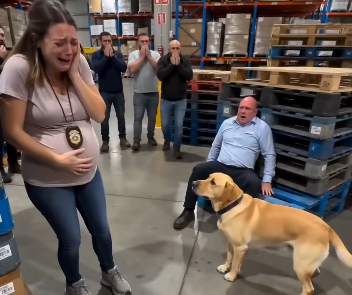
By the time Owen was granted emergency leave, Vance had been arrested on fraud and theft-related charges, Holt had been charged for assault and document falsification, and the warehouse contract was suspended pending review.
When Owen finally walked into my hospital room, Diesel reached him first.
The dog pressed his whole body against Owen’s legs and whined like something inside him had been holding its breath for weeks.
Owen dropped to his knees.
“You stayed,” he whispered.
Then he looked at me.
At my cheek.
At my belly.
At the coin on the table.
“I trusted a dog and a piece of metal to protect you.”
I shook my head.
“No. You trusted me to read what they hoped I’d drop.”
Part 7: The Hearing Under The Warehouse Lights
The formal hearing took place three weeks later.
I was still pregnant, still sore, and very tired of rooms full of people deciding whether my fear counted as evidence. But I went because I wanted Holt to see that I could stand without carrying what he tried to put in my arms.
Owen sat beside me.
Diesel lay at my feet.
Captain Reyes sat behind us with the federal investigator and two lawyers. Nina and Mateo waited to testify. The warehouse representatives looked smaller outside their loading floor.
The hearing opened with the video.
Holt ordering me to lift the heavy crate.
Me refusing.
Holt insulting Owen.
The slap.
Diesel knocking him back.
The room watched in silence.
No one called it a misunderstanding after that.
Then came the documents: my real light-duty form, the forged one, Owen’s authorization, the Bay 12 scan logs, the rerouted freight, the after-hours videos, the resale invoices tied to Vance’s shell company.
Vance tried to sound calm.
He said systems were complex. Shipments were confusing. Supervisors sometimes made judgment calls.
The investigator asked:
“Was slapping Mrs. Mitchell a judgment call?”
Vance did not answer.
Holt’s lawyer argued that Diesel was aggressive.
The hearing officer looked at the footage again and said:
“The dog created distance after a physical assault. That will be noted.”
Diesel thumped his tail once, as if accepting the record.
Nina testified next.
Her voice shook, but she named names.
Mateo testified after her.
He described Bay 12, the midnight access, the missing labels, the way workers were told pregnant Grace Mitchell was “useful pressure” because Owen would stop pushing the complaint if his wife’s job became complicated.
Owen’s hand tightened around mine.
Useful pressure.
That was what I had been to them.
A belly they could threaten.
A paycheck they could squeeze.
A signature they could fake.
When it was my turn, I stood slowly.
Owen moved as if to help, then stopped until I nodded.
I appreciated that more than I could explain.
I told the room:
“I did not refuse work. I refused danger. HR had approved lighter duty. My husband had filed a report. My dog did not start the violence. My supervisor did. And the crate was not heavy because I was weak. It was heavy because it carried the truth they wanted destroyed.”
The hearing officer wrote that sentence down.
I saw it.
And for the first time since the warehouse, I felt something inside me settle.
The decision came later that week: the contract was terminated, whistleblower protections were extended to involved employees, Owen’s report was validated, and my forged form became central evidence in the criminal case.
Owen took me home from the hearing and made soup badly.
I ate it anyway.
That night, Diesel slept across our bedroom door.
Owen looked at him and said:
“He still thinks he’s on duty.”
I touched my belly.
“Maybe we all are.”
Part 8: The Box That Became A Nursery Shelf
Our son was born twelve days after the hearing.
We named him Miles.
He arrived during a storm, loud enough to make every nurse laugh and strong enough to make Owen cry before anyone even placed him in his arms.
When Owen finally held him, he whispered, “No heavy lifting for you either, little man.”
I laughed, exhausted and whole in a way I had almost forgotten was possible.
Diesel met Miles the next day.
He sniffed the blanket, looked at Owen, looked at me, and lay down beside the bassinet as if he had just accepted the most important assignment of his life.
The warehouse investigation continued for months.
Vance’s resale network collapsed under its own paperwork. Holt pled guilty to lesser charges tied to assault and falsification. Several families received delayed shipments they had been told were lost. Others received compensation. Workers who had stayed silent out of fear were interviewed, protected, and in some cases rehired under a new contractor with real safety oversight.
Bay 12 was renamed.
Not officially at first.
Workers started calling it Mitchell Bay.
Then someone put up a printed sign:
“No shipment is worth a person’s body.”
The new management left it there.
My heavy crate was eventually released from evidence, empty of documents but still carrying scratches, tape marks, and the old red label.
TEAM LIFT REQUIRED.
Owen asked what I wanted to do with it.
“Burn it?” he offered.
“No.”
“Throw it into the sea?”
“We live in Zaragoza.”
“I can find a river.”
I smiled.
“No. I want to use it.”
He looked alarmed.
“For what?”
“A shelf.”
So he sanded it. Carefully. Angrily at first, then gently. We sealed the wood, kept one side of the red label visible, and mounted it in Miles’s nursery. Not over the crib. Not like a trophy. On the opposite wall, holding books, soft blankets, and a framed copy of Owen’s line:
“I trusted you because you know when to refuse.”
Some people thought that was a strange thing to put in a nursery.
I did not.
I wanted Miles to grow up knowing refusal could be love. Safety could be honest. Strength did not mean carrying every box someone shoved into your arms.
Nina visited when Miles was two months old. She brought a tiny yellow toy forklift. Mateo sent a blanket. Captain Reyes sent a card with only one sentence:
“Diesel’s conduct remains exemplary.”
Owen framed that too.
Diesel got older that year. A little slower. A little gray around the mouth. But whenever someone knocked, he still rose first, steady and calm, making sure the world entered gently.
Months later, we were invited back to the warehouse after the new contractor opened a family support distribution center in the same building. I almost said no.
Then I thought about the crate.
The slap.
The forged form.
The workers who had finally spoken.
So we went.
Owen carried Miles. I held Diesel’s leash. The loading floor looked different. Brighter. Cleaner. Bay 12 had new cameras, clear logs, and a posted employee rights board beside the clock-in station.
On the wall near the entrance was a plaque:
“Safety accommodations are not favors. They are facts.”
I stood there for a long time.
Owen touched my shoulder.
“You okay?”
I looked at the spot where Holt had slapped me.
The plastic pallets were gone.
The floor was empty.
“No,” I said honestly. “But I’m not afraid of this place owning the story anymore.”
Miles stirred in Owen’s arms.
Diesel leaned against my leg.
A new pregnant employee walked past us wearing a light-duty badge. A supervisor stopped a pallet jack to let her cross and said, “Take your time.”
She did.
Nobody rolled their eyes.
Nobody called her special.
Nobody handed her a heavy box to prove she belonged.
That was when I finally cried.
Not because of the pain.
Because the room had changed shape around the truth.
The box they said a pregnant woman could lift had been meant to crush my credibility, my safety, and Owen’s report. Instead, it carried the evidence home.
And every night after that, when I laid Miles beneath the small shelf made from that crate, I remembered the warehouse lights, Diesel’s body between me and harm, Owen’s coin against my chest, and the moment I learned that the honest thing is sometimes the heaviest thing in the room — but no one has the right to make you carry it alone.
