Part 2: The Timestamp In The Leaves
…the timestamp was 1:42 p.m. that same afternoon.
Only twenty minutes before Craig Dalton told me to hurry downhill.
The camera screen was small, scratched at the edge, and speckled with damp mist from the trail. Still, the image was clear enough. Craig’s hands were visible, pulling a red warning rope away from two pine posts and stuffing it beneath a pile of wet leaves.
A sign flashed briefly in the frame before he turned it facedown.
SLOPE CLOSED — UNSTABLE FOOTING AFTER RAIN.
My stomach tightened.
Not because Owen had been right.
Because Craig had known.
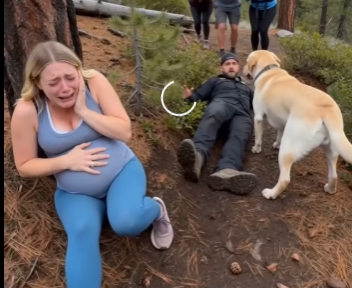
Craig pushed himself up from the bed of leaves where Scouty had knocked him away from me. Mud streaked his jacket. His pride looked more damaged than his body.
“Hand that over,” he said.
Scouty stepped closer to my knee.
I held the camera tighter.
A woman in a blue hiking vest lifted her phone.
“No. She keeps it until the rangers get here.”
Craig pointed at Scouty.
“That dog attacked a licensed guide.”
A man near the back of the group snapped, “That dog stopped you from reaching her again.”
Someone else said, “And we all saw you slap her.”
My cheek burned hotter at the words.
I hated that strangers had to say it before the air believed me.
Craig looked toward the ridge, then down the steep dirt path, then back at the camera in my hand. His panic was no longer hidden. It was breathing through him.
I touched my belly.
The baby shifted slowly, as if reminding me I was not just standing for myself.
The helmet camera had not stopped recording.
It caught everything now: the hikers gathered in shock, Craig’s mud-streaked face, Scouty standing guard, my hand shaking around the device.
Then a voice crackled from Craig’s radio.
“Craig, did you get the pregnant spouse down the slope yet? Ranger Beck is asking why the closure rope is missing.”
The group froze.
Craig lunged for the radio.
Too late.
The blue-vest woman whispered, “Pregnant spouse?”
A younger hiker said, “They planned this?”
Craig grabbed the radio and switched it off.
I stared at him.
“Why did you need me on that slope?”
He wiped mud from his sleeve.
“You are making this dramatic.”
“No,” I said. “You made it dangerous.”
The man at the back moved toward the trailhead to call for help. Another hiker started guiding people away from the drop-off. Everyone suddenly understood the ground beneath us was not part of the scenery; it was evidence.
Scouty pressed his shoulder against my thigh.
The camera screen flickered as the recording continued.
A file preview appeared beneath the current video.
The filename started with Owen’s name.
MORRIS_REPORT_PRIOR_TOUR.
My breath caught.
I tapped it.
Craig’s face drained of color.
A video from weeks earlier opened. Owen’s voice came through faintly under the wind:
“This is Sergeant Owen Morris. Guide has ignored injury report and is rushing guests down closed-grade terrain. Requesting review before civilian tours continue.”
Then Craig’s voice, sharp and impatient:
“Keep walking. If you can stand, you can finish the trail.”
A woman in the video cried out somewhere off-screen.
My hand flew to my mouth.
Craig whispered, “You don’t understand what that recording cost me.”
A ranger’s truck engine sounded from below.
And for the first time since the slap, Craig Dalton looked more afraid of the truth than of the trail.
Part 3: The Rope Hidden Before The Ranger Came
Ranger Beck arrived with two county rescue volunteers and a medical kit.
She was a small woman with gray-streaked hair, mud on her boots, and the kind of calm that made people straighten without being ordered. Her eyes went first to my belly, then to my cheek, then to Scouty, then to the missing rope posts.
“What happened?”
Three people answered at once.
Craig tried to talk over them.
“Guide safety issue. Dog interference. Guest noncompliance.”
Ranger Beck looked at me.
“Mrs. Morris?”
The fact that she knew my name scared me.
“Yes.”
“Your husband sent us a warning after his prior training hike. He also notified us you were booked today and requested you not be rushed on downhill terrain.”
My eyes stung.
“Owen told you?”
“He copied our office after the tour company dismissed his report.”
Craig snapped, “It was not a formal complaint.”
Ranger Beck held out her hand.
“The camera, please.”
I hesitated.
Not because I did not trust her.
Because every person who had wanted proof so far had tried to take it from me.
She seemed to understand.
“You may keep your hand on it while I watch.”
So I did.
We replayed the clip of Craig hiding the warning rope. Then the radio message. Then Owen’s earlier file.
Ranger Beck’s face hardened with each second.
“This slope was closed at 11:30 this morning.”
The hikers began murmuring.
The woman in the blue vest pointed downhill.
“Then why were we on it?”
Craig said, “The alternate route adds forty minutes. Weather was coming in. I made a field call.”
Ranger Beck looked at the fallen sign.
“You made a business call.”
The rescue volunteer checked my blood pressure. I wanted to tell him I was fine, but my hands had gone cold, and the baby had shifted lower in a way that made me suddenly aware of every step I had taken.
Scouty stayed still as the volunteer worked.
“Good dog,” the volunteer murmured.
Craig muttered, “That animal should be removed.”
Ranger Beck turned.
“That animal kept a pregnant woman away from a drop-off after you struck her.”
Craig fell silent.
Then the radio on Ranger Beck’s vest crackled.
“Beck, office says RidgeLine Tours has a donor hike scheduled after this group. They’re asking if the closure can be delayed until after photos.”
She closed her eyes for one second.
“Absolutely not.”
Donor hike.
There it was again: the shape beneath the cruelty.
A trail company, a closed slope, a warning rope hidden, and a pregnant military spouse they wanted moving downhill on camera before officials could stop them.
Ranger Beck asked Craig:
“Who told you to keep this trail open?”
He did not answer.
The helmet camera did.
It was still recording, and in the current file, just before he slapped me, it had captured his own voice low under the waterfall of wind:
“If the soldier’s wife makes it down, Owen’s report dies.”
I stared at him.
My husband’s warning had not failed.
It had been targeted.
Part 4: The Tour Owner Waiting At The Trailhead
They escorted us down by the emergency access path.
Not the steep trail.
Not the slope Craig wanted me to take.
The safer path wound through pines and wet ferns, wide enough for two people and marked with fresh gravel. I moved slowly. This time, no one sighed. No one rolled their eyes. No one called my steps baby steps.
Scouty walked beside me with his shoulder near my knee.
Every few minutes, Ranger Beck asked, “Still okay?”
And every time I answered, I realized how strange it felt to be believed before collapsing.
At the trailhead, an SUV waited beside the tour company van.
A woman stepped out wearing a quilted jacket, polished boots, and a face arranged for donors, not emergencies. Her name was Marla Crane, owner of RidgeLine Tours and Craig Dalton’s aunt.
She looked at the group.
Then at me.
Then at Ranger Beck.
“Why is the closed-route group returning early?”
The way she said closed-route told me she knew.
Craig, muddy and silent, looked at the ground.
Ranger Beck held up the warning rope.
“This was hidden.”
Marla sighed.
“Craig must have made a judgment call.”
A man from our group laughed bitterly.
“Your judgment call slapped a pregnant woman.”
Marla’s gaze flicked to my cheek.
Just once.
Not with guilt.
With calculation.
“Mrs. Morris, I’m sure emotions ran high. The trail is demanding, and sometimes guests overestimate their comfort level.”
Scouty gave one low sound.
I did not need him to.
“I did not overestimate anything. I refused.”
Ranger Beck produced the helmet camera.
“Your guide’s camera recorded the removal of a closure rope, assault, and a statement about killing Sergeant Morris’s report.”
Marla’s face sharpened.
“Owen Morris has been harassing my company for weeks.”
I stepped forward.
Not much.
Enough.
“My husband reported an injured guest.”
Marla smiled thinly.
“Your husband misunderstood outdoor liability.”
A rescue volunteer behind me said:
“An injured guest is not liability. It’s a person.”
Marla ignored him.
The county medical team insisted I sit in the ambulance for monitoring. I did, reluctantly, while the trailhead filled with evidence: hikers giving statements, Beck bagging the rope, the camera being copied, Craig refusing questions until his lawyer arrived.
Then a white pickup pulled in.
A man in a forest service jacket got out, carrying a sealed envelope.
“Mrs. Morris?” he asked.
“Yes.”
“I’m Daniel Price. Sergeant Morris filed a copy of his safety report through our office. He asked us to deliver this if RidgeLine attempted to place you on the closed slope.”
He handed me the envelope.
Inside was a printed trail map, Owen’s report, and a note in his handwriting.
“Leah, if they try to make your caution look like weakness, ask why Marla Crane edited the injury log before the county review.”
I looked at Marla.
For the first time, she stopped smiling.
Part 5: The Injury Log With Missing Names
They took me to the clinic in town.
The baby was fine.
I held on to that fact with both hands.
Scouty lay beside the exam bed after Daniel Price confirmed his training records and Ranger Beck explained what he had done. The nurse cleaned my cheek and asked if I had pain anywhere else. I told her my back was tight, my hands were numb, and my pride was somewhere on that trail under the pine needles.
She smiled sadly.
“Pride comes back. Safety first.”
Ranger Beck arrived with Daniel Price an hour later. They had the injury log.
Or what was left of it.
Marla Crane had submitted a version to the county showing only minor complaints: blisters, twisted ankles, “guest anxiety,” “fatigue,” “weather discomfort.”
But Owen’s copy was different.
He had photographed the original log during the prior training incident, after a woman sprained her knee because Craig rushed her down the same steep slope. That version included names, dates, severity, and guide comments.
One comment, written beside Owen’s report, made my stomach harden:
“Military guest overreacted. Wife booked in June — monitor response.”
Monitor response.
They had known I was coming.
They had not just failed to protect me. They had prepared to use me.
Daniel Price explained the donor hike. RidgeLine Tours was seeking a state partnership for “accessible veteran-family outdoor experiences.” Owen’s report endangered the approval. A pregnant soldier’s wife completing the steep trail would make the concern look exaggerated.
“So I was supposed to be the proof,” I said.
Ranger Beck’s face softened.
“You were supposed to be the picture.”
I closed my eyes.
The nurse’s monitor continued to pick up the baby’s steady heartbeat.
A picture.
Not a person.
Not a mother close to delivery.
Not Owen’s wife.
Just an image that could be placed in a brochure with a caption about courage and resilience.
My phone rang.
Owen.
I answered too fast.
“Leah?”
His voice was tight, almost breathless.
“I’m okay. Baby’s okay.”
He exhaled like he had been holding up a wall.
“Scouty?”
“Perfect.”
At his name, Scouty lifted his head and whined softly.
Owen made a sound that was almost a laugh and almost pain.
“Good boy.”
Then his voice changed.
“Did they put you on the slope?”
“They tried.”
“Craig?”
“He slapped me.”
Silence.
The kind of silence that lives between anger and helplessness.
“I should have warned you harder.”
“You did warn me.”
“I should have been there.”
I looked at Scouty.
“You were.”
Owen’s breath shook.
Daniel Price asked if Owen could confirm the injury log.
I put him on speaker.
Owen said:
“I recorded the prior tour because Craig rushed an injured woman downhill after she asked to stop. Marla later claimed the injury happened after the tour ended. That was false.”
Ranger Beck asked, “Did you know your wife’s booking was being monitored?”
“No,” Owen said. “But I suspected they might use her if they found out she was pregnant. That’s why I sent the map.”
Marla’s edited injury log was placed into evidence that night.
By morning, three former guides had contacted Ranger Beck.
One message said:
“Craig wasn’t the only one hiding ropes.”
Part 6: The Former Guides Who Stopped Being Quiet
The former guides came forward one by one.
A young man named Peter, who had quit after a hiker fell on a wet switchback and was told to “walk it off” for the sake of schedule.
A woman named Elise, who said Marla trained staff to call safety concerns “comfort issues” so reports looked less serious.
An older guide named Ron, who had kept copies of closure notices because he knew someone would eventually get hurt badly enough that silence would become impossible.
Their statements created a map no brochure had ever shown.
Closed slopes reopened for donor photos.
Ropes moved.
Signs turned around.
Guest complaints softened into personality notes.
Pregnant, elderly, disabled, injured, nervous.
Every label used to make careful people look like the problem.
RidgeLine had built a business model out of turning danger into adventure and doubt into weakness.
The helmet camera Craig carried held more than my incident. It had automatic backups from prior tours. Daniel Price recovered footage of guides joking about “Owen’s hill,” the nickname they gave the slope after my husband’s report.
In one clip, Marla’s voice was clear:
“Keep the rope visible only if Beck is on-site. Otherwise it scares guests.”
In another:
“If the Morris wife walks it, we can bury his complaint in the accessibility file.”
When Ranger Beck played that clip for me, I felt cold all over.
The baby rolled under my palm.
“I was not even there yet,” I whispered.
“They were using you before you arrived,” she said.
The county suspended RidgeLine’s steep-route permit immediately. The state paused the veteran-family partnership. Craig was investigated for assault, reckless endangerment, and evidence tampering. Marla tried to blame him, but the recordings disagreed.
Owen called every night he was allowed.
Sometimes we talked about the case. Sometimes we talked about nothing: crib sheets, hospital bag snacks, whether Scouty would be jealous of the baby. Those small conversations saved me more than the dramatic ones.
Then Owen received emergency leave.
He arrived at the clinic apartment where I was resting with one duffel bag, red eyes, and mud still on his boots from whatever rushed route got him across the world.
Scouty hit him like a happy storm.
Owen dropped to both knees.
“You did it,” he whispered into Scouty’s fur. “You stayed between them.”
Then he came to me.
He stopped before touching me.
“Can I?”
I nodded.
He held my face gently and looked at the fading mark on my cheek.
“I recorded him hurting someone else,” he said. “I didn’t know he would try to hurt you.”
“You recorded the warning.”
“I hate that warning had to become proof.”
I took his hand and placed it on my belly.
The baby kicked.
Owen broke.
He cried quietly, forehead against my hand, while Scouty sat pressed against both of us.
Part 7: The Hearing At The Trail Office
The emergency hearing was held in the county trail office, with rain tapping against the windows and the mountains hidden under low cloud.
I attended in person because the doctor cleared me for short travel, and because I wanted Craig and Marla to see that I had walked into that room by choice, not because anyone rushed me.
Owen sat beside me.
Scouty lay across my feet.
Ranger Beck presented the evidence.
The hidden rope.
The helmet camera.
Owen’s prior report.
The edited injury log.
The donor partnership documents.
The former guide statements.
The radio message.
Then the clip of Craig slapping me played on the screen.
I hated watching it.
I hated hearing the sound.
I hated seeing the split second where everyone stood still before Scouty moved.
Owen’s hand tightened around mine, but he did not pull me away from the screen. He let me decide when to look down.
Craig’s lawyer argued he had acted under stress.
Ranger Beck answered, “Stress did not fold a rope under wet leaves at 1:42 p.m.”
Marla’s lawyer argued the company had a strong record of “challenging but rewarding outdoor experiences.”
Daniel Price placed the injury log on the table.
“Rewarding experiences do not require falsified records.”
Then I spoke.
My voice shook at first.
“I was told to move faster because my slow steps made the group suffer. But the truth is, the trail was already closed. My caution did not slow the tour. The hidden danger did.”
I looked at Craig.
“You did not slap me because I was weak. You slapped me because my no stood between you and the picture you needed.”
Then I looked at Marla.
“And you did not want a pregnant woman on that slope because you believed it was safe. You wanted me there because if I survived it smiling, you could sell the lie.”
The room stayed quiet.
No one called me dramatic.
No one said pregnancy emotions.
No one asked why I brought a dog.
The county revoked RidgeLine’s steep-route license, suspended the company’s operating permit pending criminal review, and referred Marla’s records for fraud investigation connected to the veteran-family partnership. Craig’s guide certification was suspended.
Outside, reporters waited.
I did not want to speak.
Owen asked:
“Do you want me to?”
I shook my head.
Then Ranger Beck opened the door, and I stepped forward with Scouty beside me.
I said only one thing:
“A warning is not an insult to adventure. It is how people get home.”
That sentence became the headline.
Part 8: The Trail Where Slow Steps Were Allowed
Our son was born three weeks later.
We named him Rowan.
Owen said the name sounded like a tree that could survive weather. I told him he was not allowed to become poetic every time the baby blinked. He said deployment had made him emotionally dangerous.
Rowan arrived with a cry sharp enough to make Scouty lift his head from the hallway.
When Owen held him, he whispered:
“No rushing downhill. Ever.”
I laughed, exhausted and teary.
Scouty met Rowan that afternoon. He sniffed the blanket, then lay beside the bassinet with the seriousness of a guard assigned to a mountain pass.
The case against RidgeLine continued through Rowan’s first year.
Craig accepted responsibility for the assault and for tampering with safety equipment. Marla fought longer, but the helmet camera, edited logs, former guides, and donor emails made denial expensive. The veteran-family partnership was canceled and rebuilt under county oversight with real accessibility experts, not brochure language.
The steep trail reopened the following summer.
Not as a challenge route.
As a marked educational trail with switchbacks widened, drainage repaired, warning posts fixed in place, and a clear alternate path for anyone who needed it. The old dangerous slope stayed closed for restoration. No one was asked to prove courage on wet leaves above a drop-off.
Ranger Beck invited us to the reopening.
I nearly said no.
My body remembered the slap before my mind did. It remembered the damp leaves, the edge, Craig’s hand, the way strangers became furniture until Scouty moved.
Owen did not push.
He only said, “We can go slowly.”
That was why I went.
Rowan rode against Owen’s chest. Scouty walked beside me, gray beginning to show around his muzzle but pride still carrying his head high. Ranger Beck met us at the trailhead with a new sign.
It read:
“Choose the pace that keeps you safe.”
I had to stop there.
Owen waited.
No sigh.
No hurry.
No one behind me complaining that my steps were too small.
The new trail curved gently through pines. Moss shone on rocks. The air smelled of damp earth and resin. Hikers passed us, some quick, some slow, some with poles, some with children, one older woman pausing every few yards to catch her breath.
A guide waited ahead, smiling.
“Take your time,” she told the older woman.
No sarcasm.
No shame.
Just permission.
I turned away because my eyes filled.
Owen noticed.
“You okay?”
I shook my head.
“Not exactly.”
He nodded.
We kept walking anyway.
At the overlook, a plaque had been placed near the old rope posts:
“This trail records warnings so people do not become them.”
Below that were names of guides, rangers, guests, and whistleblowers who helped rebuild the route. Owen’s name was there. Ranger Beck’s. Hannah, Peter, Elise, Ron.
Mine too.
And Scouty’s, printed at the bottom with a small paw symbol.
Owen laughed through tears.
“He’s going to be impossible now.”
Scouty sat as if accepting public recognition.
Rowan slept through the whole thing, completely unimpressed by justice.
I stood at the railing and looked down at the slope Craig had wanted me to descend. It was still steep. Still beautiful. Still capable of harm if ignored. The difference was that no one was pretending anymore.
That was all safety ever really asked for: honesty before impact.
A young pregnant woman arrived at the overlook with her partner. She studied the trail, then said, “I think I’ll take the alternate path down.”
The guide answered, “Good choice. It’s marked in blue.”
No debate.
No insult.
No hand raised.
Just a choice respected the first time.
I put a hand over my heart.
Owen shifted Rowan gently and took my other hand.
The clouds moved over the ridge. Pine needles rustled. Scouty leaned against my leg, steady as the day he had knocked Craig into the leaves and made everyone admit what they had seen.
I had walked into that forest holding one ordinary thing from my husband: his warning.
It turned out not to be ordinary at all.
It was love written in advance. It was proof left where panic could not erase it. It was a voice saying that slow steps still count, that refusal is not weakness, and that no view, tour, deadline, donor, or guide has the right to make a mother gamble her body for someone else’s story.
And as we took the safer path down, slowly, together, I finally understood that the steep trail had recorded Owen’s warning for one reason: so my no could be heard before gravity had the chance to speak.
