Part 2: The Donor Who Paid For My Grief
The donor’s confession did not sound like guilt.
It sounded like ownership.
He stood beneath the lanterns with one hand still around his champagne glass, his silver hair untouched by the sea wind, his face calm in the way only very rich men looked calm after saying something monstrous.
The host, Vivienne Ashcroft, went white.
—Sir Alistair —she whispered—, not here.
But Sir Alistair Vane did not look at her. He looked at me, then at the program lying face-up in the sand by my shoes.
My husband’s obituary stared back at me in black ink.
Captain Adrian Bell.
Beloved husband. Devoted father. Honored soldier.
Except Adrian was not confirmed dead.
He was missing.
And the program had been printed two days before the Army ever called my phone.
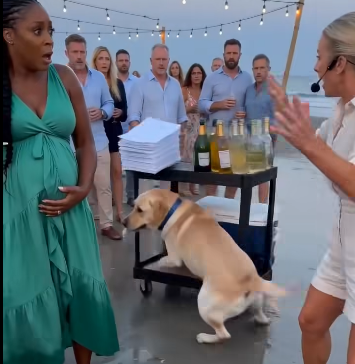
My Labrador, Bear, stood between me and the scattered drink cart, his yellow coat damp with melted ice, his body rigid. He had not attacked anyone. He had simply gone after the thing Vivienne had been guarding.
Now I knew why.
—Why would you pay for my husband’s obituary before I knew he was missing? —I asked.
My voice came out quieter than I expected.
That scared people more than screaming would have.
Sir Alistair lowered his glass.
—Because public grief requires preparation.
A murmur moved through the guests.
I stared at him.
—My grief is not your event schedule.
Vivienne stepped forward quickly, trying to put her face back together.
—Clara, you’re in shock. This is a standard contingency draft. Military families often—
—Do not say military families like you speak for us.
Her mouth shut.
I bent down and picked up the program. Bear moved with me, pressing his shoulder against my knee as if he could feel the ground tilting under me.
On the back page was a printed quote attributed to me.
“My husband gave his life so others could stand free.”
I had never said that.
I had not even been told he had given his life.
My fingers tightened around the paper until it wrinkled.
—You wrote words for my mouth.
Vivienne’s eyes flickered toward the staff.
—Collect the programs. Now.
No one moved.
The same servers who had been silent when she slapped me now stared at the sand, the programs, the cooler, Bear, and me. Something had shifted. A slap could be excused by powerful people as emotion. A dated obituary could not.
A young corporal near the buffet stepped forward.
—Mrs. Bell, I can call the casualty liaison office.
Vivienne snapped:
—This is a private donor event.
The corporal did not look at her.
—Not anymore.
Sir Alistair set down his glass.
—Everyone needs to calm down.
I turned to him.
—My son is eight years old. He went to sleep tonight asking if his father was coming home. You printed a program telling strangers the answer before anyone told me the truth.
His face hardened.
—Your husband was becoming difficult.
The words left his mouth before caution could catch them.
I felt Bear growl.
Not loud.
Just enough.
—Difficult how? —I asked.
Vivienne moved toward Sir Alistair, panic breaking through her painted smile.
—Stop talking.
But he was angry now, and men like him mistook anger for permission.
—Adrian was interfering in matters above his rank.
The corporal froze.
I looked around the party. The lanterns. The champagne. The cameras waiting for a widow’s toast. The donors who had come expecting elegant sadness with a sea view.
Then I saw the second stack of papers half-buried under the spilled ice.
Bear pawed at them once.
A consent form slid free.
At the top were the words:
Authorization For Memorial Trust Transfer.
At the bottom was a blank line for my signature.
My knees almost gave out.
The toast had never been about closure.
It had been about getting me, stunned and humiliated, to sign away something before I understood what had been taken.
I lifted the form.
—What trust?
Sir Alistair’s calm finally cracked.
Vivienne reached for the papers.
Bear stepped in front of her.
She stopped immediately.
I looked at the corporal.
—Call the Army. Call the police. Call whoever you need to call. But no one leaves with these papers.
Sir Alistair smiled thinly.
—You have no idea what you are starting.
I held up the obituary.
—No. You started it when you tried to bury my husband on paper before he was dead.
Part 3: The Program With My Signature Missing
The police arrived before midnight.
So did Lieutenant Marta Keene, the casualty liaison officer whose voice had shaken when she saw the printed date.
—This did not come from our office —she said, holding the obituary program with both hands, as if it were contaminated.
Vivienne had retreated into the event office near the beach club, suddenly fragile, suddenly offended, suddenly claiming that she was only following instructions.
Sir Alistair had stopped speaking entirely.
That was when I knew he had lawyers on the way.
Bear stayed beside my chair while I gave my first statement. I told them about the toast, the slap, the cart, the cooler, the obituary, the donor’s words. I did not make myself sound braver than I was. I told the truth: I was terrified. I still did not know if Adrian was alive. I still had to go home and tell Oliver something without breaking him.
Lieutenant Keene sat across from me.
—Mrs. Bell, I need to ask something difficult.
I nodded.
—Did Captain Bell ever mention Sir Alistair Vane?
My fingers tightened on Bear’s collar.
—Once. He called him “the man behind the clean money.”
Keene’s face changed.
—Do you know what he meant?
—No. Adrian stopped talking whenever I asked. He said it was safer if I didn’t know until he had proof.
The officer looked toward the glass wall of the event office, where Sir Alistair stood with two lawyers now, looking less like a guest and more like a commander giving silent orders.
—Captain Bell filed a concern three weeks ago about a veterans’ housing fund tied to Sir Alistair’s foundation.
My stomach dropped.
—What kind of concern?
—Missing money. False contractors. Properties listed as renovated that were still unsafe or empty. He believed military families were being used in donor reports to secure more funding.
I looked at the program again.
My husband’s smiling photo had been printed beside a paragraph about sacrifice. Under it, in smaller text, was a line inviting donations to the Adrian Bell Memorial Housing Trust.
Adrian had been investigating the same people who were now fundraising from his supposed death.
I felt sick.
Marta Keene lowered her voice.
—If he had evidence, they may have wanted access to his files.
I lifted the consent form.
—That is what this was for.
The form authorized transfer of “personal correspondence, field notes, unpublished statements, and digital property” to the memorial trust.
Digital property.
Adrian’s laptop. His drives. His cloud backups. Everything.
Vivienne had planned to put a glass in my hand, shove grief into my mouth, and lead me toward a signature.
I stood so quickly Bear rose with me.
—Where is she?
—Mrs. Bell—
—Where is Vivienne?
Marta did not stop me. Maybe she knew I was past being managed.
Vivienne was in the event office, wrapped in a cream shawl, speaking to a policewoman as if she were the victim of unfortunate optics. When she saw me, her lips parted.
—Clara, I am sorry for the slap. The pressure tonight was enormous.
—You printed my husband’s obituary.
—The donor team supplied copy for a possible memorial moment.
—Possible? There were cameras facing the stage.
She looked away.
I stepped closer.
—You had my quote printed. You had a form ready. You told me the donors needed closure. You were not preparing for grief. You were staging it.
Her eyes flashed.
—Do you know how many families receive help because of these people?
—Do you know how many families they robbed first?
That struck her.
For half a second, I saw it: not surprise, but knowledge.
She knew.
Maybe not all of it. Maybe enough.
—Adrian should have stayed quiet —she whispered.
The room went still.
Marta Keene, standing behind me, heard it too.
Vivienne realized too late.
I looked at her.
—You know where he is?
She shook her head, too fast.
—No.
Bear suddenly turned toward the back door of the office. His nose lifted. He pulled once, sharply.
—Bear? —I whispered.
He pulled again.
The policewoman opened the back door. It led to a narrow path behind the beach club where supply vans were parked.
Bear moved straight to a black equipment case near the bins.
Inside, under folded banners for the memorial trust, was Adrian’s field jacket.
I knew it before I touched it.
The left cuff had the stitch I had repaired myself.
I sank down beside the case.
The world blurred.
Marta knelt next to me.
—Mrs. Bell, when did you last see this jacket?
—The morning he left.
Bear pressed his nose into the fabric and whined.
Hidden inside the inner pocket was a small waterproof envelope.
Marta opened it carefully.
Inside was a memory card and a note in Adrian’s handwriting.
Clara, if Bear finds this before I do, trust his nose before you trust their grief.
Part 4: Bear Followed The Scent Of The Lie
I did not go home that night.
I called my sister from the police station and asked her to stay with Oliver until morning. I told her only what I knew for certain: there had been a problem at the event, Bear and I were safe, and I still did not have an official answer about Adrian.
I did not tell her about the obituary.
I could not make the words live in another mouth yet.
The memory card was copied in a secure room at the station. Marta Keene stayed. So did a financial crimes inspector named Henrik Soren, who had been called after Sir Alistair’s name appeared in the documents.
The first file opened with Adrian’s voice.
My hand flew to my mouth.
He was sitting in what looked like a storage room, the camera angled too low, his face tired but focused.
—If this reaches Clara, assume the Vane Foundation has moved before I could file the full packet.
My chest hurt so badly I had to grip the edge of the table.
Adrian continued:
—The memorial trust is the laundering point. They use public grief, donor dinners, and veteran housing announcements to move restricted funds into private development accounts. Sir Alistair approves the transfers. Vivienne Ashcroft manufactures the family-facing events. The forms are signed under emotional pressure.
Henrik Soren paused the video.
—There may be more victims.
I nodded, but I could barely hear him. I was staring at Adrian’s face.
He had recorded this before he disappeared.
Marta touched the table gently.
—Can you keep going?
I nodded again.
The next file showed scanned contracts. Housing units marked completed. Families listed as “successfully placed.” Several names were crossed out.
One was mine.
Clara Bell — approach only if casualty status confirmed.
Below it:
Widow likely resistant. Use child angle if needed.
I felt cold all over.
They had studied me.
Not as a person.
As a weakness.
The final video was shorter. Adrian was outside at night, sea wind loud against the microphone.
—They know I copied the ledgers. I am moving the original to St. Enoch’s boathouse before I report in. If I do not make the call by 0600, assume my chain is compromised.
The video cut off.
Marta looked at Henrik.
—St. Enoch’s is north of the beach road.
Bear stood suddenly.
His ears lifted.
He went to the door and stared at it.
Henrik frowned.
—What is he doing?
I knew.
—He heard the place.
Marta hesitated.
—Mrs. Bell, we can send officers.
—He found the jacket when none of us knew it was there.
I clipped Bear’s lead onto his collar.
—He is coming.
We drove before dawn. Marta rode in the front. Henrik followed with two officers. Bear sat beside me in the back, nose pressed to the window, body shaking with the need to move.
St. Enoch’s boathouse stood at the end of a narrow road near a dark strip of rocky shore. The tide was low. Old nets hung from the side wall. The place looked abandoned.
Bear did not care.
He pulled me toward the side entrance so hard Marta had to jog beside us.
The lock on the door was broken.
Inside, the air smelled of salt, rope, old fuel and damp wood.
Bear went straight to a stack of crates under a tarpaulin. He barked once.
An officer lifted the tarp.
There was a metal box underneath.
Henrik opened it with gloves.
Inside were ledgers, hard drives, printed maps, and a sealed envelope addressed to me.
But there was something else.
A medical wristband.
Not old.
Not weather-worn.
The name on it made my breath stop.
Adrian Bell.
Henrik turned it over.
The date was yesterday.
My voice came out as a whisper.
—Yesterday?
Marta looked at the wristband, then at me.
—Clara, this means he was alive after the missing notice.
Bear barked toward the back wall.
Behind the crates, half-hidden by a hanging net, was a small radio transmitter.
Its red light was blinking.
Part 5: The Boathouse Where The Truth Waited
The transmitter was still warm.
Henrik ordered everyone back from it until a communications specialist arrived, but Bear refused to move. He stood between me and the back wall, whining low in his throat, staring at the old radio as if it had spoken in a language only he understood.
Marta crouched beside him.
—What is it, boy?
The radio crackled.
Everyone froze.
A burst of static filled the boathouse.
Then a man’s voice, faint and broken by distance, came through.
—Foxglove to shore. Repeat. Foxglove to shore.
Marta grabbed the receiver.
—Identify yourself.
Silence.
Then:
—This is Captain Adrian Bell.
I stopped breathing.
The room tilted.
Marta looked at me, her face pale.
—Adrian? —I said.
The radio hissed.
—Clara?
I made a sound I did not recognize. Bear barked once, sharp and frantic, tail beating against the crates.
—Adrian, where are you? —Marta demanded.
There was a pause, then his voice again, strained but alive.
—Fishing station east of Port Kernow. I am with Tomas Ried. Do not send local private security. Vane has men on the roads. I have the original ledger witness.
Henrik was already calling it in.
I pressed a hand to my chest as if I could hold my heart in place.
—Are you hurt?
The pause before his answer was too long.
—I am alive.
That was enough.
For that moment, it had to be enough.
The rescue team moved quickly, but not recklessly. Marta made sure official military police and regional officers went together. Henrik contacted a judge to secure the evidence from the boathouse. No one used Sir Alistair’s network. No one called Vivienne. No one touched the donor foundation.
I waited in the car with Bear because they would not let me go to the fishing station.
It was the longest hour of my life.
At 07:18, Marta returned.
Her eyes were wet.
—They have him.
I opened the car door and nearly fell out.
—Alive?
—Alive.
Bear shoved past me and ran toward the ambulance pulling into the gravel lane.
—Bear! —I shouted.
But no one stopped him.
The rear doors opened.
Adrian sat inside wrapped in a grey blanket, thinner than when I had last seen him, exhausted, but there.
Real.
Breathing.
His eyes found mine.
I could not run at first. My body did not believe what my eyes were telling it.
Then I moved.
I climbed into the ambulance, and Adrian reached for me with shaking hands.
We did not kiss like people did in films. We held on like two people who had both been dragged to the edge of a cliff and pulled back by the same rope.
Bear put both front paws on the ambulance step and pushed his head into Adrian’s lap.
Adrian laughed once, broken and hoarse.
—Good boy.
I cried against his shoulder.
—They wrote your obituary.
He closed his eyes.
—I know.
I pulled back.
—How?
His face changed.
—Because Sir Alistair told me I was worth more dead than testifying.
Marta, standing outside, heard him.
Adrian looked at her.
—I will testify now.
Part 6: The Hearing That Turned The Camera Around
Sir Alistair Vane tried to turn the story before we could.
By noon, his lawyers released a statement claiming the obituary was a “premature memorial draft prepared out of compassion,” that my distress had caused “misinterpretations,” and that Adrian’s disappearance had “no connection” to the Vane Foundation.
By three, Vivienne Ashcroft claimed she had been “emotionally overwhelmed” and denied knowing anything about forged consent forms.
By five, every news outlet in the county wanted the video of Bear hitting the cart.
But Henrik did not start with the dog.
He started with the ledgers.
The emergency hearing took place two days later in a government building overlooking the grey water. Adrian was not fully recovered, but he insisted on appearing by secure video from a protected medical facility. I sat in the room with Marta, Henrik, and a solicitor assigned to military families.
Sir Alistair arrived as if entering a club, not a hearing. Vivienne came behind him, no cream shawl now, just a black dress and a face powdered over fear.
The first evidence shown was not dramatic.
Numbers rarely are.
Transfers. Shell companies. Renovation invoices. Donor reports. Names of families who had been photographed in front of houses they were never allowed to live in.
Then came the forms.
Widows and spouses signing away access to personal files, estates, and digital materials during memorial events.
Some had signed after being told the money would help other families.
Some had signed because they were grieving too hard to read.
Some had never signed at all.
Their signatures had been copied.
When my forged quote appeared on screen, Vivienne looked down.
The chair of the hearing, Lady Marion Elwes, asked her:
—Who wrote this statement attributed to Mrs. Bell?
Vivienne whispered:
—I did.
—Did Mrs. Bell approve it?
—No.
—Did she approve the obituary?
—No.
—Did she know her husband was to be announced dead at the event?
Vivienne closed her eyes.
—No.
Lady Elwes let the silence sit.
Then Adrian’s video feed appeared.
He looked tired, but his voice was steady.
—Captain Bell, can you confirm why you began reviewing the Vane Foundation?
—Military families were being used to certify housing projects that did not exist or were not fit for occupation.
—Did you notify anyone?
—Yes. My first report disappeared. My second was delayed. After that, I stopped using internal channels and copied the ledgers.
Sir Alistair’s lawyer stood.
—Captain Bell is under obvious stress and may be confused about events following his disappearance.
Adrian looked directly into the camera.
—I am not confused. Sir Alistair’s private men intercepted me before I could deliver the ledger. I escaped with help from Tomas Ried, a fisherman who owed my father nothing but kindness.
No graphic detail. No performance.
Just fact.
Sir Alistair finally lost his smile.
Henrik played the final audio.
Sir Alistair at the party:
“Because I paid for that draft.”
Then:
“Adrian was becoming difficult.”
The room seemed to tighten around him.
Vivienne began to cry.
Lady Elwes turned to her.
—Ms. Ashcroft, did you knowingly organize a memorial event for a man whose death had not been confirmed?
Vivienne nodded once.
—Why?
She looked at Sir Alistair.
He did not look back.
That finished her loyalty.
—Because he said if Clara Bell signed the transfer, the ledger would be buried with the memorial. He said grief made people cooperative.
My hands went cold.
Lady Elwes asked:
—And the slap?
Vivienne swallowed.
—She refused to say he was dead on camera.
I looked at the table.
I thought hearing it would make me feel powerful.
It did not.
It made me tired.
Adrian’s voice came through the speakers.
—Clara did what everyone else failed to do.
I lifted my head.
He looked straight at me through the screen.
—She asked for the truth before she accepted the performance.
Part 7: My Husband Walked Into His Own Memorial
The public memorial had already been scheduled.
Sir Alistair’s people tried to cancel it once Adrian was found alive, but the invitation had spread too far, the reporters had gathered, and too many families connected to the foundation had begun asking questions.
So the military changed the purpose.
It would no longer be a memorial.
It would be a statement of record.
I did not want to go.
Adrian did not want me to go.
Oliver, however, looked at us both from the kitchen table and said:
—If Dad is alive, why do bad people still get to use his picture?
He was eight.
He should have been asking about football boots, breakfast cereal, whether Bear could sleep on his bed.
Instead, he understood too much.
So we went together.
The same beach club looked different in daylight. The lanterns were gone. The champagne tables were gone. The cart Bear had knocked over was gone too, though reporters kept photographing the place where it had stood.
Bear wore his plain blue lead. Oliver held it with both hands, proud and serious.
Adrian arrived through the side entrance with Marta beside him. The crowd went silent when they saw him.
A man cannot attend his own obituary without making every liar in the room look smaller.
Sir Alistair was not there; his legal team had advised absence. Vivienne was there under formal summons, sitting near the front with her face empty.
Lady Elwes read a brief statement: the obituary had not been authorized, Adrian Bell was alive, and an investigation into the Vane Foundation was underway.
Then Adrian stepped to the microphone.
He held the printed program in one hand.
The same program Bear had knocked into the sand.
—This was written to make my wife behave like a widow before anyone had the right to ask that of her.
The crowd stayed utterly still.
—It used my name, my service, and my family to cover theft from people who had already sacrificed enough. I am alive, but even if I were not, no donor, host, or foundation would have the right to turn my wife’s grief into a signature.
Oliver leaned against my side.
I wrapped an arm around him.
Adrian looked at us.
—My son deserved the truth. My wife demanded it. My dog apparently enforced it.
A small, shaky laugh moved through the crowd.
Bear wagged his tail once, as if he knew timing mattered.
Then other families began to step forward.
A widow from Plymouth whose housing grant vanished.
A father from Cardiff whose injured son had been used in donor brochures without permission.
A young wife from Bristol who had signed a transfer form at a memorial luncheon and never saw her husband’s research files again.
The event became what Vivienne had feared most.
Not closure.
Testimony.
When Vivienne was asked to speak, she stood with difficulty.
She faced the families, not the cameras.
—I helped make grief look elegant so rich people would keep paying us. I told myself the money helped someone. I ignored who it hurt.
Her voice broke.
—Clara Bell asked one question I should have asked months ago: who benefits when the family is rushed into mourning?
No one applauded.
It was not that kind of moment.
But it mattered.
As the statement ended, Bear suddenly tugged Oliver toward the old cart path. Oliver laughed for the first time in days.
—Bear wants to leave.
Adrian looked at me.
—Smart dog.
I took his hand.
We walked off the beach before the cameras could turn our survival into another performance.
Part 8: The Family They Failed To Bury
Sir Alistair Vane was arrested three weeks later.
Not dramatically. Not under lanterns. Not with champagne in his hand. He was taken from a private office in London while auditors carried boxes past portraits of men who had mistaken wealth for innocence.
Vivienne testified. So did Tomas Ried, the fisherman who had hidden Adrian long enough for him to make contact. So did former staff members, military families, accountants, drivers, and assistants who had once believed silence was part of their salary.
The Vane Foundation collapsed under the weight of its own paperwork.
Funds were frozen, then redirected under court supervision to the families whose names had been used. The memorial trust forms became evidence. My forged quote became evidence. Adrian’s obituary became evidence.
The program meant to bury him became the document that helped expose them.
Adrian came home slowly.
Not all at once.
People imagine survival as a door swinging open and light flooding in. Real survival is quieter. It is waking from nightmares. It is sitting at breakfast and forgetting where the tea is kept. It is your son asking if you will disappear again and having no perfect answer.
Adrian did not pretend to be untouched.
I did not pretend not to be angry.
We learned how to tell the truth gently enough for Oliver to live with it.
Bear made fewer compromises. If Adrian moved too far from the room, Bear followed. If I stood too long by the window, Bear leaned against my leg. If Oliver cried, Bear climbed halfway onto the bed despite every rule we had ever made.
Eventually, we stopped pretending he was not in charge.
Six months later, the Army introduced a new family notification protocol for missing personnel connected to sensitive investigations. No charity, donor office, or private host could announce, imply, stage, or fund memorial material before official confirmation and direct family briefing.
The policy had a plain name.
The Bell Rule.
I hated it at first.
I did not want our name attached to what almost broke us.
Then Marta Keene called and told me a young wife in Portsmouth had refused to sign a rushed media release because she had heard of our case. Another family in Edinburgh demanded a second review before a foundation accessed their son’s files. A mother in Cork asked for legal counsel before attending a donor ceremony.
The name stopped feeling like a scar.
It became a warning sign.
One year after the beach party, we returned to the same shore.
Not for cameras.
Not for donors.
Just us.
Oliver ran ahead with Bear, throwing a tennis ball badly and laughing every time Bear retrieved it anyway. Adrian walked beside me, his hand warm around mine.
The sea was grey-blue, the wind sharp, the sand damp under our shoes.
—Do you ever think about that program? —he asked.
I did.
Sometimes I still saw the ink before I slept.
The date before the call.
The quote I never said.
The neat little paragraph where strangers tried to end my life with him before I had proof of his death.
—Yes —I answered.
Adrian stopped.
—Me too.
We watched Oliver and Bear chase each other near the tide line.
—They wanted me to lift a glass when they said your name —I said.
His hand tightened around mine.
—I know.
—Now when I hear your name, I hear Oliver shouting it from the kitchen because you burned toast again.
Adrian smiled softly.
—That toast was only lightly ruined.
I laughed.
It surprised me, that laugh.
It came from somewhere real.
Bear came bounding back, wet and triumphant, dropping the ball at my feet. Then he sat directly on the sand, lifted his chin, and stared at us like he expected gratitude.
Adrian saluted him.
—Sergeant Bear, defender of widows who were never widows.
Oliver giggled.
I crouched and wrapped my arms around Bear’s neck.
—You ruined their perfect moment.
Bear licked my cheek.
I looked back at the beach club in the distance. It had new ownership now. No memorial plaques. No donor stage. No cart full of hidden papers.
Just windows facing the sea.
Adrian knelt beside me, Oliver leaning against his shoulder, Bear between us like the golden wall that had refused to let a lie pass.
They had printed my husband’s obituary before the Army called.
They had prepared my grief like a speech.
They had expected me to raise a glass, sign a paper, and let powerful men decide when my family ended.
But Bear knocked over the cart.
The date showed.
The truth breathed.
And my family, the one they tried to bury under ink and money, walked home from that beach alive.
