The worst part was not the nachos sliding down my shirt.
It was the silence afterward.
For one frozen second, the entire Festival Coastal Kite hall stopped breathing. The bleachers, packed with parents and students and local sponsors, blurred into a wall of faces. Booster-club banners hung crooked from the railings. Paper kites spun slowly from the ceiling vents. The big screen behind the stage still showed the Covington Foundation logo, bright blue against a white sky, as if nothing ugly had happened underneath it.
But everyone had seen.
Savannah Covington had thrown a tray of nachos at me in front of invited guests, school officials, sponsors, and half the town of Cape Marlow, Virginia.
The cheese was warm. The chips stuck to my sleeve. Salsa dripped from my collarbone onto my worn gray hoodie.
And I, Antonia Nelson, stood there with my mouth open, unable to remember how words worked.
Five seconds earlier, the crowd had been clapping for me.
Five seconds before that, the presenter had said my name into the microphone.
“Chosen to release the main kite this year is Antonia Nelson.”
For a moment, I had not even believed it.
I had been working behind the scenes for weeks, showing up early, staying late, tightening knots, checking diagrams, labeling wind braces, and updating files no one else wanted to touch. Half the people at the festival thought I was just a helper because I kept my head down and wore old shoes dusty from the storage field. My clothes looked worn because they were. My mother worked double shifts at the marina diner, and I had learned long ago that clean mattered more than new.
When the presenter called my name, people actually clapped.
I saw my mother stand near the back, still in her diner uniform, both hands pressed over her mouth like she was afraid joy might spill out too loudly.
That was when Savannah moved.
She cut through the applause like a blade.
Savannah Covington was the sponsor’s daughter, the polished face of Festival Coastal Kite, and the kind of girl people described as “driven” when they meant cruel but useful. Her father’s money paid for the festival tents, the bleachers, the livestream equipment, and the glossy banners that made the whole gym look like a coastal charity gala instead of a school-community event.
She wore a pale blue dress that matched the sponsor logo and white sandals that had never touched mud. Her friends were already lifting their phones before she reached me.
That was how I knew.
They had known she was about to perform.
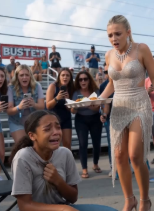
Her jaw tightened. Her eyes fixed on the microphone in my hand. And before I could step back, before I could even understand the fury in her face, the tray flew.
Nachos hit my chest.
The crowd gasped.
Then Savannah laughed once, sharp and breathless.
“Oh, please,” she said loudly. “Don’t look so shocked. This is what happens when people mistake a poverty-case prop for actual talent.”
My face burned hotter than the cheese on my shirt.
Someone whispered, “Savannah.”
She turned toward the bleachers, toward the donors, toward the phones. Her voice rose with the confidence of someone who had never had to wonder whether the room would choose her.
“Everybody knows why she was picked,” Savannah said. “Rich donors love a touching little story. Poor girl, old shoes, hardworking background character. It looks good on video.”
My fingers tightened around the microphone.
I wanted to say I was not a prop.
I wanted to say I had rebuilt the kite-frame plan after the first design failed. I wanted to say I had stayed until almost midnight with Mr. Delling from engineering, testing the main kite’s spine after the coastal wind model showed it would snap above twenty-five miles per hour.
I wanted to say Savannah had not even opened the final design file until two days ago.
But every phone was pointed at me.
Every stare sat heavy on my skin.
And shame has a terrible way of making innocent people feel guilty.
My throat closed.
Savannah stepped closer, lowering her voice just enough that it sounded intimate but still carried through the live microphone.
“Walk away, Antonia,” she said. “Before this gets worse.”
My name in her mouth sounded like something dirty.
Behind her, one of her friends giggled nervously. Another kept filming.
I looked toward my mother.
Her face had gone pale.
That nearly broke me.
I almost walked off the stage. I almost let Savannah have the story she wanted: the poor girl overwhelmed, the sponsor’s daughter restoring order, the crowd relieved not to have to choose between money and truth.
Then a voice cracked through the speakers from somewhere above us.
“Stop the program!”
Everyone turned.
The voice belonged to Jalen Price, a volunteer from the control booth. He was a senior from the tech crew, usually invisible behind headsets and cables. Now his voice echoed through the hall, sharp with panic.
“The final file has Antonia’s initials on it.”
Savannah’s smile died.
The big screen flickered.
For half a second, the Covington Foundation logo glitched, stretching into blue lines.
Then it disappeared.
A project history file opened behind us.
The crowd went silent in a different way.
Not shocked.
Focused.
Line after line appeared on the screen.
A.N. — upload: wind brace revision
A.N. — emergency note: crossbeam stress point
A.N. — late-night fix: spine reinforcement
A.N. — backup file restored
A.N. — frame drawing updated before wind test
My initials.
Again and again.
A tremor moved through my hands.
Savannah backed up like the floor had burned her shoes.
Her father, seated in the front row beside the mayor and three school board members, stood so fast his chair scraped against the floor. He pulled out his phone and started calling someone, his face dark with anger.
But the microphone was still live.
And before anyone could shut it off, Mr. Delling, the volunteer engineer, stepped onto the stage.
He was a tall, gray-haired man with sun-reddened skin and reading glasses hanging from his shirt pocket. He had spent most of the festival moving between the control booth and the launch field, checking weather updates like a sailor reading warnings in clouds.
He took the microphone gently from my frozen hand.
Then he turned to me.
“Antonia,” he said, his voice carrying through every speaker in the hall, “tell the crowd exactly what Savannah deleted from the record.”
The room erupted.
Savannah lunged forward. “No.”
Mr. Covington shouted, “Cut the microphone!”
But nobody did.
Jalen’s voice came from the booth again, shaky but determined. “Audio stays on until Mr. Delling tells me otherwise.”
For the first time all afternoon, Savannah looked truly afraid.
Not embarrassed.
Afraid.
Mr. Delling handed the microphone back to me.
It felt heavier now.
My shirt was stained. My hands were trembling. My mother was crying silently near the back. Savannah’s friends still had their phones raised, but now they were no longer filming my humiliation.
They were filming the crack in Savannah’s perfect story.
I swallowed.
“The first main kite design failed stress testing,” I said.
My voice shook, but it worked.
A murmur spread through the bleachers.
I continued. “The center spine was too light for the coastal wind forecast. If we launched it during the festival, it could have folded midair or broken loose.”
Savannah’s face twisted. “You’re exaggerating.”
Mr. Delling turned toward her. “She is not.”
The screen changed again. A drawing appeared: the main kite frame, twenty feet wide, shaped like a blue heron with silver wing panels. Red circles marked the weak points along the spine.
My drawing.
My notes.
My handwriting.
I could hear people reacting as they recognized what they were seeing.
I pointed at the screen. “I added a reinforced crossbeam here and changed the tension lines here. I uploaded the fix under the backup folder because the main folder was locked.”
“Locked by who?” Principal Vaughn asked from the front row.
Everyone looked at Savannah.
She opened her mouth, but no sound came out.
Mr. Delling answered. “Savannah Covington had administrative access to the showcase folder.”
Mr. Covington snapped, “My daughter was project lead.”
“No,” Mr. Delling said. “Your daughter was presentation lead. The engineering lead was never finalized because the student committee kept changing the documentation.”
Savannah’s voice came back sharp. “Because Antonia kept messing with files she wasn’t authorized to touch.”
I looked at her.
For once, the fear inside me had somewhere to go.
“You told everyone the file corrupted,” I said. “You said my revision disappeared.”
“That’s because it did.”
“No,” Jalen called from the booth. “It was deleted.”
The screen changed again.
An access log appeared.
Savannah Covington — file opened
Savannah Covington — revision hidden
Savannah Covington — contributor name removed
Savannah Covington — backup file deleted
The crowd gasped.
Savannah’s friends lowered their phones slowly.
Her father stopped talking into his phone.
Principal Vaughn stood up. “Savannah?”
Savannah shook her head. “That log is wrong.”
Jalen, still in the booth, said, “It’s from the server backup.”
Savannah spun toward the glass control room above the bleachers. “You had no right to pull that!”
Jalen’s voice came back, stronger now. “You had no right to delete it.”
A cheer rose from somewhere in the bleachers, then faded quickly when Principal Vaughn lifted her hand.
Mr. Delling looked at me again. “Tell them the rest.”
My stomach tightened.
The rest was worse.
Because the deleted record did not only prove I had done the work.
It proved why Savannah needed my name gone.
I took a breath.
“When the first frame failed,” I said, “Savannah told me not to write it in the project notes.”
Savannah barked, “That is a lie.”
I kept going. “She said sponsors did not want to hear about failure. She wanted the final presentation to say her original design worked from the beginning.”
Mr. Delling nodded. “And it did not.”
The big screen switched to a video from the test field three nights earlier.
The main kite prototype lifted into the wind beautifully for about seven seconds.
Then its spine bent.
A loud crack came through the speakers.
The frame collapsed sideways, dragging two guide lines across the grass before volunteers pulled it down.
People in the bleachers recoiled.
The video cut to me kneeling beside the broken frame with a roll of measuring tape, my old shoes planted in the mud, my hoodie sleeves pushed up, my hair falling out of its braid. Mr. Delling stood beside me, pointing at the break. Jalen’s timestamp glowed in the corner.
Savannah was nowhere in the shot.
Then the video switched again.
Me in the storage room at 10:42 p.m., sketching reinforcement angles on cardboard.
Me uploading the backup file at 11:18 p.m.
Me typing a note: DO NOT LAUNCH WITHOUT REINFORCEMENT.
The room was so quiet I could hear a child near the front whisper, “She saved the kite.”
Mr. Delling heard it too.
“Yes,” he said into the microphone. “She did.”
Savannah’s eyes shone with angry tears. “This is ridiculous. It’s a kite festival, not a trial.”
“No,” Principal Vaughn said coldly. “It is a safety issue.”
That word changed everything.
Safety.
Sponsors could ignore credit.
Students could laugh off humiliation.
But safety made adults sit up straighter.
Mr. Delling turned to the crowd. “Without Antonia’s reinforcement, the main kite could have failed during the live release. With the wind speed today, a snapped frame could have injured volunteers, children, or guests near the launch line.”
A wave of murmurs rolled through the hall.
Savannah looked at her father.
This time, he did not rescue her.
He was staring at the screen, at the words backup file deleted, like he had never seen his daughter clearly until that exact moment.
Then Principal Vaughn stepped onto the stage. She was a composed woman with silver hair and a navy blazer, the kind of principal who never raised her voice because she never needed to.
“Savannah,” she said, “did you delete Antonia’s name from the final record?”
Savannah’s lips trembled. “I was cleaning the file.”
“Did you delete the safety note?”
“I thought it was outdated.”
“Did you remove the test failure video?”
Savannah said nothing.
Principal Vaughn’s face hardened. “Answer.”
Savannah looked around the room.
At the phones.
At the screen.
At her father.
At me.
Then she whispered, “It made the project look bad.”
The confession was small, but the microphone caught it.
The entire hall heard.
For a moment, I thought that was the twist.
Savannah humiliated me because I had done the work she wanted credit for.
But then Jalen spoke again from the booth, and the real twist arrived.
“Mr. Delling,” he said slowly, “there’s another file.”
Savannah’s head snapped up.
Mr. Covington said, “What file?”
Jalen did not answer him. The screen changed.
A folder appeared titled DONOR PRESENTATION FINAL.
Inside was a video file.
Savannah moved so fast that two teachers stepped forward to block her path.
“Don’t play that,” she said.
Nobody spoke.
Principal Vaughn looked toward the control booth.
“Play it,” she said.
The video opened with a black screen, then Savannah appeared in the storage room, filmed from the corner security camera. She was alone at first, pacing beside the half-repaired main kite. Her phone was pressed to her ear.
Her voice came through the hall speakers.
“Dad, I can’t just put her name on it. That ruins everything.”
The crowd froze.
Mr. Covington’s face drained of color.
On the video, Savannah listened, then snapped, “Because she looks like charity. That’s the whole point. She’s supposed to be in the background, not holding the ribbon.”
My stomach twisted.
The video continued.
Savannah kicked one of the loose kite rods lightly with her sandal.
“I know the donors like hardship stories,” she said into the phone. “But they like them managed. They like them grateful. If Antonia gets credit, people will ask why I was project lead when she did the fix.”
Mr. Covington stood absolutely still.
His mouth was slightly open.
On the video, Savannah listened again.
Then she said the sentence that made every person in the hall turn toward her father.
“You said the Covington name has to stay on the save.”
The sound seemed to leave the world.
Savannah looked at her father with terror and betrayal, as if the video had exposed both of them, but only one of them had expected it.
Mr. Covington took one step back.
“I did not mean erase her,” he said.
His voice was not on the microphone, but the front rows heard him.
Then the microphone on stage picked up Principal Vaughn’s reply.
“But you told your daughter the Covington name had to stay on the save?”
He looked trapped. “I meant the foundation needed good press. The festival almost lost insurance approval after the failed test. We needed confidence restored.”
Mr. Delling stared at him. “So you knew about the failed frame.”
Mr. Covington rubbed a hand over his face. “Savannah told me there was a technical issue.”
“And instead of reporting the safety correction accurately,” Principal Vaughn said, “you encouraged a sponsor-branded version of events.”
“I encouraged my daughter to protect the festival.”
“No,” I said.
My voice surprised even me.
Everyone looked at me.
I stepped forward, nacho stains drying stiff against my hoodie.
“You encouraged her to protect the story,” I said. “Not the festival.”
Mr. Covington looked at me as if he wanted to argue.
But he could not.
The evidence was glowing twenty feet tall behind us.
Savannah began crying then. Not delicate tears. Not performance tears. Real ones. Messy, furious, humiliated.
“I did everything you wanted,” she said to her father. “Everything. You said if the festival looked perfect, the board would approve the coastal youth lab. You said I had to be the face of it.”
Mr. Covington whispered, “Savannah.”
“No,” she said, voice breaking. “You always do this. You say it’s for the community, but it has to be our name, our photo, our speech, our perfect story.”
For the first time, I saw something I had never expected to see in Savannah Covington.
A girl crushed under the same spotlight she had tried to steal.
It did not excuse what she had done.
It did not unthrow the food.
It did not erase her words.
But it made the room more complicated.
And real stories always become more painful when they stop being simple.
Principal Vaughn took the microphone.
“The main kite release is paused,” she announced. “The safety record will be reviewed publicly before any launch. Mr. Covington, Savannah, please come with me.”
Savannah looked at me.
Her face crumpled.
“I’m sorry,” she whispered.
I could not answer.
Not yet.
She followed Principal Vaughn down the stage steps. Her father walked behind her, no longer making calls.
The hall stayed silent after they left.
Then my mother pushed through the crowd.
She climbed the stage stairs without waiting for permission and wrapped her arms around me, nacho stains and all.
“Mija,” she whispered, though we were not Spanish by blood; she had picked up the word from coworkers and used it whenever love made English too small. “You stayed standing.”
That broke me.
I cried into her shoulder in front of everyone.
This time, no one laughed.
The festival did not end that day.
It changed.
Mr. Delling spent twenty minutes on stage explaining the corrected kite design, not as a scandal, but as a lesson. He showed where the frame had failed and how the reinforcement worked. He said engineering was not about never being wrong. It was about telling the truth fast enough to keep people safe.
Then he turned to me.
“Antonia,” he said, “will you explain your fix?”
My hands went cold again.
“I look terrible,” I whispered.
My mother squeezed my shoulder. “You look like the person who saved the kite.”
So I stood in front of the crowd with salsa on my hoodie and talked about crossbeams, wind force, tension lines, and why the original frame snapped.
At first, my voice shook.
Then it steadied.
By the time I finished, people were not looking at my clothes anymore.
They were looking at the design.
At the work.
At me.
Outside, the wind had softened but stayed strong enough for launch. After the safety review, Mr. Delling approved the release. Principal Vaughn asked if I still wanted to do it.
I looked toward the main kite lying across the field, blue and silver wings spread like a sleeping bird.
Part of me wanted to say no. Part of me wanted to go home, shower, hide under a blanket, and never see another phone camera again.
But then I saw the children lined up along the rope barrier, waiting.
I saw Jalen giving me two thumbs up from the control booth window.
I saw my mother crying and smiling at the same time.
And I thought about Savannah saying I was supposed to stay in the background.
“No,” I said softly. “I don’t want to do it alone.”
Mr. Delling nodded. “Who do you want with you?”
I looked at the volunteers who had helped quietly for weeks. The kids who tied tail ribbons. The parents who sorted supplies. The janitor who unlocked the storage room for late repairs. Jalen, who had saved the backup. My mother, who had driven me to school before dawn even after night shifts.
“All of them,” I said.
So that was how the main kite rose.
Not in the hands of a sponsor’s daughter.
Not in one perfect photo.
But with twenty people holding the line together while the wind pulled the blue heron upward.
For one terrifying second, the frame flexed.
My heart stopped.
Then the reinforced spine held.
The kite climbed.
Higher.
Higher.
The crowd erupted.
I looked up until my eyes watered from the bright coastal sky.
For the first time all day, I forgot the stains on my clothes.
The kite did not know who had money. It did not know who had old shoes. It did not know whose name looked better on a sponsor banner.
It only knew the truth of its own frame.
If the structure was honest, it could fly.
Two weeks later, the Covington Foundation issued a public apology and withdrew its name from the youth engineering lab. Mr. Covington resigned from the festival board after the school district found that sponsor influence had affected project documentation. He still donated the money, but the lab was renamed the Coastal Student Design Lab.
No family name.
No plaque larger than the work.
Savannah was removed from leadership and required to complete a restorative accountability process. She wrote apology letters to the volunteer team, the school, and me. I did not read mine for three days.
When I finally opened it, I expected excuses.
Instead, I found six pages.
She admitted what she had done. She admitted she had deleted my name, hidden the safety note, and humiliated me because she could not stand being exposed as the face of work she had not done. She wrote that her father had pressured her, but that pressure did not make her cruel words mine to carry.
At the end, she wrote:
I called you a prop because I was terrified that without my family name, I was the one with nothing real to show.
I read that sentence twice.
Then I folded the letter and put it in my desk.
Not because everything was okay.
Because the truth deserved to be kept.
By spring, the Coastal Student Design Lab opened in a refurbished classroom near the gym. Mr. Delling volunteered twice a week. Jalen ran the digital archive. I became one of the first student mentors, which was funny because I still felt nervous every time someone called me an expert.
On opening day, Principal Vaughn hung a framed copy of the kite-frame drawing near the door.
The one with my initials.
Under it, a small plaque read:
DESIGN SAVED BY ANTONIA NELSON AND THE FESTIVAL VOLUNTEER TEAM.
ALWAYS KEEP THE RECORD WHOLE.
My mother took a picture of me standing beside it.
My shoes were still old.
But they were clean.
Savannah came to the opening but stayed near the back. She looked thinner somehow, quieter, wearing jeans and a plain sweater instead of sponsor colors. When the crowd thinned, she approached me.
“I’m not asking you to forgive me,” she said.
I looked at her for a long moment. “Good.”
She nodded, accepting it.
“I’m working with the middle school kite club now,” she said. “Not leading. Just helping.”
“That’s probably good for you.”
A small, sad smile touched her face. “Yeah. It is.”
She looked at the framed drawing.
“You really did save it,” she said.
I followed her gaze. “We saved it.”
Her eyes filled.
Maybe one day I would forgive her.
Maybe I would not.
But that day, I let the sentence stand between us, not as a gift, but as a boundary.
We saved it.
Meaning the work mattered more than the spotlight.
Meaning the truth belonged to everyone who protected it.
Meaning no one got to erase the quiet hands behind a public success again.
Months later, when the next Festival Coastal Kite was announced, the committee asked me to design the student showcase system. Every upload would show contributor initials, timestamps, revisions, and safety notes. Nothing could be deleted without review.
Jalen called it “Antonia-proofing.”
I told him that sounded like I was the problem.
He grinned. “No. It means the problem can’t survive you.”
On the day of the new festival, the main kite flew again. The blue heron had been repaired, repainted, and strengthened. This time, beneath one wing, in tiny letters almost invisible from the ground, the volunteer team had written every contributor’s initials.
Mine were there.
So were Jalen’s.
So were Mr. Delling’s.
And, after a long committee vote, so were Savannah’s, beside the words documentation recovery volunteer.
Some people disagreed with that.
I understood why.
But I had learned something from broken frames.
A structure becomes stronger when the repaired places are not hidden.
When the kite rose into the Virginia sky, the crowd cheered. Phones lifted again, but this time I did not flinch.
My mother stood beside me, holding the launch rope with both hands.
“You ready?” she asked.
I looked up at the kite, bright and steady against the wind.
Then I smiled.
“I already am.”
Because Savannah had tried to turn me into a humiliating little story.
A poor girl. A prop. A background helper lucky enough to be noticed.
But the record told the truth.
I had seen the weak point.
I had fixed the frame.
And when the wind came hardest, the thing I built did not break.
THE END
