The mashed potatoes were still sliding down my cheek when I realized the whole school had already decided I was guilty.
Not because they had proof.
Not because they had listened.
Not because anyone had looked at the dress, the sewing table, the supply log, the receipt folder, or the tiny camera mounted above the fashion classroom for project security.
They had decided because Brielle Kensington cried first.
That was all it took.
At Westbridge High, truth did not travel faster than popularity. Truth walked. Popularity sprinted in designer shoes, holding a phone, already knowing which angle made it look innocent.
My name is Mila Kovac. I was seventeen, Croatian American, and the kind of student most people did not notice unless they needed something fixed. A torn hem. A club poster. A missing spreadsheet. A costume emergency ten minutes before a school performance. I was not invisible exactly, but I was useful in a way that made people forget usefulness came from a person.
That afternoon, I stood in the fashion classroom wearing a faded black long-sleeve shirt, loose jeans with a paint stain near one knee, and sneakers I had repaired myself with fabric glue because buying new ones could wait until after college application fees. My dark hair was tied back with a pencil because I had misplaced my clip during lunch. My fingers smelled faintly of thread wax and recycled denim.
I had come to check the display rack for the Eco-Fashion Showcase.
The showcase was supposed to be simple. Each senior team created a wearable piece from recycled materials, then presented it in front of parents, donors, teachers, and the student body. The winning design would receive a local arts scholarship, and the school would post the top three looks on its official page.
For someone like Brielle Kensington, the showcase was another stage.
For me, it was a chance.
My mother worked mornings at a bakery and evenings doing alterations from our apartment. My father drove freight routes across the state and came home with road dust in his jacket seams. I had learned sewing at our kitchen table before I learned algebra properly. I knew how to take apart an old curtain and turn it into a skirt, how to reinforce a zipper, how to hide a repair so cleanly that nobody noticed there had ever been a tear.
I wanted that scholarship.
I needed that scholarship.
Brielle wanted the photo.
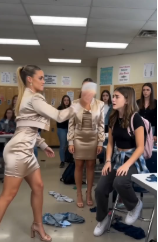
She was eighteen, privileged in that polished, effortless way that never looked accidental. That day, she wore a champagne silk dress, a cropped jacket, and tiny diamond earrings that caught the classroom light every time she moved her head. Her hair fell in soft waves over her shoulders, and even her outrage looked styled.
Her recycled dress hung in the center of the room.
It was beautiful, I had to admit that.
The bodice was made from layered scraps of pale satin and translucent packaging film, arranged to look like petals. The skirt had strips of old formalwear braided into waves. It was dramatic and delicate, the kind of dress that looked expensive even when the label said “sustainable.”
But it had one problem.
The back zipper was gone.
Not broken.
Gone.
The whole zipper had been removed from the seam, leaving neat little needle holes where it used to be attached. Someone had picked it out carefully, thread by thread, then tugged it free.
By the time I arrived, Brielle was standing beside the dress with one hand over her mouth while her friends formed a protective wall around her.
“She was the last one near it,” someone whispered.
“Mila handles the sewing kits.”
“She asked about the file earlier.”
“She wanted Brielle disqualified.”
My name moved around the room like a stain spreading through water.
I stopped near the supply cabinet.
“What happened?” I asked.
Brielle turned slowly, as if she had been waiting for my voice.
Her eyes were already wet.
“You know what happened.”
I looked at the dress. “The zipper was removed.”
Her mouth trembled.
“Don’t say it like you just noticed.”
A few students lifted their phones higher.
I felt my stomach drop.
“Brielle, I didn’t touch your dress.”
She gave a soft, wounded laugh. “You didn’t touch it? Mila, you were at the sewing table during lunch.”
“So were six other people.”
“But you’re the one who complained about the judging rubric.”
“I asked Ms. Porter if repair work counted in construction difficulty,” I said. “That had nothing to do with your dress.”
Brielle stepped closer.
The room seemed to tighten around us.
“You hated that my design was getting attention.”
I almost laughed, but there was no air in me.
“I was trying to finish my own project.”
“You mean your little patchwork jacket?” one of her friends said.
A few people snickered.
My face burned.
My project was not little. It was a reconstructed coat made from old denim, torn choir robes, broken umbrellas, and embroidered scraps from my mother’s alteration bin. Every panel meant something. Every stitch had been intentional. It was about immigrant hands, repair, survival, and the beauty of making something last after the world decided it was disposable.
But I knew better than to explain art to people who had already decided I was a villain.
“I want Ms. Porter,” I said.
Brielle’s expression shifted.
Just for half a second.
Fear.
Then anger covered it.
“Of course you do,” she said. “You always run to records and logs like that makes you better than everyone.”
“No,” I said, trying to keep my voice steady. “It makes things clear.”
Her eyes flicked toward the sewing table.
That was when I remembered the camera.
Two weeks earlier, Ms. Porter had installed a small classroom camera above the main worktable after several expensive supplies went missing. It did not record audio, and it only faced the sewing area, not the changing corner or student desks. Everyone knew it was there. Everyone had signed the classroom notice.
Everyone except Brielle, apparently, seemed to have forgotten.
I turned toward Ms. Porter, who had just entered from the hallway with an armful of fabric boards.
“Ms. Porter,” I said quickly, “please check the sewing-table camera. And the kit log. And the receipts.”
The room went quiet.
Not fully quiet.
The kind of quiet that means people have suddenly realized a story might not end where they expected.
Brielle’s face hardened.
“You’re unbelievable.”
“I’m asking for proof.”
“You’re trying to humiliate me.”
“I’m trying not to get punished for something I didn’t do.”
Her hand tightened around the paper plate she was holding.
I had not even noticed the plate until then.
The fashion classroom had a refreshment table near the windows because parents were arriving later for the showcase preview. There were cookies, lemonade, fruit cups, and a tray of mashed potatoes left over from the culinary club’s sustainable-food demo next door. Brielle had a scoop of mashed potatoes on a compostable plate, probably untouched because eating in front of cameras did not fit her image.
She moved before Ms. Porter could step between us.
One second, I was standing there with my hands visible.
The next, cold mashed potatoes hit my face.
They splattered across my cheek, nose, mouth, and shirt. A heavy lump slid down my chin and landed on my sleeve. Someone gasped. Someone else laughed before stopping quickly. My eyes stung, not from pain, but from shock and humiliation so sharp it felt like pain.
For a moment, I could not move.
The whole room blurred behind the pale mess on my eyelashes.
Phones were recording.
Of course they were recording.
Brielle stood in front of me breathing hard, her perfect champagne dress untouched, her diamond earrings shining like punctuation marks at the end of my shame.
“Maybe now you’ll stop lying,” she said.
Ms. Porter’s voice cut through the room.
“Brielle Kensington. Step back.”
Brielle blinked like she had forgotten adults existed.
“She sabotaged me.”
“Step. Back.”
I wiped my mouth with the back of my hand and tasted salt, butter, and humiliation.
I wanted to disappear.
I wanted the floor to open.
I wanted to run to the bathroom, lock the door, and cry until the showcase ended without me.
But if I left, the video would become the story.
Mila got food dumped on her because she ruined Brielle’s dress.
Mila ran away when they asked for proof.
Mila was guilty.
So I stood there with mashed potatoes on my face and kept my eyes on Ms. Porter.
“Please open the record,” I said.
My voice shook.
But it did not break.
Ms. Porter looked at me for one long second. Her face softened, then turned firm in a way that made the room straighten.
“All phones down,” she said.
Nobody moved.
“Now.”
A few phones lowered.
Not all.
Ms. Porter walked to the classroom computer connected to the display screen. Her movements were controlled, but I could tell she was angry. Not loud angry. Teacher angry. The kind that meant consequences were already forming in complete sentences.
Brielle crossed her arms.
“This is ridiculous,” she said. “You’re really going to investigate me when my dress is destroyed?”
Ms. Porter did not look away from the computer.
“I am going to investigate what happened to a student project in my classroom.”
“My project.”
“A student project,” Ms. Porter repeated.
The screen lit up.
The Westbridge High logo appeared, then the classroom security folder. Ms. Porter entered her staff password. The room stayed frozen around us.
My friend Tessa pushed through the edge of the crowd and reached me with a handful of paper towels.
“Oh my gosh, Mila,” she whispered.
I took them, but I did not wipe everything off. I could not explain why. Maybe because cleaning my face felt like admitting the worst part was over.
It was not.
Ms. Porter opened the supply log first.
The fashion program had a check-in system for sewing tools after several blades and specialty items went missing. Each student signed out supplies with the time and project table number.
The log appeared on the screen.
10:42 a.m. — Mila Kovac, denim thread, seam ripper, measuring tape.
11:03 a.m. — Tessa Grant, fabric shears.
11:18 a.m. — Brielle Kensington, champagne thread, invisible zipper foot.
11:21 a.m. — Brielle Kensington, seam ripper.
11:23 a.m. — Brielle Kensington, replacement zipper kit.
A murmur moved through the room.
Brielle’s eyes widened.
“That’s wrong.”
Ms. Porter clicked the entry.
The digital signature expanded.
Brielle Kensington.
Her student ID.
Her timestamp.
Her project table.
Brielle laughed once, too high.
“Someone used my account.”
Ms. Porter’s voice stayed even. “The supply cabinet requires student ID scan.”
“Then someone had my ID.”
“Did you report it missing?”
Brielle’s lips parted.
No answer.
Ms. Porter opened the receipt folder next.
The fashion program required receipts for any new materials purchased after the official material deadline. Replacement supplies were allowed only if logged and approved.
A scanned receipt appeared.
HARRIS FABRIC & NOTIONS
Invisible zipper, champagne, 22 inches
Purchased: 11:37 a.m.
Payment: Kensington family card ending 9021
Customer name: Brielle Kensington
The room made that sound again.
The one people make when a lie starts losing oxygen.
My heartbeat pounded in my throat.
Brielle shook her head.
“No. No, I bought that because mine broke.”
“When did it break?” Ms. Porter asked.
“This morning.”
“Why didn’t you report it?”
“I was going to.”
“But instead, you accused Mila of removing your zipper.”
Brielle looked toward her friends.
None of them spoke.
That was the cruel thing about popularity. It felt like an army until the first real consequence appeared. Then everyone became a witness.
Ms. Porter opened the camera folder.
Brielle stepped forward.
“You can’t show that in front of everyone.”
Ms. Porter paused.
“You were willing to accuse Mila in front of everyone.”
“That’s different.”
“No,” Ms. Porter said. “It is not.”
She clicked play.
The video had no sound.
The angle showed the main sewing table from above. The timestamp in the corner read 11:19 a.m.
At first, the screen showed ordinary classroom movement. Students cutting fabric. Someone carrying a mannequin torso. Me at the far left table, bent over my denim coat, measuring the curve of a sleeve. Tessa beside me, threading a needle.
Then Brielle entered the frame.
Her champagne dress was draped over her arm.
She looked around once.
Then she placed it on the sewing table.
My stomach tightened.
On the screen, Brielle opened a small kit. She took out a seam ripper. Slowly, carefully, she turned the dress inside out. The zipper seam faced the camera.
The whole room watched her begin to cut the stitches.
One by one.
Neat.
Patient.
Deliberate.
No accident.
No panic.
No broken zipper.
She removed her own zipper.
In the video, she rolled the original zipper into a scrap of fabric and slipped it into her jacket pocket. Then she took out her phone, snapped a picture of the damaged seam, and walked out of frame.
Ms. Porter stopped the video.
For several seconds, nobody breathed.
The mashed potatoes had dried cold on my shirt.
Brielle looked smaller now.
Not innocent.
Smaller.
Ms. Porter turned to her.
“Explain.”
Brielle’s mouth opened, but no words came.
One by one, the students who had been recording lowered their phones.
The same phones that had risen so quickly for my humiliation now sank like they had become too heavy to hold.
Ms. Porter clicked another file.
A second clip appeared.
11:41 a.m.
Brielle returned with a small paper bag from Harris Fabric & Notions. She removed a new zipper, held it against the dress, then put it back in the bag without installing it. She looked toward the door.
Then she placed the bag under a stack of muslin near my work area.
A chill moved through me.
There it was.
The plan.
Not an emotional mistake. Not a misunderstanding.
A setup.
Ms. Porter stopped the video.
The classroom stayed silent.
Then Tessa said, quietly but clearly, “She planted it near Mila.”
Brielle snapped, “Shut up.”
Ms. Porter’s voice became steel.
“Brielle. Do not speak to another student that way.”
Brielle’s face twisted.
“You don’t understand.”
“Then explain.”
Her eyes filled with tears again, but this time they did not command the room. They only revealed that the performance had failed.
“I needed time,” she whispered.
“For what?” Ms. Porter asked.
Brielle looked at the dress.
Then at me.
And suddenly, I understood something that made my anger shift into confusion.
She was not looking at me like she hated me.
She was looking at me like I had been standing in front of something she was desperate to hide.
Ms. Porter folded her arms.
“Brielle.”
“My dress wasn’t fully recycled,” Brielle said.
The words came out barely audible.
Someone whispered, “What?”
She swallowed.
“My mother had part of it made.”
The room shifted again.
Brielle kept talking now, faster, like once the truth started, she could not stop it.
“She hired a private seamstress to rebuild the bodice after my first design collapsed. I told her that wasn’t allowed, but she said everyone gets help and only stupid people follow rules when scholarships are involved.”
My throat went dry.
Brielle’s eyes flicked to the camera.
“The zipper was the only part that still had the seamstress’s tag on the inside. If judges looked closely, they’d see it. So I removed it. I was going to replace it before the preview.”
“Then why blame Mila?” Tessa demanded.
Brielle looked at the floor.
“Because she asked for the process files.”
I remembered.
That morning, I had asked Ms. Porter whether all students’ design journals would be visible to the judging panel. I asked because my own journal included sketches of my mother’s embroidery patterns, and I wanted to credit her properly without violating the outside-help rule.
Brielle had been standing by the printer.
Listening.
“You thought I’d notice,” I said.
She did not answer.
But she did not have to.
Ms. Porter closed the video window.
“This showcase is paused,” she said. “Brielle, you are coming with me to the office. Mila, you may go clean up, and then I’d like you to meet us with an administrator.”
Brielle’s head snapped up.
“Why does she need to be there?”
“Because you publicly accused her, physically humiliated her, and attempted to place evidence near her workspace.”
Brielle went pale.
The words sounded bigger when an adult said them.
Attempted to place evidence.
That was not drama.
That was a record.
As Ms. Porter led Brielle toward the door, Brielle’s friends moved aside. None of them touched her arm. None of them said it would be okay. Their silence followed her out like a punishment.
I finally wiped my face.
The paper towels came away thick with mashed potatoes and melted butter. My hands shook so badly that Tessa had to take over.
“I should’ve said something sooner,” she whispered.
“You didn’t know.”
“I knew they were being awful.”
“That’s not the same thing.”
She looked at me with tears in her eyes.
“It should’ve been enough.”
I did not know what to say to that.
In the bathroom, I washed my face until my skin turned red. I scrubbed at my shirt with damp paper towels, but a pale stain remained across the front like a ghost of what had happened.
For a moment, alone under the buzzing fluorescent light, I leaned both hands on the sink and let myself shake.
I had not cried in the classroom.
I had not cried when the video played.
But now, with no cameras pointed at me, my eyes burned.
Not because of the potatoes.
Because for those first few minutes, before the proof loaded, almost everyone had believed I was capable of doing something cruel.
That was the part nobody apologized for quickly enough.
The accusation had fit too easily.
Poor girl wants scholarship. Poor girl damages rich girl’s dress. Poor girl gets jealous. Poor girl gets desperate.
They did not need evidence because the story already had a shape they recognized.
I looked at myself in the mirror.
My face was clean now, but my eyes were not.
“Don’t disappear,” I whispered.
It was something my grandmother used to say in Croatian when I was little and shy, hiding behind my mother’s skirt at family gatherings.
Ne nestaj.
Don’t disappear.
So I went to the office.
Brielle was sitting outside Assistant Principal Monroe’s door with her arms wrapped around herself. Her mother stood beside her, typing furiously on her phone.
Mrs. Kensington looked exactly like the kind of parent who believed rules were for people without lawyers. Tall, elegant, wearing a white coat draped over her shoulders and sunglasses on her head though we were indoors. When she saw me, her eyes flicked over the stain on my shirt, then away, as if I were an unpleasant detail in a room she expected to control.
“This has become completely overblown,” she said.
Ms. Porter stood near the desk, jaw tight.
Assistant Principal Monroe opened his office door.
“Mila, come in.”
Mrs. Kensington stepped forward.
“I don’t see why she needs to be part of a private family matter.”
Mr. Monroe looked at her calmly.
“Because she was the student your daughter accused.”
“She is also the student escalating this.”
I stopped walking.
For a second, I felt seventeen in the worst way. Too young to argue with an adult. Too tired to defend my existence.
Then Ms. Porter said, “Mila asked for records. Records are not escalation.”
Mrs. Kensington smiled coldly.
“Of course you would say that. You’ve always favored the scholarship children.”
Something in the office changed.
Mr. Monroe’s expression went flat.
Brielle closed her eyes.
I realized then that Brielle had learned her cruelty fluently from someone else’s mouth.
Inside the office, the facts were reviewed.
The supply log.
The receipt.
The sewing-table video.
The planted bag.
The outside seamstress.
The accusation.
The food dumped on me.
Brielle barely spoke. Her mother spoke too much.
She insisted the outside seamstress had only “consulted.” She said the zipper removal was “design adjustment.” She said the mashed potatoes were “unfortunate emotional behavior between girls.” She suggested I had provoked Brielle by “creating a hostile atmosphere of suspicion.” She said the scholarship committee would look ridiculous if it disqualified one of the strongest designs over “technicalities.”
Mr. Monroe listened.
Then he said, “Mrs. Kensington, your daughter violated showcase rules, falsely accused another student, attempted to mislead staff, and physically humiliated a peer in front of witnesses.”
Mrs. Kensington’s lips tightened.
“I’ll be speaking to the principal.”
“I expect you will.”
“And the district.”
“You’re welcome to.”
“And our attorney.”
Mr. Monroe nodded.
“Then I recommend you request the full evidence packet.”
For the first time, Mrs. Kensington had no immediate answer.
Brielle stared at her hands.
Then, quietly, she said, “Mom, stop.”
Her mother turned.
“Excuse me?”
“Stop,” Brielle repeated, louder this time.
Mrs. Kensington looked offended, not concerned.
“You are emotional.”
“I’m guilty.”
The room went still.
Brielle’s voice trembled, but she kept going.
“I removed the zipper. I hid the receipt. I blamed Mila. I threw food at her. And you told me to do whatever I needed to do because losing to her would be embarrassing.”
Mrs. Kensington’s face changed.
Not with shame.
With fury.
“Brielle.”
“No,” Brielle said. Tears spilled down her cheeks. “You said if a girl like Mila won, people would start asking why you paid so much for my private lessons.”
A girl like Mila.
The words landed hard, but not unexpectedly.
I had heard versions of them my whole life. Cleaner versions. Smiling versions. Whispered versions.
Mrs. Kensington looked at Mr. Monroe.
“My daughter is under stress.”
Brielle laughed once, broken.
“I’m under you.”
Nobody spoke.
That was the moment the story became bigger than a zipper.
The school investigation lasted a week.
Brielle was disqualified from the Eco-Fashion Showcase. She received disciplinary consequences for the false accusation and the food incident. Mrs. Kensington’s complaint to the principal went nowhere because the evidence packet was too clean, too complete, too impossible to spin.
But the school had another problem.
The showcase had been damaged. Half the students were afraid the event would be canceled. Sponsors had heard rumors. Parents were emailing. The fashion program looked messy, and schools hate mess when donors are watching.
At first, I thought they would quietly move on.
Instead, Ms. Porter did something I did not expect.
She called an emergency meeting for all showcase participants.
We gathered in the auditorium, nervous and whispering. Brielle was not there. Her empty seat near the front felt louder than her presence would have.
Ms. Porter stood onstage beside Principal Ellis.
“The showcase will continue,” she said. “But judging will include a new category: process integrity. Your design journals, supply records, repair notes, and material sourcing will matter as much as the final garment.”
A murmur moved through the room.
Then Principal Ellis stepped forward.
“We also owe an apology to Mila Kovac.”
My body stiffened.
I hated public attention. I wanted apologies, yes, but private ones. Real ones. Not school announcement apologies polished until nobody felt responsible.
Principal Ellis looked directly at the students.
“Many of you witnessed an accusation before evidence was reviewed. Some of you recorded humiliation instead of seeking help. This is not the community we claim to be.”
A few heads lowered.
Good.
Let them feel it.
Then Ms. Porter said, “Mila, only if you are comfortable, we would like your project to close the showcase.”
My heart stopped.
Close the showcase?
That was the final slot. The one everyone remembered.
I looked at Tessa.
Her eyes were wide.
I looked back at Ms. Porter.
“I don’t know if my coat is ready.”
Ms. Porter smiled gently.
“Then we’ll help you make it ready.”
For the next four days, the fashion classroom changed.
Students who had whispered my name now asked if they could press seams, organize thread, or cut labels. Some apologies were awkward. Some were late. Some sounded like people trying to make themselves feel better.
But a few were real.
A junior named Hannah came up to me while I was reinforcing the coat lining.
“I recorded,” she said.
I kept sewing.
“I deleted it,” she added.
I still did not look up.
“I’m sorry I didn’t put my phone down sooner.”
My needle paused.
“Why didn’t you?”
She swallowed.
“Because everyone else was recording.”
That answer was not noble.
But it was true.
I nodded once.
“Don’t let that be enough next time.”
She whispered, “I won’t.”
My coat came together slowly.
The outside was made from old denim in different shades of blue, arranged like storm clouds. The lining came from torn choir robes, deep burgundy and gold. Along the cuffs, I embroidered small patterns inspired by Croatian folk designs my grandmother had stitched onto tablecloths when she first came to America. Inside the collar, hidden unless the coat opened, I stitched a phrase in red thread.
NE NESTAJ.
Don’t disappear.
My mother helped me finish the final embroidery the night before the showcase. We sat at our kitchen table under the yellow light, thread spools scattered between mugs of tea.
She touched the coat carefully.
“This is not just clothing,” she said.
“I know.”
“It is testimony.”
I smiled faintly. “That sounds intense.”
“It should be intense.” She looked at me. “They tried to make you small in front of everyone.”
My throat tightened.
“And you stood there covered in potatoes.”
I groaned. “Mama.”
“What? It is true.”
We both laughed, and somehow that laughter stitched something inside me back together.
The night of the showcase, the auditorium was packed.
Parents filled the aisles. Students crowded the back wall. Judges sat at a long table with clipboards. A local news blogger had come because the school was trying to turn the controversy into a story about accountability and sustainable fashion.
I stood backstage wearing black leggings and a fitted shirt so the coat would stand out. My hands were cold.
Tessa adjusted the collar.
“You okay?”
“No.”
“Good. That means you’re alive.”
I gave her a look.
She grinned. “Inspirational, right?”
Before I could answer, I saw Brielle.
She stood near the backstage entrance, wearing plain black pants and a sweater. No champagne silk. No diamonds. No protective circle of friends. Her face was pale, but her eyes were clear.
My whole body tensed.
“I’m not here to ruin anything,” she said quickly.
Tessa stepped closer to me.
Brielle looked at her, then back at me.
“I asked Ms. Porter if I could help backstage. She said only if you were okay with it.”
I almost said no.
I had every right to say no.
Then I noticed what she was holding.
A garment repair kit.
Not fancy. Not new. Just needles, thread, safety pins, tape, chalk, scissors.
Her hands trembled around it.
“I owe you more than an apology,” she said. “But I’m starting with not running away.”
I studied her face.
There was no audience back here. No phones. No mother beside her. No reason to perform.
“What did your mom say?” I asked.
Brielle’s mouth tightened.
“A lot.”
“And?”
“And I’m staying with my dad for a while.”
I did not know what to say.
She looked down.
“I’m not asking you to forgive me.”
“Good,” I said.
A tiny, sad smile touched her mouth.
“I deserved that.”
“Yes.”
She nodded.
Then, after a pause, she said, “Your coat is beautiful.”
I waited for jealousy in her voice.
There was none.
Only grief.
“Thank you,” I said.
When my name was finally called, the auditorium lights felt too bright. I walked onto the stage wearing the coat, each step loud in my ears. At first, I could not see the audience, only darkness beyond the light.
Then I opened the coat slightly so the lining flashed burgundy and gold.
A hush moved through the auditorium.
I began my presentation.
“My design is called Repair Is Not Shame,” I said.
My voice echoed.
I thought it would shake.
It did not.
“It is made from discarded denim, broken umbrellas, damaged choir robes, and fabric scraps from my family’s alteration work. I wanted to make something that showed what happens when materials are not thrown away just because someone else decides they are no longer perfect.”
I turned, showing the back panel where denim pieces curved like wings.
“My grandmother used to say, ‘Don’t disappear.’ She meant that when the world overlooks you, you must still leave evidence that you were there.”
I looked toward the judges.
“This coat is evidence.”
For a second, the room was silent.
Then applause rose.
Not explosive at first. It grew. Layer by layer. Students. Parents. Teachers. The back wall. The balcony. Ms. Porter stood with tears in her eyes.
I saw my mother in the third row, both hands pressed to her mouth.
I saw my father beside her, home early from a route, still wearing his work jacket.
And near the backstage curtain, I saw Brielle clapping.
Quietly.
Without trying to be seen.
The judges deliberated for twenty minutes.
It felt like twenty years.
When they returned, Principal Ellis announced third place, then second.
My name had not been called.
I told myself it was fine. Being able to present had been enough. Clearing my name had been enough. Standing there without disappearing had been enough.
Then Ms. Porter took the microphone.
“And the first-place winner of the Westbridge Eco-Fashion Showcase, recipient of the Art Futures Scholarship, is…”
She paused.
My heart slammed once.
“Mila Kovac, for Repair Is Not Shame.”
The auditorium erupted.
Tessa screamed so loudly I almost missed my own name.
I walked onto the stage in a blur. Ms. Porter hugged me before handing me the certificate. My mother was crying. My father was crying but pretending not to by rubbing his forehead.
The scholarship amount was printed at the bottom.
Five thousand dollars.
Five thousand dollars toward school.
Toward fabric.
Toward a future I could almost touch.
But the final twist came after the awards, when the judges asked to speak with me privately.
One of them was a woman named Adrienne Shaw, the director of a local sustainable design nonprofit. She held my process journal in her hands.
“Mila,” she said, “your documentation is extraordinary.”
I laughed nervously. “I’m kind of obsessed with records now.”
She smiled. “Good. Fashion needs people obsessed with records. Especially ethical fashion.”
I did not understand where she was going.
Then she said, “We partner with a summer youth design lab. Paid internship. Studio access. Mentorship. College portfolio support. We’d like to offer you a spot.”
My mouth opened.
No sound came out.
My mother grabbed my arm.
Adrienne continued, “Your coat is beautiful, but your process is what convinced us. You know how to tell the truth through materials.”
Truth through materials.
I thought about the missing zipper. The planted receipt. The camera. The mashed potatoes. The way the room had turned on me before the proof loaded.
Then I thought about my grandmother’s words stitched inside my collar.
Don’t disappear.
I looked at Adrienne.
“Yes,” I said. “Absolutely yes.”
Later, after everyone had gone home, I returned to the fashion classroom to get my bag.
The room was quiet now. No crowd. No phones. No accusations. Just sewing machines, scraps of thread, empty chairs, and the faint smell of steam from the iron.
On the main table sat a small envelope with my name on it.
MILA.
I opened it carefully.
Inside was a handwritten note from Brielle.
I know sorry does not undo what I did. I blamed you because I was scared of losing, scared of my mother, and scared that without the perfect image, there would be nothing impressive about me. But you were never my enemy. You were the person I should have learned from. I told the judges the full truth about the dress, the seamstress, and the zipper. I also told Ms. Porter that the first time I ever understood real design was watching you turn scraps into something honest. I hope someday I become brave enough to make something honest too.
Under the note was the original champagne zipper.
The one she had removed.
The one that started everything.
For a long time, I just stared at it.
Then I did something I did not expect.
I took it home.
Not as a trophy.
Not as forgiveness.
As a reminder.
A zipper is supposed to close something.
Hide the seam.
Hold the shape.
Keep the inside from showing.
But this zipper had done the opposite.
Once removed, it opened everything.
The cheating.
The pressure.
The classism.
The cruelty.
The fear.
The truth.
Weeks later, I stitched that zipper into a new piece for my summer portfolio. Not on the outside. Not as decoration. I placed it inside a jacket lining, slightly visible only when the garment moved.
Beside it, in red thread, I embroidered three words.
PROOF LOADED FIRST.
Because that was what saved me.
Not popularity.
Not money.
Not a perfect performance.
Proof.
The school saw me blamed for a zipper I never touched.
They watched Brielle Kensington dump mashed potatoes onto my face and almost turned my humiliation into their entertainment.
But when the record opened, my name disappeared from the accusation.
Hers appeared in the evidence column.
And mine appeared somewhere better.
On the winner’s certificate.
On the scholarship list.
On the internship offer.
On the inside collar of a coat that told the truth.
For once, nobody could remove it.
THE END
