The first spoonful of pumpkin soup struck my cheek before I understood that Avery Prescott had lifted the bowl.
One second, I was standing beside the greenhouse worktable, holding a printed sensor report and trying to explain why forty-seven seedlings had nearly died overnight.
The next, warm orange soup was dripping from my hair, sliding beneath my thin scarf, and staining the front of my navy sweatshirt.
Nobody moved.
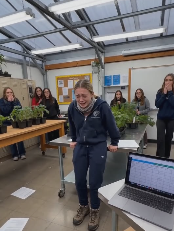
Twenty students, three teachers, two visiting sponsors, and the assistant principal stood beneath the greenhouse’s fogged glass ceiling as though someone had pressed pause on the entire room.
Avery lowered the empty bowl slowly.
Her face showed no panic.
That was the frightening part.
She looked relieved.
“There,” she said, breathing hard enough to make her voice tremble. “Maybe now she’ll stop lying.”
A few students gasped. Someone near the door whispered my name. Two phones rose above the crowd.
I tasted salt and cinnamon at the corner of my mouth.
Every part of me wanted to wipe my face, shove past the crowd, and disappear into the Montana cold. But I knew that was what Avery wanted. She needed me humiliated, emotional, and far away from the computer before anyone opened the original greenhouse data.
So I did the hardest thing I had ever done.
I stayed still.
Then I looked past her at the laptop sitting beside the seed trays.
“Open the sensor heat data,” I said.
My voice sounded quieter than I expected, but the greenhouse carried it.
Avery’s confident expression flickered.
Only for an instant.
Then she laughed.
“Mackenzie, you’re covered in soup, and you’re still pretending this is about a heater?”
“It has always been about the heater.”
“No,” she snapped. “It’s about you trying to destroy our project because you weren’t chosen to present it.”
That lie had traveled through Billings Central High School for nearly six hours.
By lunch, people said I had sabotaged the greenhouse because I was jealous.
By the end of fifth period, they said I had deliberately overheated the rare native seedlings donated by a local conservation group.
Now, with two sponsors visiting to decide whether our agriculture program would receive a forty-thousand-dollar grant, Avery was trying to make the rumor official.
Assistant Principal Daniel Hale stepped forward at last.
He was a tall man with silver at his temples and a voice that usually ended arguments before they began.
“That is enough,” he said. “Ms. Prescott, step away from Mackenzie.”
Avery obeyed, but her eyes remained fixed on the report in my hand.
Mr. Hale turned to me.
“Are you hurt?”
“I’m fine.”
“You are not fine.”
“I need you to open the data first.”
One of the sponsors, Dr. Helena Ruiz from the Montana Youth Agriculture Foundation, exchanged a concerned glance with our environmental science teacher, Mrs. Bell.
Mrs. Bell looked pale.
She had been pale since morning, when we discovered the greenhouse temperature had reached one hundred and twelve degrees at 2:17 a.m.
The heater should never have risen above sixty-eight.
The seedlings had survived only because I arrived early for volunteer duty, noticed condensation pouring down the walls, and forced open the swollen greenhouse door.
At least, that was what everyone had believed until Avery produced a maintenance request carrying my name.
According to that document, I had changed the overnight temperature schedule myself.
I had supposedly done it at 8:42 the previous evening.
There was only one problem.
At 8:42, I had been working at my mother’s diner across town.
And I still had the grease-stained timecard in my bag.
Mr. Hale studied me.
“What exactly do you believe the sensor data will show?”
“That the heating schedule was changed from inside the school network,” I said. “And that it happened after my account had already been logged out.”
A murmur passed through the students.
Avery folded her arms.
“That doesn’t prove anything.”
“It proves I didn’t do it.”
“You could have given someone your password.”
“I didn’t.”
“You expect everyone to believe that?”
“No,” I said. “I expect them to read the record.”
For the first time, Avery looked toward the person standing behind her.
It was not one of her friends.
It was Mr. Conrad, the district technology coordinator.
He had arrived ten minutes earlier carrying a black laptop case. He was broad-shouldered, always overdressed, and known throughout the school for speaking to students as though we were defective machines.
His gaze met Avery’s.
Something passed between them.
A warning.
Then he smiled at Mr. Hale.
“I have already reviewed the network activity,” Mr. Conrad said. “The change was made using Miss White’s credentials. That is all the system can confirm.”
My stomach tightened.
“That’s not all it can confirm.”
His smile vanished.
I held up the printed pages.
“The greenhouse sensors don’t only store the username. They store the device identification, connection time, manual overrides, and the exact temperature at every thirty-second interval.”
Mr. Conrad’s eyes dropped to the pages.
For the first time that day, he looked afraid.
Three weeks earlier, nobody at school would have expected me to understand any of that.
I was Mackenzie White, the quiet girl who wore old hiking shoes because new ones cost too much. I worked four evenings a week at my mother’s diner, helped my younger brother with homework, and spent lunch periods in the library repairing damaged textbooks for volunteer credit.
Avery Prescott lived in a house overlooking the Yellowstone River, arrived at school in a new silver SUV, and somehow appeared in every photograph connected to student leadership.
She was president of the Green Futures Club, chair of the winter fundraiser, and the face of the greenhouse grant campaign.
I had joined the project because my father had loved native plants.
Before he died, he had taken me into the hills outside Billings and taught me the names of things most people walked past without seeing: bluebunch wheatgrass, blanketflower, prairie smoke.
After his death, the greenhouse became the only place where grief felt useful.
Avery treated it like a stage.
The grant was supposed to fund a community program named in memory of local farmers. But whenever photographers arrived, Avery positioned herself beside the healthiest plants and spoke as though she had grown every one.
I never challenged her.
Not until I found the door.
The evening before the overheating incident, I had finished watering the western beds at 6:13. Before leaving, I noticed the greenhouse door did not latch correctly. The metal frame had warped in the cold, leaving a gap wide enough for icy air to enter.
I photographed it, submitted a maintenance request, and placed a wooden wedge beneath the door so it could not lock completely.
The next morning, that wedge saved the seedlings.
It allowed me to force the door open when heat pressure jammed the frame.
But Avery told everyone I had deliberately left the greenhouse unsecured.
Then she produced the altered maintenance request showing that I had also changed the heater.
Her evidence looked perfect.
Too perfect.
Except I kept everything.
Receipts. Photos. Original files. Time stamps.
My father had taught me that truth could disappear if nobody bothered to preserve it.
“Records are memories that don’t get scared,” he used to say.
That morning, while rumors spread through school, I compared my original photograph to the copy attached to Avery’s report.
The image looked identical until I opened the metadata.
My photo had been taken at 6:09 p.m.
The version in Avery’s file had been exported at 9:03 p.m. from a district-owned computer.
Someone had copied it, renamed it, and attached it to a fraudulent form.
That was when I requested the raw sensor data.
Mr. Conrad denied me access.
So I went to Mrs. Bell.
She hesitated.
That hesitation hurt more than Avery’s accusations.
Mrs. Bell had known me for two years. She knew I arrived early, stayed late, and never touched equipment without permission.
Yet she looked toward the principal’s office and whispered, “The district is under pressure not to lose this grant.”
I stared at her.
“Are you saying the truth could cost too much?”
“I’m saying we need to be careful.”
“Careful with what?”
“With accusations.”
“I’m the one being accused.”
She closed her eyes.
Then, without another word, she printed the sensor archive.
That printout was now crumpled in my soup-covered hand.
Mr. Hale turned toward the laptop.
“Mrs. Bell, open the raw data.”
Mr. Conrad stepped forward.
“That file contains restricted network information.”
Dr. Ruiz raised an eyebrow.
“Restricted from whom?”
“Outside individuals.”
“I represent the organization funding this greenhouse.”
“That does not grant you access to student network records.”
“It grants me an interest in whether your school is falsifying reports connected to our money.”
The greenhouse fell silent again.
Mr. Hale pulled out the chair.
“Open it.”
Mrs. Bell entered her password.
Avery moved closer to Mr. Conrad.
I watched his hand tighten around the handle of his laptop case.
The sensor dashboard appeared.
Rows of numbers filled the screen: temperature, humidity, heater output, ventilation status, door pressure.
Mrs. Bell opened the change log.
At 8:42 p.m., the scheduled temperature had been raised from sixty-eight to one hundred and fifteen degrees.
The username displayed beside the change was mine.
Avery exhaled loudly.
“There. We already knew that.”
“Keep reading,” I said.
Mrs. Bell expanded the entry.
The device identification appeared beneath it.
BCSD-ADMIN-04.
Mr. Hale’s expression hardened.
“That is an administrative workstation.”
Mr. Conrad answered too quickly.
“User credentials can be entered from any district machine.”
“Which office contains workstation four?” Dr. Ruiz asked.
Nobody replied.
Mrs. Bell looked at Mr. Conrad.
“The technology office.”
Every face turned toward him.
Avery’s friends stepped away as though distance could erase their association.
Mr. Conrad cleared his throat.
“Mackenzie may have entered the office.”
“I was at the Silver Spoon Diner,” I said. “My manager has the security footage.”
“She may have scheduled remote access earlier.”
“The system records remote sessions,” Mrs. Bell whispered.
She clicked another tab.
No remote session had occurred.
The change had been entered physically from the technology office.
At 8:42 p.m.
Mr. Hale’s voice became dangerously calm.
“Who was in that office?”
Mr. Conrad looked at Avery.
This time, everyone saw it.
Avery’s mouth opened, but no sound emerged.
I expected Mr. Conrad to blame her.
Instead, he said, “I was.”
The admission landed harder than the bowl of soup.
Avery spun around.
“What are you doing?”
Mr. Conrad did not look at her.
“I changed the temperature.”
Mrs. Bell gripped the edge of the table.
“You nearly destroyed the entire seed collection.”
“It was supposed to be corrected before midnight.”
“Why would you do it at all?” Mr. Hale demanded.
Mr. Conrad’s face had gone gray.
He glanced at the sponsors, then at the students filming.
“Turn off those phones.”
Nobody obeyed.
Mr. Hale repeated the question.
“Why?”
Mr. Conrad swallowed.
“To create a manageable equipment failure.”
I stared at him.
“A manageable failure?”
“The district needed evidence that the old heating system was unreliable. The grant committee had refused to fund a replacement without documented risk.”
Dr. Ruiz’s face changed from confusion to disgust.
“You tried to manufacture a crisis to influence our decision?”
“It wasn’t supposed to harm anything. I planned to lower the temperature after an hour.”
“But you didn’t,” Mrs. Bell said.
Mr. Conrad glanced at Avery again.
“Someone changed the administrator password.”
Avery backed into the seed table.
“No.”
Mr. Conrad finally looked at her.
“You said you would restore the setting.”
“You told me it was safe.”
“I told you to lower it at nine thirty.”
“You said the plants could survive.”
“For one hour, not all night.”
The truth began unfolding too quickly for anyone to stop it.
Avery’s face collapsed.
She turned toward the crowd.
“He came to me because the grant was going to fail. He said the greenhouse needed a visible emergency. He said we could prove the school deserved a better system.”
“You agreed?” Mrs. Bell asked.
Avery’s eyes filled with tears.
“I didn’t understand.”
“You understood enough to use Mackenzie’s account,” I said.
She looked at me.
For one second, I saw the girl behind the polished speeches and expensive clothes.
She looked terrified.
“He gave me your password,” she whispered.
All eyes returned to Mr. Conrad.
He shook his head.
“That is not true.”
“You printed it for me.”
“You stole it.”
“You said nobody would question Mackenzie because she had reported the broken door.”
Mr. Conrad lunged toward the laptop.
Mr. Hale blocked him.
In the struggle, the black laptop case fell from his hand and struck the concrete floor.
The zipper burst open.
Papers slid across the damp aisle.
Invoices.
Network diagrams.
Copies of student login records.
And a sealed envelope bearing the logo of Prescott Development Group.
Avery stared at it.
Her surname was printed in the corner.
Dr. Ruiz bent down first.
Mr. Conrad reached for the envelope, but Mr. Hale caught his wrist.
“Don’t.”
Dr. Ruiz opened it.
Inside was a consulting agreement between Prescott Development Group and Conrad Systems Solutions, a private company registered to Mr. Conrad’s wife.
The agreement promised a payment of eighteen thousand dollars if the greenhouse renovation contract was awarded to a specific construction supplier.
A supplier owned by Avery’s father.
Avery read the first page over Dr. Ruiz’s shoulder.
The color drained from her face.
“My father said he donated the materials.”
Nobody answered.
She grabbed the agreement.
“He said the company was helping the school.”
Mr. Conrad looked toward the exit.
Mr. Hale took out his phone.
“Security is on the way.”
But the worst discovery had not yet appeared.
Mrs. Bell was still staring at the sensor chart.
“Mackenzie,” she said slowly, “you said the proof pointed to someone standing behind Avery.”
I looked at Mr. Conrad.
“I thought it meant him.”
“No.” Mrs. Bell enlarged the timeline. “There were two manual changes.”
At 8:42, the temperature had been raised.
At 9:31, someone attempted to lower it.
The second command failed because the administrative password had been changed at 9:26.
The password change came from the principal’s office.
Every person in the greenhouse turned toward Mr. Hale.
He did not move.
Avery whispered, “You knew?”
Mr. Hale stared at the screen.
His face revealed nothing.
Then he placed his phone on the table.
“I did not make that change.”
“The workstation is in your office,” Mrs. Bell said.
“I left the building at seven.”
Mr. Conrad laughed bitterly.
“Now you understand how it feels.”
Mr. Hale ignored him.
“Who had access?”
Mrs. Bell shook her head.
“Only you and the principal.”
Principal Judith Voss was not in the greenhouse.
She had left school that morning for what the office called an emergency district meeting.
Mr. Hale called her.
The call went directly to voicemail.
Dr. Ruiz folded the consulting agreement.
“Until this is investigated, the grant review is suspended.”
Avery let out a broken sound.
The grant had been her path to a state leadership award, a scholarship nomination, and the glowing newspaper profile her father had already promised to frame.
But when she looked at the contract again, her devastation changed.
“My father’s signature is dated four months ago,” she said.
Mr. Conrad said nothing.
“He planned this before the grant application was even submitted.”
Avery’s voice cracked.
“He used me.”
I should have felt satisfied.
For hours, she had lied about me. She had thrown food in my face and tried to destroy my reputation.
Yet watching her realize that her own father had built her success on a hidden business deal did not feel like victory.
It felt like seeing someone fall through ice.
Security officers arrived and escorted Mr. Conrad from the greenhouse.
Before leaving, he turned toward me.
“You think you uncovered everything because you kept a few photographs?”
“No,” I said. “I think you were exposed because you believed nobody important would listen to me.”
His expression twisted.
Then he looked at Mr. Hale.
“You should tell them why Voss had access to that password.”
Mr. Hale went rigid.
Mr. Conrad smiled.
“That secret is bigger than the grant.”
The greenhouse door closed behind him.
For the next three days, Billings Central felt less like a school than a building waiting for another wall to collapse.
Mr. Conrad was placed on administrative leave. Police opened an investigation into fraud, unauthorized access, and deliberate damage to school property.
Principal Voss disappeared.
Her office claimed she was ill.
Her home was empty.
Avery was suspended for assaulting me and falsifying records. Videos of the soup incident spread across social media, but the comments changed once the sensor data became public.
Some students apologized to me.
Most pretended they had never believed the rumor.
I returned to the greenhouse after school on Friday.
The damaged seedlings rested beneath temporary grow lights. Their leaves were curled, but small green centers remained alive.
I was adjusting a humidity tray when Avery entered.
She wore no makeup, no varsity jacket, and none of the confidence she usually carried like armor.
“You’re not supposed to be here,” I said.
“My suspension ended at three.”
She stopped several feet away.
“I came to apologize.”
I continued filling the tray.
“You assaulted me.”
“I know.”
“You falsified a record.”
“I know.”
“You told people I tried to destroy something my dead father taught me to care about.”
Her eyes lowered.
“I know.”
I set down the watering can.
“Then don’t apologize like you broke my pencil.”
Avery flinched.
For a long moment, neither of us spoke.
Finally, she reached into her backpack and removed a small flash drive.
“I found this in my father’s office.”
I did not take it.
“What is it?”
“Emails between him, Mr. Conrad, and Principal Voss.”
“Give it to the police.”
“I made a copy for them.”
“Why bring one to me?”
“Because your name appears in the messages.”
A cold feeling moved through me.
“My name?”
“Not just yours.”
She placed the drive on the table.
“Your father’s.”
The greenhouse seemed to tilt beneath my feet.
“My father died three years ago.”
“I know.”
“How could he be part of this?”
“He wasn’t part of their plan.” Avery looked at the struggling seedlings. “I think he discovered it first.”
At home, my mother begged me not to open the files.
We sat at the kitchen table after closing the diner, surrounded by unpaid bills, coffee cups, and the familiar smell of fried onions clinging to our clothes.
My younger brother was asleep upstairs.
Mom stared at the flash drive as though it were something alive.
“Your father worked maintenance for the district,” she said. “He complained about strange invoices before he died.”
“You never told me that.”
“He told me not to involve you.”
“Involve me in what?”
“He found records showing that Prescott Development had billed the district for repairs that were never completed.”
I felt my chest tighten.
“Did he report it?”
“He tried.”
“What happened?”
Her eyes filled.
“The week before his accident, someone broke into our house. Nothing valuable was taken, but his work files disappeared.”
My father had died when his truck slid off an icy road outside Laurel.
The sheriff called it a weather-related accident.
For three years, I had pictured him losing control on black ice.
Now I remembered something I had buried beneath grief.
The night before he died, he sat at this same table and told me to keep copies of everything important.
Records are memories that don’t get scared.
My mother covered her mouth.
“He was supposed to meet Daniel Hale the morning he died.”
“The assistant principal?”
“He wasn’t assistant principal then. He worked in district compliance.”
The password change from the principal’s office suddenly felt different.
I opened Avery’s flash drive.
The emails revealed a scheme that stretched back six years.
Prescott Development had submitted inflated contracts for school repairs. Mr. Conrad manipulated digital inspections. Principal Voss approved payments.
My father, Thomas White, had discovered that safety upgrades at three schools existed only on paper.
He collected photographs and invoices.
Then he contacted Daniel Hale.
But the final email was the one that changed everything.
It was sent from Principal Voss to Avery’s father on the evening my father died.
THOMAS WHITE HAS GIVEN THE ORIGINAL FILES TO HALE. CONRAD WILL HANDLE THE VEHICLE, BUT WE NEED THE BACKUP REMOVED BEFORE MORNING.
I stopped breathing.
My mother screamed when she read it.
The police arrived within twenty minutes.
Mr. Hale came with them.
When he entered our kitchen, he looked older than he had at school.
He placed a weathered envelope on the table.
“I have carried this for three years,” he said.
Inside were my father’s original photographs.
Mr. Hale explained that my father had handed him the evidence in a grocery-store parking lot. Before Hale could submit it to state investigators, my father died.
Then Hale’s apartment was searched.
He became afraid.
Principal Voss threatened his job and his family.
So he hid the evidence and accepted a promotion that allowed him to remain close to the people involved.
“You let them continue stealing,” I said.
“Yes.”
“You let my father’s death remain an accident.”
His voice broke.
“Yes.”
Anger rose inside me so violently that I had to grip the table.
“Why did you change the password?”
He looked at the flash drive.
“I learned Conrad planned to create the greenhouse failure. I changed the administrator password to stop him from reversing the temperature. I believed a visible incident would force investigators to examine the system.”
“You let the greenhouse overheat?”
“I thought the emergency ventilation would activate at eighty degrees.”
“It didn’t.”
“Because the ventilation repair was another fraudulent contract.”
The meaning struck all of us.
The greenhouse crisis had not merely exposed the new scheme.
It had proven my father’s old accusations.
Mr. Hale’s attempt to trap them had nearly destroyed the seedlings and placed me in danger, but it had also created a data trail nobody could erase.
“You used us,” I said.
“Yes,” he whispered. “And I will spend the rest of my life regretting it.”
He handed himself over to the detectives that night.
Within two weeks, Principal Voss was arrested at a motel in Idaho. Mr. Conrad agreed to cooperate. Avery’s father was charged with fraud, conspiracy, obstruction, and involvement in the circumstances surrounding my father’s death.
Investigators discovered that Mr. Conrad had tampered with my father’s truck brakes. The icy road had only hidden what they had done.
The revelation shattered my family.
But it also gave us something grief had denied us for three years.
The truth.
Mr. Hale lost his position and faced charges for withholding evidence, though my mother asked prosecutors to consider his eventual cooperation.
Avery testified against her father.
She lost the scholarship nomination, the club presidency, and many of the friends who had once surrounded her.
But she did something I never expected.
At the school board hearing, she stood before a crowded room and admitted everything.
“I used Mackenzie’s account because I believed her reputation was worth less than mine,” she said. “I told myself I was protecting a project, but I was protecting my status. She preserved the truth while I tried to bury it.”
Then she turned toward me.
“I cannot undo what I did. I can only stop lying about it.”
The agriculture foundation reinstated the grant under one condition: no money could pass through the old district administration.
The greenhouse was rebuilt with transparent contracts, independent inspections, and public expense records.
They asked me to name the new community program.
I called it the Thomas White Native Plant and Accountability Project.
Avery volunteered there after completing her suspension and community service.
We did not become instant friends.
Some wounds should not be covered with easy forgiveness.
But spring arrived slowly in Montana, and as the snow melted, we worked at opposite ends of the greenhouse, restoring what had survived.
One afternoon, Avery brought me a replacement navy sweatshirt.
“I know it doesn’t fix anything,” she said.
I looked at it.
“No soup?”
“Guaranteed.”
I almost smiled.
Then she held out the original maintenance photograph I had taken of the broken door. She had printed it and placed it in a plain wooden frame.
Beneath the image, she had written a sentence.
THE SMALLEST RECORD CAN HOLD OPEN THE DOOR TO THE TRUTH.
We hung it near the greenhouse entrance.
Months later, the first bed of prairie smoke blossomed.
My mother, my brother, Mrs. Bell, Dr. Ruiz, and half the school gathered beneath the repaired glass roof.
A plaque honoring my father stood beside the plants.
When it was time for me to speak, I looked toward the door that had once refused to open.
Then I looked at Avery, standing quietly in the back rather than pushing toward the cameras.
“My father taught me that records are memories that don’t get scared,” I told the crowd. “But records cannot speak for themselves. Someone still has to be brave enough to open them.”
Outside, sunlight spread across the snowmelt.
Inside, the greenhouse remained at exactly sixty-eight degrees.
And for the first time since my father’s death, the warmth around me did not feel dangerous.
It felt like spring.
THE END
