Part 2: The Drawer He Needed Opened Before Dawn
The open drawer looked like an accusation.
I could see it through the narrow gap between the hallway and the nursery door: the bottom dresser drawer hanging out crooked, one tiny yellow blanket half-draped over the edge like someone had searched beneath it in a hurry.
Adam saw it too.
His face changed so fast that my fear sharpened into something colder.
“Move,” he said.
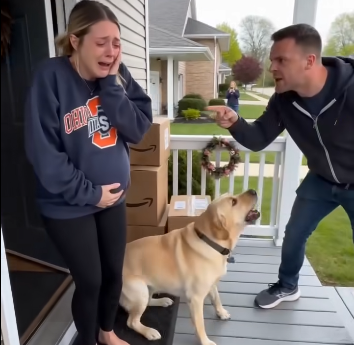
Bear’s bark cut across the porch like a warning siren.
My neighbor, Mrs. Novak, was still standing on her lawn with her phone raised. She had lived across from us for nine years, the kind of woman who watered her roses at sunrise and knew which delivery drivers worked which route. She had never liked Adam. She had never said it directly, but whenever he pulled into my driveway, her curtains moved.
Now she shouted, “I’ve called the police, Mara!”
Adam’s head snapped toward her. “Mind your business!”
Bear lunged one step forward, not biting, not touching, just planting his heavy body between Adam and me with such force the porch boards groaned.
The baby monitor crackled again.
Adam’s recorded whisper came through, low and frantic.
“Where did she put it? She always hides things where she thinks nobody will look.”
My stomach tightened.
Not from the baby.
From memory.
Three weeks earlier, my grandmother’s lawyer had handed me a sealed envelope and said, “Do not let Adam see this until the petition is filed.” I had hidden the envelope beneath the nursery drawer liner, under a stack of newborn clothes Adam had never once cared enough to fold.
Adam’s eyes flicked toward my belly, then the hallway.
“You don’t understand what’s in there,” he said.
“No,” I whispered. “I think I finally do.”
He stepped toward me again.
Bear lowered his head.
The sound that came from him was not a bark anymore. It was a deep, shaking growl I felt in my ribs.
Adam froze at the top porch step, his hand still raised from where he had slapped me minutes earlier. For the first time, he looked unsure. Not sorry. Never sorry. Just unsure whether he could win in front of a camera, a dog, and a neighborhood witness.
Then the nursery monitor played one more sentence.
“If she files those papers, I lose everything.”
Part 3: The Neighbor Who Had Been Watching Longer
Mrs. Novak crossed the street before the police arrived.
She moved fast for a woman in house slippers, phone in one hand, gardening shears still clutched in the other like she had grabbed the first weapon her roses offered her.
“Stay right there, Adam,” she said.
He laughed, but it was thin. “What are you going to do, trim me?”
“No,” she said. “But I already sent the video to my daughter.”
His smile disappeared.
I stared at her.
“What video?”
Mrs. Novak’s mouth softened when she looked at me. “Sweetheart, last night around eleven, my porch camera caught him climbing your side fence.”
Adam swore under his breath.
“You said you were in Cleveland,” I said.
His eyes went flat. “I said a lot of things.”
That sentence should not have surprised me. It did anyway. My hand found the curve of my belly, and the baby shifted as if even she had heard enough.
The sirens came from the end of the block, not screaming, just close enough to make Adam step backward. Bear followed the movement, keeping himself between us.
Mrs. Novak reached me and touched my shoulder carefully, as if she knew exactly where a frightened person might break.
“Did he hurt you?”
I shook my head too quickly.
She looked at my cheek.
Her expression hardened. “Don’t lie for him anymore.”
The words landed so gently they almost undid me.
Two officers came up the walk. Adam immediately changed his face. His voice turned smooth, wounded, practiced.
“My wife is emotional. She’s pregnant. We had an argument. The dog got aggressive.”
Bear sat down.
Right there on the porch, like a perfectly trained witness.
Mrs. Novak lifted her phone. “He hit her. He tried to force entry. Her monitor recorded him admitting he broke in last night.”
Adam stared at Bear, then at the officers, then finally at me.
“Mara,” he said quietly, “tell them this is family business.”
For two years, that phrase had worked.
Family business meant swallowing insults at dinner. Family business meant explaining bruised feelings away. Family business meant not telling anyone when he punched the wall beside my head and called it restraint.
I looked at the nursery door.
Then I looked at the police.
“I want him off my porch.”
Part 4: The Envelope Beneath The Baby Clothes
One officer stayed with Adam outside.
The other, Officer Hale, followed me in.
Bear came too, pressed so close to my leg that his fur brushed my fingertips with every step. The house looked strangely ordinary. A mug in the sink. A basket of folded towels. The hallway table with the baby monitor blinking green, innocent after betraying the truth.
At the nursery door, I hesitated.
I had painted that room pale cream because Adam hated pink and said yellow looked cheap. I had built the mobile myself from felt stars while he watched sports downstairs. I had cried the first time Bear curled up on the rug beneath the crib, as if he had accepted his post before the baby even arrived.
Now the room smelled wrong.
Not like lavender detergent and wood polish.
Like Adam’s cologne.
The dresser drawer was still open.
Officer Hale said, “Don’t touch anything yet.”
But I already knew where to look.
She photographed the drawer, the shifted clothes, the peeled liner. Then she nodded.
With shaking hands, I lifted the stack of onesies and slid my fingers beneath the corner of the paper lining.
The envelope was still there.
But it had been opened.
The seal was torn. The papers inside were bent, as if someone had shoved them back in quickly after realizing he could not take them without leaving the envelope empty.
My chest tightened.
“He read it,” I said.
Officer Hale put on gloves and took the envelope carefully. “What is it?”
I swallowed. “A legal petition. My grandmother left me her house and a trust account, but Adam told me everything became marital property. The lawyer said that wasn’t true. He said Adam had been trying to get me to sign away control before the baby was born.”
Officer Hale’s eyes lifted.
Outside, Adam shouted something I couldn’t make out.
Bear stood at the nursery doorway, staring down the hall.
Officer Hale unfolded the top page.
Her brows drew together.
“This isn’t just about the house,” she said.
I went cold.
“What?”
She turned the page toward me.
At the bottom was Adam’s name.
Not as spouse.
Not as emergency contact.
As the person my grandmother had specifically barred from accessing the trust.
Underlined in legal language was one sentence that made my breath leave my body.
“Evidence suggests attempted coercion and financial concealment by Adam Keller.”
Then Bear began barking at the closet.
Part 5: The Closet Wall That Was Never Solid
The closet was supposed to hold diapers.
Stacks of them lined the top shelf, still wrapped in plastic, next to two knitted blankets from my aunt in Bristol and a little box of wooden blocks Adam had never noticed.
Bear faced the back wall.
His body was rigid.
Officer Hale lifted one hand, signaling me to stay behind her. She opened the closet door wider, then moved aside the hanging baby clothes.
At first, there was nothing.
Just wall.
Then Bear shoved his nose against the lower panel and scratched once.
A soft click answered.
Officer Hale looked at me. “Did you know this was here?”
“No.”
My voice barely existed.
She pressed where Bear had scratched. A loose square of wall panel shifted inward, then dropped forward into her gloved hand.
Behind it was a narrow hollow space.
Inside sat a black document pouch.
For a moment, the entire house seemed to hold its breath.
Officer Hale removed it slowly and placed it on the changing table. “Mara, step back.”
But I could already see my name through the clear plastic window.
Not just my married name.
My maiden name.
Mara Whitcomb.
The pouch contained bank statements, photocopies of my signature, a spare checkbook from an account I had closed last winter, and a stack of forms I had never seen before.
At the top of one page was a title that made my knees weaken.
Property Transfer Authorization.
My signature was on the bottom.
Except I had never signed it.
Officer Hale’s face changed.
“This is forgery.”
The word sounded too clean for what it meant.
Forgery was a word for offices and courtrooms.
This had happened in my nursery.
Beside a crib.
Under the roof where my daughter was supposed to sleep.
Bear pressed his body against my knees when I swayed.
Then, from outside, Adam’s voice rose in panic.
“You can’t search my house without me!”
Officer Hale looked toward the porch.
I looked at the fake signature.
For months, Adam had told me I was forgetful. Emotional. Pregnant and confused. He had watched me question my own memory while he built a secret wall behind our baby’s clothes.
My hand closed over Bear’s collar.
“It was never his house,” I said.
Part 6: The Lawyer Who Arrived With One More Secret
By the time my grandmother’s lawyer arrived, Adam was sitting in the back of a patrol car.
Not arrested yet, the officers said. Detained.
But the difference did not matter to the neighbors peeking through blinds or to Mrs. Novak, who stood in my kitchen making me tea with the grim focus of a battlefield nurse.
The lawyer’s name was Elena Ward. She was small, silver-haired, and carried a leather briefcase that looked older than I was. She entered the nursery without flinching, surveyed the open drawer, the hidden pouch, and Bear sitting like a guardian at the crib, then said, “Your grandmother was right.”
I looked up sharply. “About what?”
Elena’s eyes softened.
“That he would come for the documents before the baby arrived.”
My throat closed.
“You knew?”
“I suspected,” she said. “Your grandmother knew.”
I sat down slowly in the rocking chair.
It creaked under me, a soft domestic sound in the middle of a nightmare.
Elena opened her briefcase and removed a second sealed envelope.
This one had my grandmother’s handwriting across the front.
For Mara, when the house stops feeling safe.
My vision blurred.
I had not cried when Adam slapped me. I had not cried when the recording played. I had not cried when they found the forged papers.
But seeing my grandmother’s handwriting nearly broke me.
Elena waited until I nodded.
Then she opened it.
Inside was a letter and a small brass key.
Elena read aloud only the first line.
“My darling Mara, if you are holding this, then Bear has done what I trained him to do.”
I looked at Bear.
He thumped his tail once.
Elena turned the letter toward me.
My grandmother had not just left me the house. She had arranged protection into every corner of it: the nursery monitor with backup recording, the hidden panel she had installed when the house was renovated, and Bear, whom she had raised for two years before giving him to me “for company.”
She had known Adam was dangerous before I was ready to know.
Then Elena showed me the last page.
A trust amendment signed six months earlier.
If Adam attempted to coerce, forge, trespass, or interfere before the baby’s birth, the trust would activate immediately.
Not when the baby was born.
Not after court.
Immediately.
The house, the accounts, and every legal protection now belonged fully to me.
Part 7: The Choice He Never Thought I Would Make
Adam asked to speak to me before they took him away.
Officer Hale said I did not have to.
Mrs. Novak said, “Absolutely not.”
Elena said nothing. She only watched me, waiting to see whether I would choose fear or freedom.
I surprised everyone, including myself.
“I’ll speak to him,” I said. “From the doorway. With everyone here.”
Adam stood beside the patrol car with one officer close enough to stop him if he moved too fast. The porch light had come on, turning the dusk gold and shadowy. Neighbors pretended not to watch from behind curtains. Bear stood at my side, silent now.
Adam looked at me with the expression he used when he wanted to become familiar again. Tired eyes. Soft mouth. Regret shaped carefully around control.
“Mara,” he said, “this got out of hand.”
I almost laughed.
He had broken into my house. Torn open legal documents. Hidden forged papers in the nursery wall. Slapped me on my porch. And still, in his mind, the problem was that things had gotten out of hand.
“I can fix this,” he said.
“No.”
The word came out clear.
His face twitched.
“You don’t want our daughter born into this mess.”
That was the final thread he thought he still held.
Our daughter.
I felt the baby move, a slow roll beneath my palm, and something inside me settled.
“No,” I said. “I don’t want her born into fear.”
He leaned forward. The officer shifted instantly.
Adam lowered his voice. “You need me.”
For years, he had made that sound like a fact.
For years, I had believed it on the worst days.
Then Bear pressed his shoulder against my leg, and behind me Mrs. Novak stood in my doorway, Elena held my grandmother’s letter, and Officer Hale waited with the evidence he had hidden behind baby clothes.
I looked at Adam and finally saw him clearly.
Small.
Cornered.
Still reaching for a key to a door that was no longer his.
“No,” I said. “You needed me silent.”
His face emptied.
And for once, I did not fill the silence for him.
Part 8: The Nursery Door Opened For Someone Else
The nursery stayed locked for three days.
Not because Adam had won.
Because I needed it cleaned of him.
Elena arranged for new locks before sunrise. Officer Hale submitted the monitor recording, the neighbor’s footage, and the forged documents. Mrs. Novak came over with soup, fresh sheets, and a list of contractors she trusted more than most family members.
Bear refused to leave the hallway.
He slept outside the nursery door every night, his head on his paws, opening one eye whenever I walked past.
On the fourth morning, Elena returned with a locksmith and one more box from my grandmother’s storage unit.
“I think you should open this in the nursery,” she said.
My hands went cold. “Is it more evidence?”
“No,” Elena said gently. “It’s the reason she chose this room.”
The nursery smelled like lemon cleaner now. The drawer was repaired. The hidden panel had been sealed properly. Sunlight poured through the curtains and landed across the rug where Bear had once guarded the crib.
Inside the box was a faded photograph.
My grandmother, younger, standing on the same nursery carpet decades earlier.
Beside her was my mother, pregnant with me.
Behind them, painted on the wall before layers of old wallpaper had covered it, was a sentence in careful blue letters.
Elena handed me the brass key from my grandmother’s letter.
“It opens the bottom of the crib,” she said.
I knelt, heart pounding, and found the tiny lock beneath the wooden frame. The key turned with a soft click.
A narrow drawer slid open.
Inside was not money. Not legal papers. Not another warning.
It was a stack of letters.
One from my grandmother to my mother.
One from my mother to me.
And one blank envelope, already addressed in my grandmother’s hand:
For the next girl who needs to know this house belongs to her.
I sat on the nursery floor and cried then, not from fear, but from the strange, aching relief of being protected by women who had loved me before I understood danger.
Bear rested his head on my knee.
Two months later, my daughter was born on a rainy morning, healthy and loud and furious at the world for making her leave warmth.
I named her Iris, after the flowers my grandmother planted along the porch.
When I brought her home, Bear walked ahead of us to the nursery door, looked back once, and waited.
I opened it.
The room was quiet, golden, and finally ours.
And when I laid Iris in her crib, Bear placed himself beside her like a promise that had crossed generations to keep its word.
