Part 2: The Name He Tried To Hide
The words blurred before I understood them.
Arriving today.
Delayed medical transport.
My husband’s name sat there in black ink, clipped beneath a fake family schedule that had been printed to make every waiting wife, parent, and child look in the wrong direction.
Sergeant Caleb Morgan.
Not missing.
Not deceased.
Not “pending notification.”
Arriving today.
My knees almost folded.
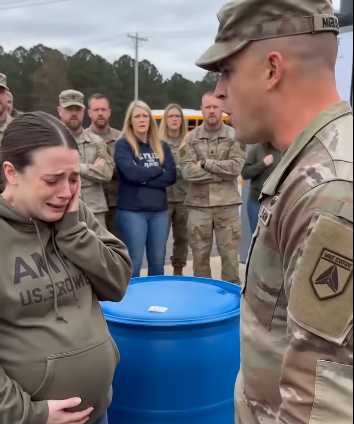
Major pressed his body against my leg, still growling at the man who had called himself Captain Ellis. The real military police officer had him pinned against the blue water barrel, one knee braced near his hip, one hand locking the fake officer’s wrist behind his back.
“Do not move,” the MP said.
The man’s laminated ID had slid across the pavement and stopped near a woman’s stroller. A teenage boy picked it up, looked at it, and shouted:
“That doesn’t say Ellis. It says Daniel Price.”
The crowd erupted.
Families surged forward. Someone yelled for a real family liaison. Someone else started recording. A little girl holding a poster that said WELCOME HOME DAD began crying because every adult around her suddenly sounded terrified.
I gripped the clipboard tighter.
The fake officer turned his face toward me.
“You don’t know what you’re holding,” he hissed.
My cheek burned where he had slapped me. The broken hoodie string scratched against my chin.
I looked down at the return list again.
There were other names beneath Caleb’s.
Several marked delayed medical transport.
Beside them, handwritten in red, was one instruction:
“Hold families at Gate C until vehicle clears.”
I lifted the clipboard toward the MP.
“He was trying to keep us away from the transport.”
The MP’s face changed.
“What transport?”
The fake officer stopped struggling.
That silence answered before he did.
Major barked toward the road beyond the checkpoint.
A siren sounded far off, but it was not coming closer.
It was moving away.
The MP grabbed his radio.
“Stop any medical transport leaving Gate Two. Repeat, stop medical transport leaving Gate Two.”
Daniel Price smiled through blood on his lip.
“You’re too late.”
And that was when Major tore free from my side and ran toward the service road.
Part 3: The Ambulance That Took The Wrong Exit
I screamed Major’s name, but he did not turn back.
He shot past the checkpoint like a yellow flash, paws striking the pavement, leash dragging behind him. Two MPs ran after him. I followed before anyone could stop me, one hand under my stomach, breath already burning in my chest.
“Ma’am, stop!” someone shouted.
I did not stop.
Not when my husband’s name was on that list.
Not when a fake officer had blocked me at the gate.
Not when the siren was fading toward the wrong exit.
The service road curved behind a line of buses and temporary fencing. Families at the gate began spilling toward the side, confusion rolling through them. I heard radios crackling, boots pounding, children crying, someone calling for medical support.
Major reached the bend first.
Then he planted himself in the middle of the road.
An ambulance came into view.
White. Unmarked except for a temporary transport placard in the windshield.
It was moving too fast for a base road.
The driver slammed the brakes.
The tires screamed.
Major did not move.
The ambulance stopped less than ten feet from him.
An MP ran up with his weapon drawn.
“Hands visible!”
The driver froze.
The passenger door opened.
A woman in scrubs stepped out, pale and shaking.
“I’m a nurse,” she said quickly. “They told us families had been redirected.”
“Who told you?” the MP demanded.
She pointed back toward the gate. “Captain Ellis.”
I reached the ambulance door, gasping so hard my ribs hurt.
“Caleb Morgan,” I said. “Is Sergeant Caleb Morgan inside?”
The nurse looked at me.
Then at my belly.
Then at the hoodie.
Her face softened with horror.
“Yes.”
The world tilted.
The MP opened the back doors.
Inside, strapped to a stretcher, pale under a thermal blanket, with a bandage wrapped around one shoulder and an oxygen line under his nose, was my husband.
Alive.
His eyes were closed.
But his chest moved.
I grabbed the edge of the ambulance door.
“Caleb.”
The nurse caught my arm. “He’s sedated, but stable.”
Stable.
That word nearly broke me.
Major jumped up, placing his front paws against the bumper. He whined once, low and desperate.
Caleb’s fingers twitched.
Then the nurse looked at the clipboard still clutched in my hand and whispered:
“There were supposed to be three more patients in this transport.”
Part 4: The Empty Stretchers In The Back
The ambulance held one patient.
My husband.
But it was built for four.
Three empty stretcher brackets lined the walls, straps clipped and waiting, oxygen hookups unused. On the floor were three folded blankets and a stack of patient transfer envelopes that had never been opened.
The MP climbed inside and checked the back.
“Where are the other soldiers?”
The nurse swallowed.
“They were removed before pickup.”
“Removed by whom?”
She looked toward the driver.
The driver refused to speak.
I stared at the envelopes.
Names were printed on the labels.
Private Owen Hart.
Corporal Elias Reed.
Specialist Thomas Keller.
All three names were on the clipboard list beneath Caleb’s.
All three marked delayed medical transport.
My stomach clenched.
“Were their families at Gate C too?” I asked.
The MP’s jaw tightened.
“Yes.”
A woman’s voice came from behind me.
“My son is Owen Hart.”
I turned.
A mother stood near the road, both hands pressed to her mouth, welcome-home sign dragging against the pavement. Behind her was an older man with a cane, and behind him a young wife holding a toddler.
The crowd had followed.
The lie was spreading open in front of everyone.
The nurse started crying.
“I thought they were transferred to another vehicle. I didn’t know.”
Major growled toward the front of the ambulance.
The MP pulled the driver out and searched the cab. From beneath the passenger seat, he removed a folder sealed with gray tape.
The fake officer’s real name was printed on the tab.
Daniel Price.
Inside were copies of return manifests, family contact sheets, and three transfer orders marked:
“Status change pending.”
The mother of Owen Hart whispered, “What does that mean?”
The MP did not answer.
But I knew enough from Caleb’s previous deployments to feel the wrongness of it.
Status did not change in an ambulance.
Status did not change before family notification.
Status did not change because a man with fake patches said so.
Then the MP found a smaller note clipped inside.
“Isolate Morgan first. He has original witness drive.”
My hand flew to my mouth.
The nurse turned toward Caleb.
“What witness drive?”
Major jumped fully into the ambulance and pressed his nose against Caleb’s old duffel bag tucked beneath the stretcher.
The bag had been cut open.
Part 5: The Drive Sewn Into His Duffel
Caleb always hid things badly when he wanted me to find them.
A spare key under the wrong flowerpot. Birthday cards tucked into obvious books. Chocolate hidden in the coffee canister even though I hated coffee while pregnant.
But this was not badly hidden.
This was desperate.
The duffel’s inner seam had been sliced, then roughly sewn shut again with black thread that did not match the original stitching. Major pawed at it and whined.
The MP looked at me.
“Do you recognize this bag?”
“It’s his.”
“Do you consent to opening it for immediate safety review?”
I nodded before he finished.
He cut the seam carefully.
A small waterproof capsule slipped into his palm.
Inside was a flash drive wrapped in a strip of fabric from Caleb’s uniform.
The fake officer had stopped smiling when they dragged him down the road toward us.
His eyes locked on that drive.
“Military evidence,” he shouted. “She can’t touch it.”
The MP looked at him coldly.
“You’re not military.”
That sentence hit harder than any insult Daniel Price had thrown at me.
The MP inserted the drive into a secured field tablet. A progress bar crawled across the screen. The crowd waited in a silence so tense I could hear the ambulance engine ticking as it cooled.
Files appeared.
Videos.
Reports.
Scanned signatures.
A folder named Gate Diversion.
The first video showed a warehouse-like room. Caleb’s voice came through weak but clear.
“If this reaches Anna, tell her I tried to report the patient transfers before they rewrote them.”
Anna.
My name.
My knees buckled, and the mother of Owen Hart caught my elbow.
Caleb’s recording continued.
“Three soldiers were separated from our medical group after we refused to sign altered return forms. The forms would reclassify injuries as non-service related and remove family access until review.”
The MP’s face hardened.
The mother beside me made a sound like she had been punched.
The next file opened automatically.
It showed Daniel Price without the fake uniform, speaking to someone off camera.
“We only need the families delayed until the signatures process. Once Morgan is off-site, the rest follows.”
Then a second voice answered.
A voice I recognized from every official email the base had sent me.
Family Liaison Officer Maren Holt.
“Make the wives look confused. Nobody questions a gate delay on return day.”
Part 6: The Liaison Who Never Came To The Gate
I had asked for the real family liaison.
That was the first thing I had said before Daniel Price slapped me.
Now I knew why she never came.
Maren Holt had not been busy.
She had been waiting for the lie to work.
The MP immediately called for her location. Radios exploded with orders. Gate Two closed. Gate C locked down. Medical command was notified. Families were moved away from the service road and into a covered staging area, but nobody went quietly.
Not after hearing those files.
Not after seeing my husband sedated in an ambulance that had tried to leave through the wrong gate.
Major refused to leave Caleb. He stayed at the back doors, eyes fixed on the stretcher, body tense but calm now that he had found what mattered.
I was allowed to climb inside for one minute before they moved Caleb to the base medical center.
I took his hand.
His skin was warm.
That was all I needed for the first breath.
“Caleb,” I whispered. “I’m here. Major found you.”
His eyelids fluttered.
Not fully open.
But enough.
His fingers curled weakly around mine.
“Anna,” he breathed.
I bent over him, crying now, not caring who saw.
“They tried to send you away.”
His lips moved again.
“Don’t sign.”
“I won’t.”
“Others…”
“I know,” I whispered. “We know.”
The MP helped me down before the ambulance moved under escort toward the medical center. This time it had three military vehicles around it and Major riding with me in the back of an MP truck, still watching the ambulance through the window.
At the staging area, Maren Holt finally appeared.
She looked polished. Real uniform. Real badge. Real authority.
That somehow made her worse than Daniel Price.
She walked toward the families with a clipboard and a practiced expression.
“Everyone, please remain calm. There has been misinformation—”
The mother of Owen Hart stepped forward.
“Where is my son?”
Maren did not blink.
“Private Hart is undergoing processing.”
The MP beside me lifted the tablet.
“No,” he said. “Private Hart was removed from a medical transport under falsified orders.”
Maren’s face tightened.
Then Major growled.
And her eyes dropped to the flash drive in the MP’s hand.
Part 7: The Three Families They Could Not Silence
The other soldiers were found within the hour.
Not in a hospital ward.
Not in official receiving.
In a secondary processing building near the cargo entrance, waiting under administrative hold with no family access and no clear medical advocate.
Owen Hart had a concussion.
Elias Reed had a fractured wrist and infection risk.
Thomas Keller had shrapnel wounds that had been labeled “pre-existing complication” on a draft form he refused to sign.
All three were alive.
All three had families at the gate being told to wait.
All three had been placed in paperwork before they were placed in care.
When the news reached the staging area, the sound that came from those families was not relief exactly.
It was relief mixed with fury.
The kind that shakes people upright.
Maren Holt was detained pending investigation. Daniel Price was taken away under military police custody. The ambulance driver admitted he had been told to bypass family receiving. The nurse gave a statement saying she had been misled by a fake captain and ordered not to communicate with families.
I sat in the medical center hallway with Major’s head on my knee and my hand over my belly, listening to doors open and close.
Caleb was being examined properly.
The others were too.
For the first time that day, the system seemed to be moving toward the truth instead of away from it.
A colonel I had never met approached with two officers.
“Mrs. Morgan,” he said, “I owe you an apology.”
I looked at him.
“No,” I said. “You owe those soldiers protection.”
He absorbed that without flinching.
“You’re right.”
That surprised me.
He looked at Major.
“And your dog?”
Major lifted his head.
The colonel’s mouth almost smiled.
“He stopped an unauthorized transport and recovered evidence. We’ll note that officially.”
I looked down at my husband’s broken hoodie string still hanging loose against my chest.
“Good,” I said. “Because he believed me before anyone else did.”
Then a nurse stepped into the hallway.
“Mrs. Morgan?”
I stood so fast Major jumped up with me.
She smiled gently.
“Your husband is awake. He’s asking for you and the dog.”
Part 8: The Return List With No Names Crossed Out
Caleb looked smaller in the hospital bed and more alive than anything I had ever seen.
His eyes found me first.
Then Major.
The dog moved carefully, as if he understood hospital rooms had rules, and rested his chin on the edge of the mattress. Caleb’s hand dropped onto his head.
“Major,” he whispered. “Good boy.”
Major’s tail thumped once.
I sat beside the bed and took Caleb’s other hand. For a while we did not talk about manifests, fake officers, altered forms, or the drive sewn into his duffel.
We just breathed in the same room.
Later, he told me what happened in pieces.
He and the other three soldiers had refused to sign documents that would change the nature of their injuries and delay family notification. They were told it was routine. Caleb noticed names missing from the return board. He recorded what he could. He hid the drive in the duffel, hoping the bag would reach me even if he did not.
“What made you think I’d find it?” I asked.
He looked at Major.
“I didn’t think you would.”
Major lifted his head.
Caleb smiled faintly.
“I thought he would.”
Two days later, the base held a corrected return briefing.
Not a ceremony.
Not a polished press moment.
A briefing.
Families were given accurate lists. Medical transports were assigned advocates. No one used the word confused. No one called us emotional. No one hid a clipboard against their chest.
The corrected list had Caleb’s name on it.
Owen’s.
Elias’s.
Thomas’s.
No names crossed out.
No fake schedule clipped on top.
I stood beside Caleb’s wheelchair in my old Army hoodie, one string still broken, my belly round beneath the fabric, Major sitting between us like a guard who had finally allowed the world one more chance to behave.
The colonel addressed the families.
“This failure began when people believed procedure mattered more than people,” he said. “It ended because a spouse asked for the truth, and because a dog refused to let a lie leave through the wrong gate.”
Caleb squeezed my hand.
Weeks later, the investigation widened. Maren Holt lost her position. Daniel Price’s false credentials led to arrests outside the base. The medical classification scheme was exposed. Families who had been delayed, dismissed, or misled were contacted again with corrected records.
Our daughter was born six weeks after the gate incident.
We named her Grace.
Not because the day had been graceful.
Because surviving it taught me that grace is not softness.
Sometimes grace is standing at a military gate with a burning cheek, a broken hoodie string, and a Labrador who knows the difference between an officer and a liar.
I saved the return list.
The real one.
I folded it into a box with Caleb’s hospital bracelet, Major’s old leash, and the fake laminated ID that had finally made everyone look closer.
One day, Grace will ask why her father’s name is circled in blue ink.
And I will tell her the truth.
Because that was the day his name came home before the people trying to steal it could drag it away.
